
HMRC reporting guide: stay compliant and stress-free
- David Rawlinson
- 14 hours ago
- 8 min read

TL;DR:
Starting April 2026, sole traders earning over £50,000 must comply with Making Tax Digital for Income Tax Self Assessment.
Businesses need to keep digital records, submit quarterly updates, and complete an annual final declaration.
Proper record keeping and timely submissions help avoid penalties and make tax compliance more manageable.
If you have ever stared at an HMRC deadline and felt your stomach drop, you are not alone. From April 2026, Making Tax Digital for Income Tax Self Assessment (MTD for ITSA) changes the reporting landscape for sole traders and landlords earning above £50,000. Missing deadlines or misunderstanding the new rules can mean penalties, interest charges, and unnecessary stress. This guide walks you through exactly what HMRC requires, how to prepare your records, how to file correctly, and the common mistakes that catch businesses out every year. Whether you are brand new to Self Assessment or a seasoned sole trader, clarity is within reach.
Table of Contents
Key Takeaways
Point | Details |
MTD is mandatory | From April 2026, many UK businesses must use digital tools for income tax updates and record keeping. |
Quarterly digital updates | Making Tax Digital requires you to send four updates a year, but the annual return stays in place. |
Accurate records avoid penalties | Keeping the right records and meeting deadlines is essential to avoid HMRC fines. |
Right method matters | Choose the accounting method (cash basis or traditional) that fits your business to simplify reporting. |
What HMRC reporting involves in 2026 and who must comply
Understanding the updated rules is the first step to staying on the right side of HMRC. The key Self Assessment changes introduced through MTD for ITSA represent the biggest shift in income tax reporting for a generation, and knowing whether they apply to you matters enormously.
MTD for Income Tax Self Assessment starts from 6 April 2026 for sole traders and landlords with qualifying income over £50,000. “Qualifying income” means your gross income from self-employment and property combined, before any expenses are deducted. If you are close to that threshold, check your figures carefully each year, because crossing it triggers your MTD obligations.
Under MTD for ITSA, you must keep digital records, submit quarterly updates to HMRC using compatible software, and still complete an annual final declaration (your tax return). Payment deadlines remain unchanged, so the 31 January and 31 July payment on account dates still apply. The HMRC requirements guide on our website explains these obligations in plain terms if you want a broader overview.
Who must comply and when
Income threshold | Start date | Who is affected |
Over £50,000 | 6 April 2026 | Sole traders and landlords |
Over £30,000 | 6 April 2027 | Sole traders and landlords |
Over £20,000 | 6 April 2028 | Sole traders and landlords |
Alongside digital record keeping, you will need to be familiar with the basics of what HMRC expects:
Digital records of all income and expenses, stored in MTD-compatible software
Quarterly updates submitted to HMRC (not full returns, just summaries)
An annual final declaration replacing the traditional Self Assessment return
Continued use of Self Assessment deadlines: 5 October to register, 31 October for paper returns, and 31 January for online returns
Pro Tip: Check your qualifying income every April. If your earnings fluctuate year to year, you could move in or out of MTD obligations, and missing that shift is a costly oversight.
Getting your reports right: Record keeping, accounting methods, and deadlines
Understanding who must comply is the first step; next, let’s get your records and approach ready for smooth reporting.
HMRC is clear that records must include all business income and expenses, calculated using either the cash basis or the traditional (accruals) method. Choosing the right method for your business is not just an administrative detail. It can significantly affect when you pay tax and how you manage cashflow.
The cash basis accounting guide on our site explains the differences in depth, but here is a quick comparison:
Cash basis vs traditional (accruals) accounting
Feature | Cash basis | Traditional (accruals) |
When income is recorded | When money is received | When it is earned |
When expenses are recorded | When money is paid | When they are incurred |
Best suited to | Sole traders with simple finances | Businesses with stock or complex invoicing |
Tax timing | Pay tax when cash arrives | May pay tax before cash arrives |
Once you know your method, keeping records throughout the year is far simpler than scrambling at year end. Follow these steps:
Open a dedicated business bank account so personal and business transactions never mix.
Save every receipt, invoice, and bank statement, either physically or in a cloud-based folder.
Record each transaction in your accounting software as it happens, not in batches months later.
Reconcile your bank account against your records at least once a month.
Review your income and expense categories every quarter before your MTD update is due.
For a practical breakdown of the full process, the sole trader tax return steps guide walks you through each stage in detail.
Pro Tip: Match your accounting method to your cashflow patterns. If you regularly wait 60 or 90 days for client payments, cash basis often means you pay tax closer to when you actually receive the money, which eases the burden considerably.
Reporting process: How to use HMRC’s forms, software, and digital updates
With your records in order, let’s look at the nuts and bolts of actually filing and submitting to HMRC.
For those not yet within MTD, Self Assessment uses the SA100 form plus supplementary pages (such as SA103 for self-employment income). Under MTD, the quarterly update replaces much of that mid-year admin, but the annual final declaration still requires the same level of detail.
Here is the step-by-step process for digital reporting under MTD:
Choose HMRC-recognised software (such as QuickBooks, Xero, or FreeAgent) and link it to your Government Gateway account.
Record every transaction in your software throughout the quarter.
At the end of each quarter, review your figures and submit the quarterly update through your software.
After the tax year ends, complete your final declaration, adding any additional income or adjustments.
Pay any tax owed by 31 January following the end of the tax year.
For those still filing on paper, the rule is straightforward:
If you miss the paper filing deadline of 31 October, switch to online submission immediately to avoid a late filing penalty.
When choosing software, consider these points:
Confirm it appears on HMRC’s list of recognised MTD-compatible software
Check it can handle your specific income types (property, self-employment, or both)
Look for automatic bank feeds to reduce manual data entry
Ensure it produces the quarterly update format HMRC requires
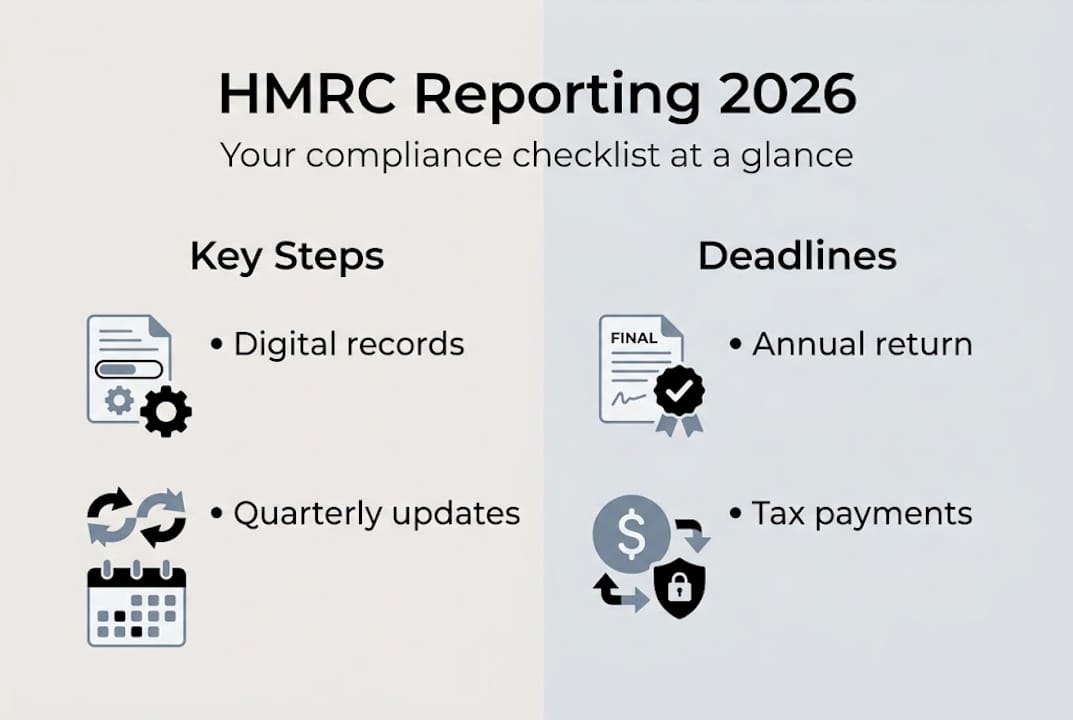
MTD quarterly updates are submitted through recognised software, but the annual return and payment cycles remain unchanged. The digital tax submission tips on our website cover software selection and upload steps in more detail.
Pro Tip: Begin your digital record keeping before your first MTD quarterly update is due. Starting mid-quarter means scrambling to reconstruct earlier transactions, which is exactly the kind of pressure MTD is designed to eliminate.
Common mistakes in HMRC reporting and how to stay compliant
Having learned how to file, it is wise to prepare for common pitfalls, so you can avoid hassle and penalties.
The businesses that struggle most with HMRC reporting are rarely careless. They are simply unaware of where the traps lie. Here are the five mistakes we see most often:
Missing the registration deadline: You must tell HMRC you need to file by 5 October after the tax year ends. Missing this date can trigger a penalty even before you have filed anything.
Losing or not keeping receipts: Without evidence, HMRC can disallow your expense claims entirely. Digital photos of receipts stored in your accounting software count as valid records.
Choosing the wrong accounting method: Switching methods mid-year or using one that does not suit your cashflow can create tax timing problems and trigger HMRC queries.
Late quarterly updates under MTD: Each quarterly update has its own deadline. Missing one is treated as a separate compliance failure, and HMRC’s penalty rules for late submissions are structured to accumulate quickly.
Software errors and mismatched figures: If your software figures do not match your bank statements, HMRC may flag your return for review. Always reconcile before submitting.
If you spot an error after filing, do not panic. You can amend your Self Assessment return online within 12 months of the original filing deadline. For MTD quarterly updates, corrections can be made in the following quarter’s submission. The HMRC compliance essentials guide explains how to handle amendments without making the situation worse.
Bookmark the tax deadline checklist on our site and review it at the start of each quarter.
Pro Tip: Set calendar reminders for every HMRC deadline, including quarterly MTD updates. Review your digital records monthly so that when a deadline arrives, you are submitting figures you have already checked, not rushing through them.
Why compliance is easier if you see reporting as an ongoing process
With the pitfalls in mind, let’s change how you think about HMRC reporting as a whole.
Most businesses treat tax reporting as a once-a-year event. The paperwork piles up, the deadline looms, and the scramble begins. MTD is actually forcing a better habit, and that is the quiet benefit nobody talks about.
When you record transactions weekly and review them monthly, something unexpected happens: you stop dreading the deadline. The figures are already there. The receipts are already saved. The quarterly update takes minutes, not days. We have seen this shift happen with clients who were initially resistant to digital record keeping. Within six months, they reported feeling more in control of their finances than ever before.
There is a deeper benefit too. Ongoing visibility into your income and expenses makes business tax calculation far more accurate throughout the year. You can spot a cashflow dip in March rather than discovering it in January when your tax bill arrives. You can make smarter decisions about spending, invoicing, and growth because you are working with current data, not figures from ten months ago.
Compliance, when treated as a continuous process rather than an annual panic, becomes a genuine business tool. That is the mindset shift MTD is nudging every sole trader and landlord towards, and the businesses that embrace it earliest will have a real advantage.
Let us help you stay HMRC-compliant, seamlessly
If compliance sounds like hard work, remember that you do not have to go it alone.

At Concorde Company Solutions, we support small businesses and sole traders across the UK with everything from bookkeeping and digital record keeping to full MTD compliance and Self Assessment filing. Our payroll support services and tax compliance packages are designed to take the pressure off you, so you can focus on running your business. Whether you need help choosing the right software, setting up your quarterly update process, or simply want someone to check your figures before you submit, we are here. Get in touch with Concorde Company Solutions today for a no-obligation conversation about how we can help.
Frequently asked questions
Who must use Making Tax Digital for Income Tax in 2026?
From 6 April 2026, sole traders and landlords with qualifying income over £50,000 must use MTD for Income Tax Self Assessment. This threshold is based on gross income before expenses.
What are the key HMRC Self Assessment deadlines for 2026?
The main Self Assessment deadlines are 5 October to notify HMRC, 31 October for paper returns, and 31 January for online returns and any tax payment due.
Do I still need to submit an annual tax return with MTD?
Yes. Alongside quarterly digital updates, you still submit a final declaration and pay your tax as usual, because annual return and payment cycles remain unchanged under MTD.
What records must I keep for HMRC reporting?
You must keep detailed records of all business income, sales, receipts, and allowable expenses, using either cash basis or traditional accounting, and retain them for at least five years after the filing deadline.
Recommended
Comments