
Sole Trader Tax Return Guide: File with Confidence and Accuracy
- Richard Ellis
- Feb 14
- 7 min read


Every year, many sole traders in Leeds face the challenge of pulling together financial records and meeting strict HMRC expectations. Sorting your income, expenses, and essential documents can quickly become overwhelming, especially when accurate reporting shapes both your business’s compliance and your personal finances. This guide reveals how accurate business record-keeping empowers you to complete your tax return with confidence, steer clear of common pitfalls, and gain greater control over your business outcomes.
Table of Contents
Quick Overview
Key Insight | Explanation |
1. Gather essential business records | Collect sales invoices, bank statements, and expense records to prepare for your Self Assessment tax return. |
2. Accurately calculate income and expenses | Record all business transactions and allowable expenses to determine your taxable profits correctly. |
3. Complete your HMRC tax return online | Log into your account, enter business income, and review all details for accuracy before submission. |
4. Confirm submission and receipt | Save your digital confirmation and verify the submission status in your HMRC account for peace of mind. |
5. Address HMRC correspondence promptly | Respond to any follow-up communication swiftly to maintain compliance and resolve potential issues efficiently. |
Step 1: Gather essential business records and documents
Preparing your business records is a critical foundation for completing your Self Assessment tax return accurately. As a sole trader, you’ll need to collect and organise various financial documents that demonstrate your income, expenses, and overall business performance.
Start by gathering the following essential documents for your tax return:
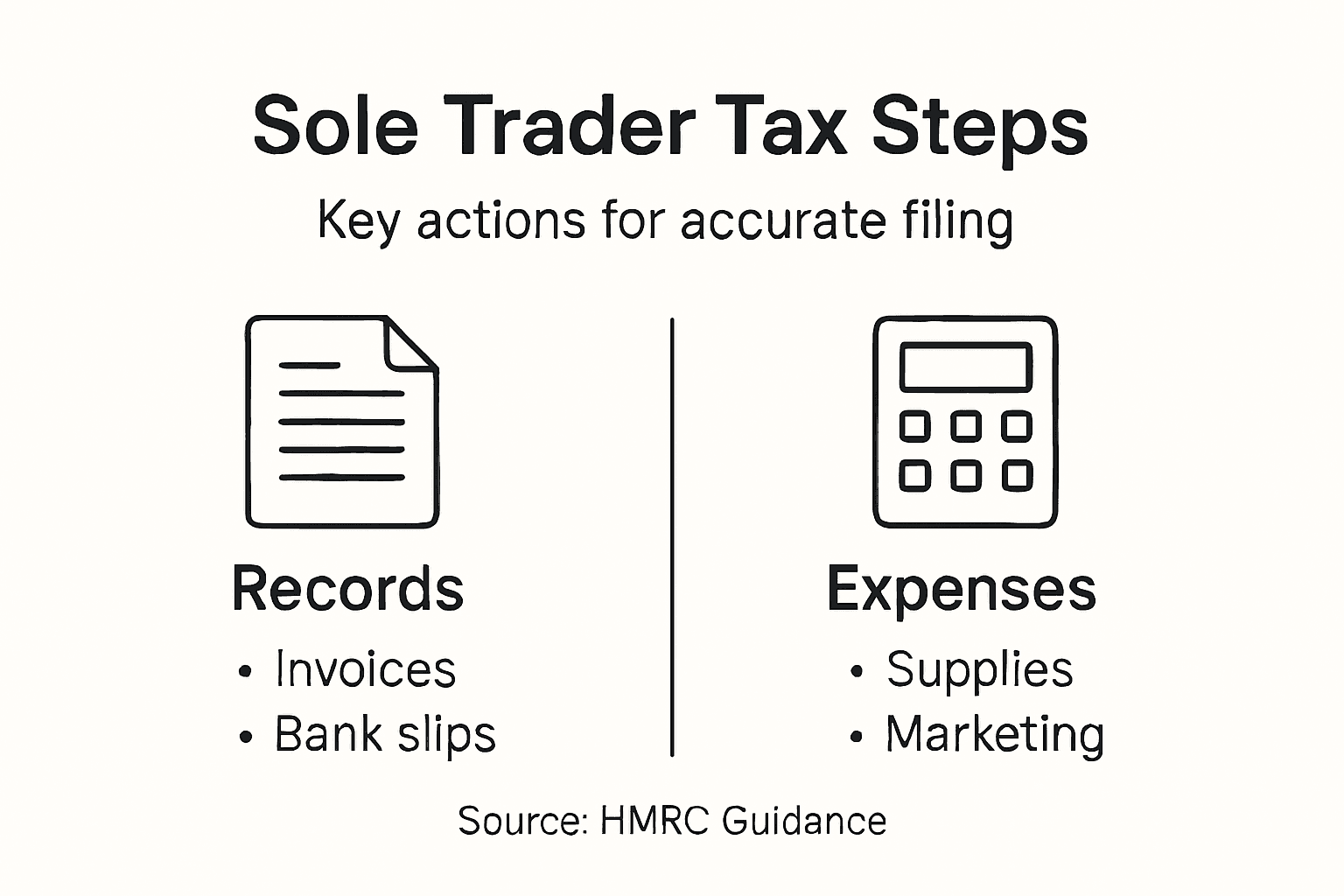
Sales invoices and receipts
Bank statements showing business transactions
Purchase receipts and expense records
Records of personal income
Vehicle and travel expense logs
Asset purchase and depreciation documentation
HMRC provides clear guidelines about record-keeping requirements for self-employed professionals. These records serve multiple purposes: calculating your taxable profits, supporting potential tax investigations, and maintaining transparent financial documentation.
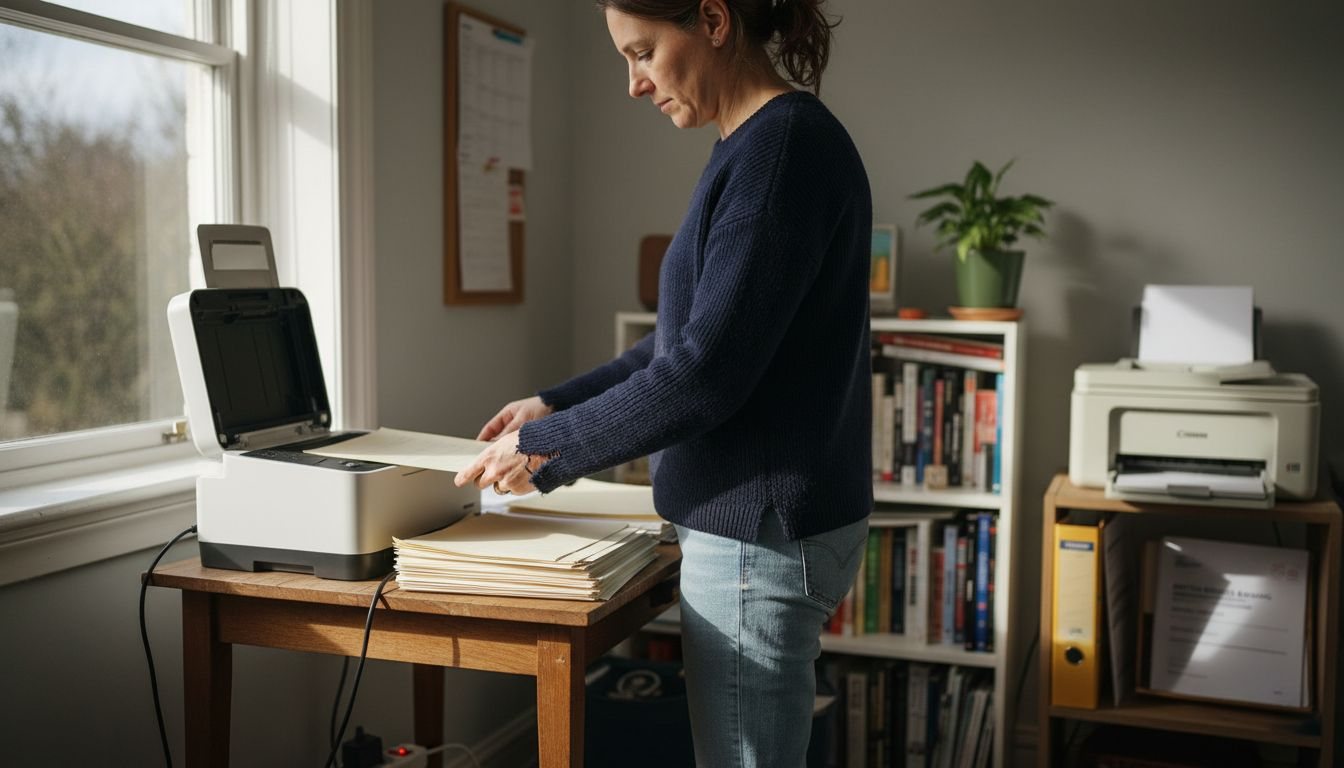
Digital record-keeping has become increasingly important. Consider scanning physical documents and storing them securely in cloud-based systems or dedicated accounting software. This approach not only helps with organisation but also ensures you have backups of critical financial information.
Here is a summary of digital versus traditional record-keeping methods for business records:
Method | Advantages | Risks & Considerations |
Traditional Paper Files | Simple setup, easy for small firms | Can be lost, harder to organise |
Digital Scanning | Accessible, secure backups | Needs tech, cloud storage costs |
Accounting Software | Automatic sorting, trackable | Software fees, learning curve |
Maintaining accurate records isn’t just a legal requirement—it’s a strategic tool for understanding your business’s financial health.
Expert advice: Invest in a dedicated business bank account to simplify transaction tracking and separate personal and professional finances.
Step 2: Calculate income and allowable expenses accurately
Calculating your business income and expenses precisely is crucial for submitting an accurate Self Assessment tax return. As a sole trader, you’ll need to meticulously track and categorise all financial transactions to determine your taxable profits.
To calculate your taxable income, follow these key steps:
Record all business revenue including sales, invoices, and service fees
Separate personal and business income streams
Identify and categorise allowable business expenses
Calculate your total income before tax deductions
Subtract allowable expenses from total revenue
HMRC provides guidance on working out taxable profits using different accounting methods. The cash basis accounting method is particularly useful for sole traders, allowing you to record income and expenses when money is actually received or paid.
This table highlights key differences between the cash basis and traditional (accrual) accounting methods for sole traders:
Accounting Method | Income Recognition | Expense Handling | Best For |
Cash Basis | When money is received | When money is paid | Small businesses |
Traditional/Accrual | When invoice is issued | When expense is incurred | Larger enterprises |
Allowable expenses typically include:
Office supplies and equipment
Professional subscriptions
Travel and vehicle costs related to business
Marketing and advertising expenses
Utility bills for business premises
Professional training and development
Maintaining detailed records of every transaction is not just good practice—it’s a legal requirement that protects your financial interests.
Expert advice: Create a dedicated spreadsheet or use accounting software to track expenses in real-time, making your annual tax return preparation significantly easier.
Step 3: Complete and review HMRC self assessment form online
Submitting your Self Assessment tax return online requires careful attention to detail and a systematic approach. Understanding the digital submission process will help you navigate the HMRC online platform with confidence and minimise the risk of errors.
Follow these key steps to complete your online tax return:
Log into your HMRC online account
Select the appropriate tax year for your return
Enter your business income and expenses
Provide details about additional income sources
Review all entries for accuracy
Submit your completed tax return
Self Assessment tax returns require precise information and careful verification. The online system provides helpful guidance throughout the completion process, with built-in checks to identify potential mistakes before final submission.
Key sections to focus on include:
Personal details and Unique Taxpayer Reference (UTR)
Self-employment income
Other income sources
Tax reliefs and allowances
National Insurance contributions
Accuracy is paramount: a single overlooked detail can trigger unnecessary complications with HMRC.
Expert advice: Set aside uninterrupted time to complete your tax return and double-check every section before submitting to avoid potential penalties.
Step 4: Submit your tax return and confirm receipt
The final stage of your Self Assessment journey involves submitting your completed tax return and ensuring HMRC has officially acknowledged your submission. This crucial step confirms your compliance and provides peace of mind for the tax year.
To successfully submit and confirm your tax return, follow these essential steps:
Double-check all entered information
Review calculation summaries
Click the official submission button
Save the digital submission confirmation
Check your HMRC online account for receipt status
Print or download the confirmation document
Top tips for filing your tax return emphasise the importance of early submission and careful verification. HMRC’s online system provides immediate confirmation, allowing you to track your submission status in real-time.
Key confirmation details to verify include:
Submission timestamp
Reference number
Total tax calculation
Payment deadlines
Confirmation of successful electronic receipt
Your digital submission is a legal document - treat it with the same care and attention as any critical financial record.
Expert advice: Create a dedicated digital folder to store all tax return documents and confirmations, ensuring you have a comprehensive and organised record for future reference.
Step 5: Check and address any follow-up HMRC correspondence
Managing follow-up communication from HMRC requires prompt attention and a systematic approach. Understanding how to effectively respond to official correspondence can prevent potential complications and ensure your tax affairs remain compliant.
When you receive correspondence from HMRC, take these critical steps:
Read the document thoroughly
Identify the specific request or query
Gather relevant supporting documentation
Determine response deadlines
Prepare a clear and concise response
Keep copies of all communication
Self Assessment tax return corrections require careful handling. Some correspondence might request additional information, clarification of income sources, or verification of expenses claimed.
Key actions for different types of HMRC correspondence include:
Compliance check responses
Providing missing information
Explaining discrepancies in your tax return
Responding to assessment notices
Requesting time to pay if needed
Professional and timely communication with HMRC can transform a potentially stressful interaction into a straightforward resolution.
Expert advice: Always respond to HMRC within the specified timeframe and maintain a professional, factual tone in all written communications.
Simplify Your Sole Trader Tax Return with Expert Support
Navigating the detailed requirements of your sole trader tax return can be overwhelming from gathering essential business records to completing your HMRC self assessment form online accurately. Common challenges include ensuring accurate income and expense calculations, maintaining thorough digital record-keeping, and handling any HMRC correspondence promptly. Avoid the stress of last-minute submissions and potential errors by partnering with professionals who understand the intricacies of the process.

At Concorde Company Solutions, we provide personalised accounting services designed to streamline every step of your tax return journey. Whether you need help organising your financial documents, calculating allowable expenses, or submitting your return securely, our expert team in Garforth, Leeds will support you with transparent advice and dedicated service. Take control of your finances today and file with confidence by contacting us now to discover how our tailored solutions can make a real difference.
Frequently Asked Questions
What documents do I need to prepare for my Sole Trader tax return?
To prepare for your Sole Trader tax return, gather essential documents such as sales invoices, bank statements, purchase receipts, and any records related to your personal income and expenses. Start by organising these documents so you can enter them accurately when completing your tax return.
How do I calculate my taxable income and allowable expenses as a Sole Trader?
To calculate your taxable income, sum all business revenue and subtract allowable expenses such as office supplies, marketing costs, and travel expenses. Track your financial transactions systematically to ensure accuracy in your calculations, making it easier to submit your tax return.
What steps should I follow to submit my tax return online with HMRC?
To submit your tax return online, log into your HMRC account, select the appropriate tax year, and enter your income and expenses. Always review your entries for accuracy before submitting to avoid errors that could lead to complications.
How can I confirm that my tax return has been officially submitted to HMRC?
After submitting your tax return, check your HMRC online account for a confirmation of receipt, which will include a timestamp and reference number. Save or print this confirmation for your records, as it serves as proof of your submission.
What should I do if I receive correspondence from HMRC after submitting my tax return?
If you receive correspondence from HMRC, read the document carefully to understand the specific request or query. Gather the necessary documentation to address their request timely and clearly, ensuring you respond before any deadlines specified in the communication.
How can I maintain accurate records throughout the year as a Sole Trader?
Maintaining accurate records can be achieved by using a dedicated spreadsheet or accounting software to track all business income and expenses in real time. Make it a practice to update your records frequently, which will simplify the process of completing your tax return at the end of the year.
Recommended


Comments