
Role of Bookkeepers Explained: HMRC Impact
- Richard Ellis
- Feb 23
- 12 min read

Running a business in Garforth brings plenty of financial questions. Confusion between bookkeeping and accounting often leads to costly compliance mistakes. Clear, organised records are not optional—HMRC expects accurate transaction tracking, regular reconciliations, and adherence to the Money Laundering Regulations. Understanding the foundation of every business’s financial health helps you avoid penalties and keep your operations strong. This guide explains bookkeeping principles and corrects common misconceptions so your Garforth business stays confident and compliant.
Table of Contents
Key Takeaways
Point | Details |
Understanding Bookkeeping | Bookkeeping is essential for accurate financial management and is distinct from accounting, which interprets recorded data. |
Common Misconceptions | Many business owners mistakenly believe bookkeeping is optional or similar to tax preparation, leading to compliance risks. |
Effective Practices | Regular reconciliation and accurate categorisation of transactions are vital for maintaining reliable financial records. |
Choosing Methods | The choice between manual, computerised, or hybrid bookkeeping methods impacts efficiency and compliance with HMRC regulations. |
Bookkeeping Fundamentals And Common Misconceptions
Bookkeeping is the foundation of every business’s financial health. It means recording every single transaction, from invoices to expenses, so you can see where your money actually goes. Many business owners think bookkeeping and accounting are the same thing—they’re not. Bookkeeping captures the raw data; accounting interprets it.
At its core, bookkeeping uses double-entry bookkeeping, a system where every transaction affects two accounts. One account receives money (credit), and another spends it (debit). This balanced approach catches errors instantly because your books must always balance.
The Core Principles Every Business Owner Should Know
Three key principles sit at the heart of proper bookkeeping:
Accurate transaction recording: Every payment, sale, and expense gets logged with the correct date, amount, and category
Proper account categorization: Transactions go into the right accounts so financial statements make sense
Regular reconciliation: You compare your records against bank statements to spot mistakes early
Double-entry bookkeeping and the accounting equation are essential for managing financial records correctly. When these principles align, your business gets a clear financial picture.
Common Misconceptions That Cost Business Owners Money
Three major myths plague small business owners in Garforth and beyond. First, many assume bookkeeping is optional until turnover hits a certain level—HMRC disagrees completely. Second, they think shoebox accounting (stuffing receipts in a box) works fine—it doesn’t. Third, they believe bookkeeping and tax preparation are identical roles.
Here’s what actually happens with poor bookkeeping:
Missing transactions create gaps in your financial records
Incorrect categorisations make tax calculations unreliable
Unreconciled accounts hide fraud and errors
Compliance penalties arrive when you can’t prove your records to HMRC
Weak bookkeeping doesn’t just hide money; it invites HMRC scrutiny and costs you thousands in penalties, interest, and professional fees to fix.
Many business owners also misunderstand common bookkeeping errors like omission, principle, commission, and reversal mistakes. These aren’t minor slip-ups—they distort your profit figures and create compliance problems.
Why This Matters to Your Garforth Business
Proper bookkeeping isn’t paperwork; it’s your financial command centre. You need accurate records to claim expenses, manage cash flow, and stay compliant with HMRC requirements. When you know what happened financially last month, you can make informed decisions this month.
Some business owners delay bookkeeping, thinking they’ll sort it all out later. That approach creates two problems. First, you lose critical details as time passes. Second, reconstructing months of transactions costs far more than recording them properly from the start.
Pro tip: Set up daily or weekly bookkeeping habits now—even 20 minutes weekly beats scrambling for records at tax time, and it keeps your HMRC standing clean throughout the year.
Different Bookkeeping Types And Methods
Bookkeeping methods have evolved dramatically over the past decade. Your business doesn’t have to choose between old-fashioned ledgers and cutting-edge software—you need to understand what’s available and pick what suits your operation. The method you choose affects how quickly you spot problems, how easily you file taxes, and how much time you spend on administration.
Three main bookkeeping approaches exist in modern UK business: manual, computerised, and hybrid systems that blend both. Each has distinct advantages depending on your business size, complexity, and HMRC requirements.
Manual Bookkeeping
Manual bookkeeping means recording transactions by hand in physical ledgers. You write each entry, calculate balances, and prepare financial statements manually. This method works best for very small businesses with minimal transactions—perhaps a sole trader with fewer than 20 transactions weekly.
Manual bookkeeping offers genuine advantages:
Forces you to understand every transaction deeply
Requires no software investment or training
Works perfectly if your business is genuinely simple
Gives you complete control over record-keeping
The downsides matter more for most businesses. Manual methods take significantly longer, invite human error, and make corrections messy. HMRC scrutiny increases when records look disorganised, and you’ll struggle to analyse business performance quickly.
Computerised Bookkeeping
Computerised bookkeeping uses accounting software to record transactions, calculate balances, and generate reports automatically. This method dominates small and medium-sized businesses in Garforth and across the UK. Software like Xero, QuickBooks, or FreeAgent handles the heavy lifting once you input basic transaction details.
Computerised systems deliver real advantages for most businesses:
Eliminates calculation errors immediately
Generates accurate financial reports in seconds
Integrates with your bank to pull transactions automatically
Creates audit trails HMRC requires
Scales easily as your business grows
Multiple bookkeeping methods and payroll elements are now essential professional knowledge. Most businesses benefit from computerised systems because they save time, reduce errors, and keep HMRC happy during inspections.

Hybrid And Cloud-Based Approaches
Many businesses now use hybrid bookkeeping, combining manual records with computerised systems. You might use software for daily transactions but maintain specific manual records for audit purposes. Cloud-based accounting platforms like Xero operate anywhere—on your phone, tablet, or laptop—giving you real-time visibility into business finances.
Cloud systems offer flexibility that matters for growing businesses:
Access your records from anywhere, anytime
Automatic backups protect your data
Real-time collaboration with your accountant
Instant mobile updates for on-the-go recording
The method you choose affects not just administration time but your ability to spot financial problems early and prove compliance to HMRC.
Your choice between methods depends on transaction volume, team size, and complexity. A micro-business might thrive with manual records. A growing company needs computerised systems. Foundational bookkeeping skills like double-entry bookkeeping and reconciliations work the same way regardless of your method—the medium changes, not the principles.
Here’s a concise comparison of bookkeeping methods to help you choose what fits your business best:
Approach | Best For | Key Benefits | Main Limitations |
Manual | Sole traders, very small firms | Full control, no tech needed | Slow, error-prone |
Computerised | SMEs with regular transactions | Fast reporting, fewer errors | Tech costs, learning curve |
Hybrid/Cloud-Based | Growing, mobile businesses | Real-time access, collaboration | Mixed processes, setup time |
Pro tip: Start with computerised bookkeeping even if you think it’s “overkill”—the time you save and errors you prevent pay for the software within weeks, plus you’ll be ready for HMRC scrutiny without panic.
Key Duties And Essential Skills Required
Bookkeepers aren’t just data-entry clerks pushing numbers around. They’re the financial backbone of your business, responsible for maintaining accurate records that HMRC trusts and your accountant depends on. Understanding what bookkeepers actually do—and what skills matter most—helps you hire well or know what to expect from the role.
A bookkeeper’s core responsibility is simple in concept but demanding in execution: record every financial transaction accurately, verify those records, and prepare information management and tax authorities need. That simple task expands quickly when you consider VAT, payroll, compliance regulations, and the sheer volume of modern transactions.
Primary Duties Every Bookkeeper Handles
Bookkeepers juggle multiple responsibilities that directly affect your business compliance:
Transaction recording: Entering sales, expenses, and transfers into accounting systems with correct dates and amounts
Bank reconciliation: Comparing bank statements against your records to spot discrepancies immediately
VAT management: Tracking VAT transactions, calculating quarterly returns, and maintaining records HMRC requires
Payroll administration: Processing employee payments, tax deductions, and statutory reporting
Financial reporting: Preparing trial balances, profit-and-loss summaries, and statements for management decisions
These duties sound straightforward until you realise one misplaced decimal point cascades through your entire financial picture. A missed VAT entry creates compliance problems. A payroll error triggers HMRC interest.
Technical Skills That Separate Good Bookkeepers From Average Ones
Technical proficiency with accounting software like Xero and Sage is non-negotiable today. You need bookkeepers who understand not just how to input data but how accounting systems work behind the scenes. Excel mastery matters too—interpreting data trends, creating reports, and spotting patterns requires more than basic spreadsheet skills.
Essential technical abilities include:
Proficiency with your chosen accounting software platform
Strong Excel skills for data analysis and reporting
Understanding of double-entry bookkeeping principles
Knowledge of VAT and payroll compliance requirements
Familiarity with bank feeds and automated data imports
Accuracy isn’t optional—one error costs hours to find and fix, and regulatory breaches cost thousands in penalties.
Soft Skills That Matter More Than You’d Expect
Bookkeepers must uphold ethical behaviour, confidentiality, and comply with Money Laundering Regulations while maintaining professional standards. These aren’t just nice-to-haves; they’re legal requirements in the UK. Beyond compliance, the best bookkeepers possess qualities that transform how your business operates.
Critical soft skills include:
Meticulous attention to detail: Catching errors before they become problems
Communication ability: Explaining financial issues clearly to non-accountants
Time management: Processing transactions efficiently without rushing
Problem-solving: Working through discrepancies logically
Continuous learning: Staying current with software updates and regulatory changes
A bookkeeper with technical skills but poor communication leaves you confused about your finances. One with detail orientation but no confidentiality sends sensitive information carelessly. Both matter equally.
Pro tip: When hiring or assessing your current bookkeeper, prioritise accuracy and regulatory knowledge above all—those prevent costly mistakes, but communication skills can be developed through training over time.
HMRC Compliance And Legal Obligations In The UK
HMRC doesn’t accept excuses. If your bookkeeper or accountant fails to meet legal obligations, your business pays the price—not them. Understanding what HMRC requires, what your bookkeeper must do, and what happens when things go wrong protects your Garforth business from costly penalties and legal trouble.
Bookkeepers operating in the UK face multiple overlapping legal frameworks. They must comply with HMRC regulations, the Money Laundering Regulations, professional conduct codes, and sector-specific rules. Ignoring any of these creates serious problems. The good news: proper systems make compliance straightforward.
HMRC’s Core Requirements For Bookkeepers
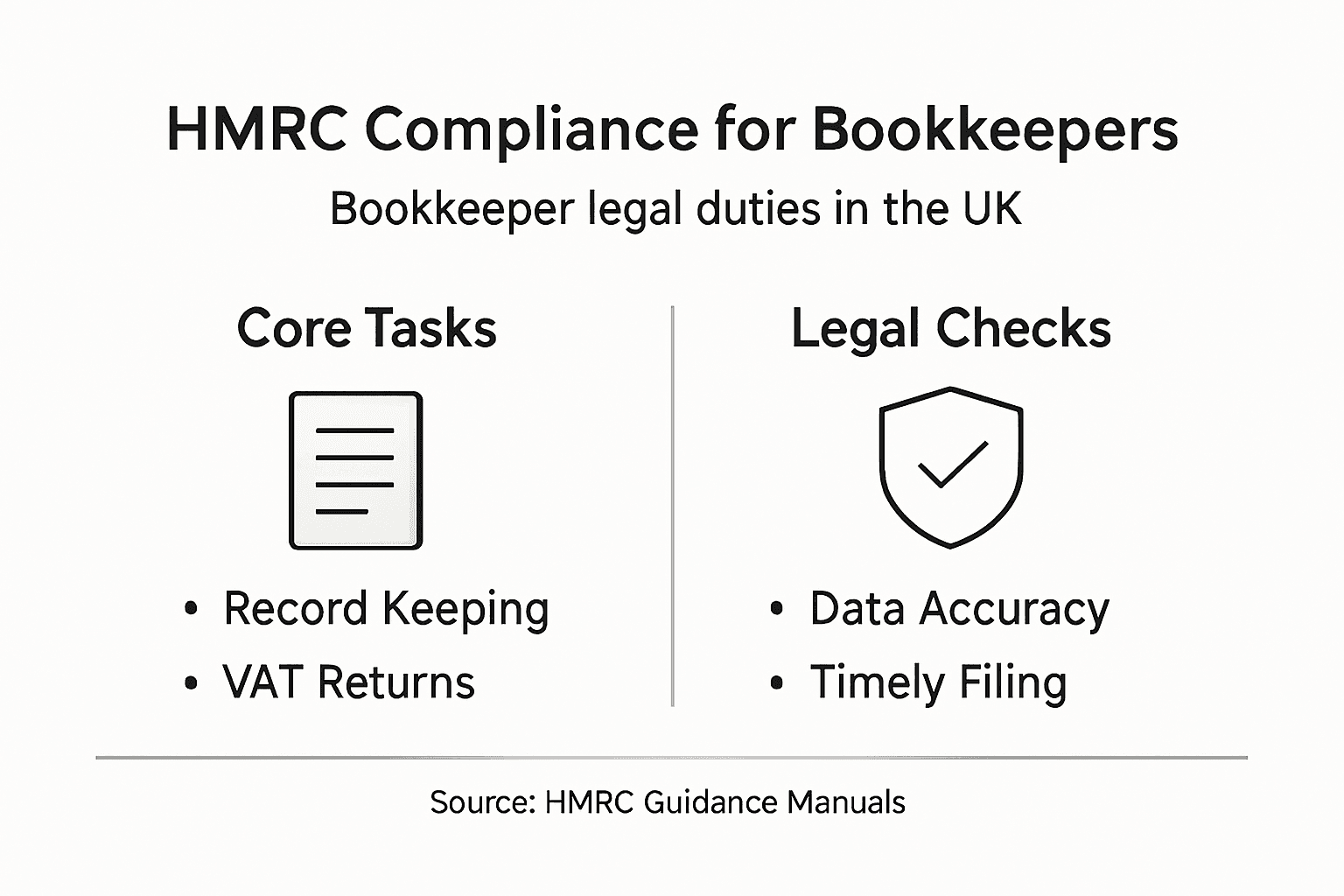
HMRC demands three fundamental things from every business and the bookkeepers who maintain their records. First, accurate financial records that reflect every transaction. Second, timely tax filing—missing deadlines triggers automatic penalties. Third, proper VAT compliance if your turnover exceeds the threshold.
Specific obligations include:
Maintaining records for at least six years
Filing Self-Assessment or Corporation Tax returns by the deadline
Submitting VAT returns quarterly (or monthly, depending on your scheme)
Keeping evidence of all deductions and expenses
Reporting any changes to business structure or registration details
HMRC manuals provide comprehensive technical guidance for bookkeepers regarding tax administration, reporting, and dispute resolution. Understanding these manuals helps bookkeepers ensure accurate filing and avoid penalties through non-compliance.
Money Laundering Regulations And Professional Standards
Bookkeepers offering services must be supervised under Money Laundering Regulations by an approved authority like the ICB. This isn’t optional—it’s a legal requirement in the UK. Supervision means implementing controls to identify and prevent money laundering, maintaining proper registrations, and adhering to professional conduct codes.
These regulations exist because criminals attempt to hide illegal proceeds through legitimate businesses. Your bookkeeper must verify client identity, understand the nature of your business, and report suspicious activity. These aren’t bureaucratic boxes to tick; they’re legal protections for everyone involved.
What Penalties Look Like—And How To Avoid Them
One missed deadline costs hundreds in penalties; repeated failures or deliberate non-compliance can trigger criminal prosecution and business closure.
HMRC penalties scale with severity. Missing a Self-Assessment deadline by a few days costs £100 automatically. Three months late triggers another £10 per day fine. Deliberate tax evasion or fraudulent record-keeping can result in prosecution, seizure of assets, and imprisonment.
The penalties affecting bookkeepers include:
Late filing penalties: £100 minimum, escalating with time
Inaccurate records penalties: up to 100% of unpaid tax
VAT compliance failures: interest charges plus penalties
Money Laundering violations: unlimited fines and criminal liability
Why Professional Supervision Matters
Hiring or working with regulated, supervised bookkeepers protects your business. They understand current regulations, maintain proper insurance, and follow professional codes. Unregulated individuals might save money short-term but create catastrophic risk—you’re personally liable for their failures.
Pro tip: Verify your bookkeeper’s regulatory status before hiring—check ICB registration or equivalent supervisory body approval—because HMRC holds you accountable regardless of who made the error.
Risks, Costs, And Accountant Comparisons
Poor bookkeeping costs more than most business owners realise. You face not just financial penalties but also wasted management time, missed business opportunities, and damaged credibility with HMRC. Understanding the real risks, what you’ll actually pay for quality bookkeeping, and how bookkeepers compare to accountants helps you make smart decisions about your financial management.
Many Garforth business owners assume bookkeeping is a simple, low-cost function. That’s partly true—but cutting corners on bookkeeping creates exponentially higher costs later. A £50 monthly bookkeeping mistake becomes a £5,000 compliance problem within months.
Real Risks Of Poor Bookkeeping
Compliance failures top the risk list. Missing VAT submissions, incorrect expense claims, or late tax filings trigger HMRC penalties that dwarf the cost of proper bookkeeping. One missed deadline costs hundreds; repeated failures invite investigations costing thousands.
Other serious risks include:
Financial record errors that distort your profit figures and mislead business decisions
Scope creep where bookkeepers take on work beyond their expertise, creating liability exposure
Fraud vulnerability when controls are weak and transactions aren’t properly verified
Cash flow blindness from inaccurate records, leading to overdrafts and missed opportunities
Professional liability if your bookkeeper lacks proper insurance and makes costly mistakes
One uncaught error compounds monthly; one compliance failure triggers investigations that cost tens of thousands in accountant fees and penalties combined.
What Quality Bookkeeping Actually Costs
Bookkeeping costs vary significantly based on your business complexity, transaction volume, and whether you choose in-house or outsourced support. Bookkeepers must balance business overheads such as software subscriptions, insurance and training with competitive pricing to provide sustainable services.
Typical cost ranges for Garforth businesses:
Sole traders, minimal transactions: £50–£150 monthly
Small limited companies: £150–£400 monthly
Growing businesses with payroll: £300–£700 monthly
Complex multi-site operations: £700+ monthly
These figures cover basic transaction recording, bank reconciliation, VAT management, and monthly reporting. Additional services cost extra.
Bookkeepers Versus Accountants: Clear Differences
Bookkeepers provide more affordable, transactional and compliance-focused services, whilst accountants offer broader advisory and strategic financial guidance at higher fees. The distinction matters for your business.
Bookkeepers handle:
Daily transaction recording and categorisation
Bank and VAT reconciliation
Payroll processing
Monthly financial summaries
Invoice and expense management
Accountants provide:
Tax planning and strategy
Year-end financial statements
Audit preparation
Business advisory services
Statutory compliance interpretation
Most Garforth businesses benefit from both roles working together. Your bookkeeper maintains clean, organised records. Your accountant uses those records to provide strategic guidance and tax efficiency. Without good bookkeeping, accountants waste time fixing records instead of advising on growth.
Use this summary to understand how bookkeepers and accountants differ in focus and value:
Role | Core Purpose | Typical Tasks | Strategic Value |
Bookkeeper | Maintain daily records | Enter transactions, reconciliation | Ensures compliance and accuracy |
Accountant | Advise and plan finance | Tax strategy, reporting, auditing | Improves profitability and growth |
Pro tip: Invest in proper bookkeeping first—it costs less and prevents the expensive mess that forces you to pay accountants to fix problems rather than plan for growth.
Take Control of Your Bookkeeping and HMRC Compliance Today
Understanding the critical role of bookkeepers in maintaining accurate financial records and meeting HMRC regulations is just the first step. Many business owners face challenges like missed deadlines, inaccurate VAT returns, and costly penalties due to poor bookkeeping practices. If you want to protect your Garforth business and ensure smooth tax filings, mastering double-entry bookkeeping, bank reconciliations, and VAT compliance is essential.
At Concorde Company Solutions, we specialise in providing personalised bookkeeping and accounting services designed to keep your business compliant and financially sound. Our expert team helps you avoid common pitfalls by maintaining clear, accurate records and filing on time. We offer tailored support for sole traders and growing businesses, including software setup and payroll management, giving you peace of mind in an ever-changing regulatory environment.
Discover how partnering with a trusted local firm can turn your bookkeeping from a potential risk into a powerful business asset.

Ready to protect your business and simplify your finances now Visit our Concorde Company Solutions homepage to learn more about our expert bookkeeping and accountancy services. Take the first step towards hassle-free HMRC compliance and financial clarity today by contacting us for personalised support.
Frequently Asked Questions
What are the main responsibilities of a bookkeeper?
Bookkeepers are responsible for recording financial transactions, managing VAT, processing payroll, reconciling bank statements, and preparing financial reports essential for compliance and decision-making.
How does poor bookkeeping impact my business’s relationship with HMRC?
Poor bookkeeping can lead to non-compliance with HMRC regulations, resulting in penalties, interest charges, and potential investigations that can be costly and damaging to your business.
What are some common misconceptions business owners have about bookkeeping?
Many business owners think that bookkeeping is optional, approach it casually with shoebox accounting, or confuse bookkeeping with tax preparation, which can lead to serious financial repercussions.
Why is it important to maintain accurate records for my business?
Accurate records are crucial for tracking expenses, managing cash flow, staying compliant with tax laws, and making informed financial decisions based on your business’s performance.
Recommended

Comments