
How to set up business banking in 2026
- David Rawlinson
- May 28
- 9 min read
TL;DR:
Getting your business banking setup correctly from the start prevents costly tax complications and ensures clear financial management.
Proper preparation of documents, choosing a suitable bank, and understanding verification requirements streamline the process and avoid delays.
Getting your business banking wrong from the start costs more than just time. It creates tax headaches, blurs your financial picture, and can raise red flags with HMRC. Yet many new business owners rush the process, picking the first account they find or mixing personal and business transactions until things become genuinely messy. Knowing how to set up business banking properly means understanding what documents you need, which account fits your business model, and what to do the moment the account is live. This guide covers all of it.
Table of Contents
Key takeaways
Point | Details |
Prepare documents in advance | Gather your ID, registration papers, and ownership details before you apply to avoid delays. |
Choose the right bank type | Compare fees, digital features, and transaction limits rather than defaulting to your personal bank. |
Disclose all beneficial owners | Anyone holding 25% or more equity must provide identification during the application. |
Set up integrations immediately | Connect your account to accounting software and activate alerts as soon as banking is live. |
Avoid documentation errors | Incomplete or incorrect paperwork is the leading cause of application rejection and delays. |
How to set up business banking: what you need first
Before you even land on a bank’s website, you need to get your paperwork in order. This is the step most business owners underestimate, and it is the single biggest reason applications stall.
The documentation requirements vary depending on your business structure, but there is a core set of items every applicant will need. These include government-issued photo ID (a passport or driving licence works well), proof of address dated within the last three months, your National Insurance number or equivalent tax reference, and your Companies House registration number if you are a limited company.
For sole traders, the bar is lower. You typically need personal ID, proof of your trading name if it differs from your own, and confirmation of your address. Limited companies face more scrutiny and will need their certificate of incorporation, memorandum and articles of association, and in some cases a copy of the shareholder register.
Pro Tip: Scan and store all your documents digitally in one folder before you begin. If you apply online and need to upload items quickly, having everything ready cuts the process from days to minutes.
Here is a summary of what to gather by business type:
Business type | Documents required |
Sole trader | Photo ID, proof of address, UTR number, trading name evidence |
Partnership | ID for all partners, partnership agreement, proof of business address |
Limited company | Certificate of incorporation, memorandum and articles of association, Companies House number, director and shareholder ID |
LLP | LLP agreement, registration certificate, ID for all designated members |
One requirement that catches many owners off guard is beneficial ownership disclosure. All owners with 25%+ equity must be identified and provide personal identification. This is a federal compliance rule in the US and an increasingly standard expectation in the UK under anti-money-laundering regulations. If your business has multiple shareholders above that threshold, every one of them must be prepared to verify their identity before the account can be approved.
Choosing the right bank for your business
The bank you choose matters more than most people think. The wrong one will charge you for every transaction, offer no integration with your bookkeeping software, and leave you on hold for an hour when something goes wrong.

Bank selection depends on fees, accessibility, online features, transaction limits, and customer support, and these vary significantly between providers. Here is how to think through the main options:
Online banks offer lower fees, faster account opening, and slick app-based management. They suit freelancers, e-commerce businesses, and sole traders who do not handle cash regularly. The trade-off is that physical support is limited, and some providers have lower transaction limits before charges kick in.
High street banks bring branch access, in-person support, and usually a wider range of business services including lending, merchant accounts, and invoice financing. The fees tend to be higher, but for businesses dealing in cash, receiving large transfers, or managing payroll for multiple employees, the added infrastructure is worth it.
Pro Tip: Do not default to the bank where you hold your personal account. That convenience bias can cost you hundreds of pounds a year in fees or leave you without features your business actually needs.
Here is a comparison of the key features to weigh up:
Feature | Online bank | High street bank |
Monthly fees | Often free or low | Typically £5 to £25+ |
Cash deposits | Limited or unavailable | Available at branch |
Accounting integrations | Usually strong | Variable |
In-person support | None | Available |
Account opening speed | 24 to 48 hours | Several days to weeks |
Transaction limits | May apply | Usually higher |
It is also worth looking at promotional offers. Some institutions offer cash bonuses up to £400 for new business checking accounts when certain transaction thresholds are met. These incentives can offset your first few months of fees if you meet the qualifying criteria. Read the terms carefully and make sure the account itself suits your needs beyond the bonus period.
For more on laying the broader financial groundwork, the Concordecompanysolutions guide on setting up business finances covers the full picture for UK business owners.
Steps to open a business bank account
Once you have your documents ready and a bank in mind, the application itself is straightforward if you approach it methodically. Here is the process from start to finish:
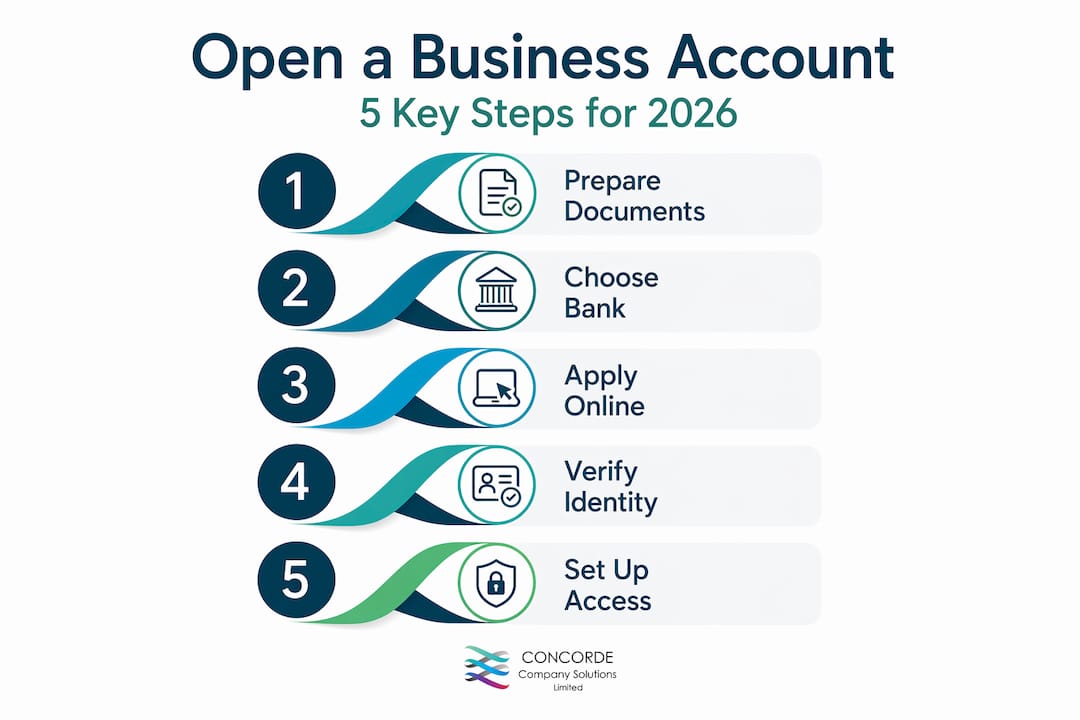
Gather and organise your documents. Preparing everything in advance reduces errors and speeds up approval significantly. Create a checklist and tick off each item before you begin.
Choose your application method. Most banks now offer online applications. However, if your business has multiple owners or a complex structure, an in-branch visit is often faster. In-person processing is preferred for multiple-owner businesses because verifying beneficial ownership online can create delays.
Complete the application form. Provide your business name, trading address, business type, anticipated monthly turnover, and the nature of your trading activity. Be precise. Vague descriptions of your business activity can trigger additional queries.
Upload or present your documents. For online applications, use clear, high-resolution scans. Blurry images are a common cause of verification failure. For in-branch visits, bring originals plus copies.
Disclose all beneficial owners. Each person with 25% or more equity must complete their own identification verification. If applying in person, bring all relevant parties. If online, the bank will usually send separate verification links to each owner.
Make your initial deposit. Many accounts require a minimum opening deposit, which varies by provider. Have this ready at the point of account activation.
Await confirmation and account details. Online approvals can come through within 24 hours. In-branch applications for limited companies may take several days while the bank conducts its checks.
Pro Tip: If you are asked for additional information during the verification process, respond within 24 hours. Applications are often paused rather than rejected when queries arise. A slow response is what turns a query into a rejection.
If you are opening an account as part of a franchise setup, the UK franchise launch guide covers the banking considerations alongside the broader business launch process.
After opening: managing your account well
Opening the account is the easy part. What you do in the first few weeks determines whether it actually helps your business run better.
The first thing to do is set up online and mobile banking access, then activate transaction alerts. These notify you of every payment in and out, which matters both for cash flow awareness and fraud detection. A business account with no alert system is a security risk waiting to happen.
Next, connect your account to your accounting software. Linking your bank account with bookkeeping tools improves cash flow visibility and makes reconciliation significantly faster. Most UK-based software such as Xero, QuickBooks, or FreeAgent offers direct bank feeds, meaning transactions import automatically rather than requiring manual entry.
Set up a routine for financial review. Weekly reconciliation is ideal for most small businesses. At minimum, do this monthly. The goal is to catch discrepancies early before they become problems at year end.
Consider automating transfers between your business current account and a business savings account. Automated transfers build cash reserves systematically without requiring willpower or manual action each month. Even a small fixed amount set aside regularly creates a meaningful buffer over time.
If you have employees, integrate payroll with your banking setup early. Most payroll providers can pull directly from your business account on a set schedule, reducing manual processing and the risk of missed payments.
Pro Tip: Set up a second signatory or admin-level banking user if you have a bookkeeper or accountant. This gives them visibility without granting full account control, which makes your monthly financial review far more efficient.
Common pitfalls and how to avoid them
Even well-prepared business owners run into problems. Documentation errors are the leading cause of delays and outright rejections, but they are almost entirely avoidable.
Here are the most frequent mistakes to watch for:
Submitting expired ID or documents with a name that does not match your registered business details
Failing to include all beneficial owners in the application when equity thresholds apply
Applying online with a complex ownership structure that the bank’s system cannot process automatically
Providing vague or inconsistent descriptions of your business activity across different parts of the form
Missing the initial deposit requirement or sending it from a personal account that does not match the business name
When applications involve multiple owners or non-standard structures, expect the process to take longer. Delays are not always a sign that something is wrong. They often reflect the bank conducting enhanced due diligence, which is standard for higher-risk business types or unfamiliar trading activities.
Financial compliance requirements around business account openings have strengthened significantly in recent years. The legal obligations involved are not bureaucratic noise. They exist to protect your business as much as they protect the bank. Understanding them before you apply reduces friction and builds your credibility as a business owner from day one.
If your application is declined, ask for the specific reason in writing. Banks are not always forthcoming, but you have the right to understand what went wrong. In many cases, a declined application simply means resubmitting with corrected or additional documents rather than being permanently barred from that provider.
My honest take on business banking setup
I have worked with enough small business owners to know that the ones who get their banking right early are not necessarily the ones who chose the fanciest account. They are the ones who treated the setup as seriously as they treated their first invoice.
The mistake I see most often is choosing a bank based on proximity or familiarity rather than fit. Your personal bank is not automatically the right bank for your business, and the switching cost later, when you realise the fees are too high or the software integration is broken, is higher than you think.
What I have also noticed is that business owners tend to set the account up and then ignore it until tax time arrives. That approach means months of unreconciled transactions, missing receipts, and a frantic scramble that costs more in accountant fees than it would have cost to just stay on top of things weekly.
The businesses that fare best treat their bank account as a live financial tool, not a place where money sits until it is needed. They set up integrations, review their numbers regularly, and engage with financial professionals before problems arise rather than after. That shift in mindset is worth more than any promotional bonus or low-fee offer.
— David
How Concordecompanysolutions can help
Once your business bank account is open, the next challenge is keeping your finances in good order month after month. That is where Concordecompanysolutions comes in.

Based in Garforth, Leeds, Concordecompanysolutions works with small and medium-sized businesses, sole traders, and limited companies to manage payroll, bookkeeping, and financial compliance. If you need your payroll managed and integrated with your business banking so employee payments run smoothly on schedule, the team can set that up and maintain it for you. From software setup to monthly reconciliation, Concordecompanysolutions offers the kind of hands-on, personalised support that takes financial management off your plate and keeps you focused on running your business.
FAQ
What documents do I need to open a business bank account?
You will typically need government-issued photo ID, proof of address, your business registration number, and ownership information for all parties with 25% or more equity. Requirements vary slightly by business type and provider.
How long does it take to open a business bank account?
Online applications can be approved within 24 to 48 hours for straightforward cases. Businesses with multiple owners or complex structures may wait several days, particularly if in-branch verification is required.
Can I open a business bank account online?
Yes, most UK banks and online providers allow online applications. However, if your business has multiple beneficial owners, visiting a branch is often faster and reduces the risk of delays during identity verification.
What is beneficial ownership and why does it matter?
Beneficial ownership refers to individuals who own 25% or more of a business. Banks are legally required to identify and verify these individuals as part of anti-money-laundering compliance before approving a business account.
Do I need a business bank account as a sole trader?
You are not legally required to have a separate business account as a sole trader, but it is strongly advisable. Separating your finances makes tax filing more accurate, presents a more professional image to clients, and makes it far easier to track income and expenses throughout the year.
Recommended


Comments