
How to Set Up Business Finances for Success in the UK
- David Rawlinson
- Jan 22
- 15 min read

Deciding how to structure your Garforth business can feel like a make-or-break moment. The choice influences everything from personal liability and tax obligations to the day-to-day paperwork you will handle. With options ranging from sole trader to limited company, each comes with its own blend of legal implications and compliance requirements. This guide offers step-by-step clarity so you move through financial setup, tax registration, and ongoing compliance with confidence and ease.
Table of Contents
Quick Summary
Key Takeaway | Explanation |
1. Choose a suitable business structure | Your choice affects liability, taxes, and administrative burden. Assess current and future needs to select wisely between sole trader, partnership, or limited company. |
2. Register with HMRC promptly | Timely registration for Self Assessment or Corporation Tax prevents penalties. Ensure you claim tax reliefs and meet your legal obligations from the start. |
3. Open a dedicated business bank account | Separating personal and business finances is essential for clean accounting, tax clarity, and professionalism. Start this process early to avoid future complications. |
4. Implement robust bookkeeping systems | Consistent tracking of all financial transactions ensures accurate records. Use software to simplify the process and meet HMRC requirements effectively. |
5. Regularly review financial compliance | Conduct monthly reconciliations and quarterly reviews. This checks for errors, ensures compliance, and prepares you for tax deadlines, avoiding costly penalties. |
Step 1: Assess legal requirements and choose structure
Before you set up your business finances, you need to decide what legal structure your business will take. This choice affects everything from how much personal liability you face to how much tax you’ll pay and what compliance obligations you’ll need to handle. Get this right at the start, and your financial management becomes simpler. Get it wrong, and you could be facing unnecessary costs and administrative headaches later.
The UK gives you several options to choose from, and each has distinct advantages and drawbacks. A sole trader structure is the simplest to set up. You trade as yourself, there is no separate legal entity, and you have complete control over all business decisions. The trade off is that your personal and business finances are legally inseparable, meaning your personal assets are at risk if the business faces debt or legal claims. Sole traders must register for Self Assessment tax, and you’ll pay income tax on your profits at standard rates. Many small businesses in Garforth start this way because the paperwork is minimal and costs are low. If you operate as a partnership, you’re sharing the business with one or more other people. Each partner has unlimited liability unless you form a limited partnership, which requires formal registration. Partnerships offer shared responsibility but also shared complexity when it comes to tax, as each partner must declare their share of profits.
A limited company is a more formal structure where the business becomes its own legal entity, separate from you personally. This means your personal liability is limited to the amount you invest in the company. Limited companies must register with Companies House and file accounts annually with Companies House and HMRC, which means more administrative work and cost. However, the liability protection and potential tax advantages often make this worthwhile as your business grows. Understanding business structures and their legal implications helps you make an informed decision based on your current situation and future plans. Your choice also influences how you’ll need to manage your bookkeeping, what records you must keep, and how you’ll file your tax returns.
To choose the right structure, consider your business size, profit projections, risk exposure, and how much administrative burden you can handle. If you’re running a low-risk service business with minimal profit, sole trader status might suit you perfectly. If you’re planning rapid growth, handling client money, or operating in a higher-risk sector, limited company status provides better protection and often looks more professional to clients and suppliers. You should also think about whether you might bring in business partners or investors later, as this could influence your choice now. Some business owners also consider how tax efficiency applies to their specific situation when deciding on structure, since the tax treatment differs significantly between sole traders and limited companies.
Here is a comparison of common UK business structures and their main implications:
Structure | Liability | Taxation Method | Administrative Burden |
Sole Trader | Unlimited personal | Income tax via Self Assessment | Low, minimal paperwork |
Partnership | Joint/unlimited | Partners taxed individually | Moderate due to split duties |
Limited Company | Shareholder-limited | Corporation Tax on profits | High, Companies House filings |
Tip Speak with an accountant before registering your business structure. A few minutes of professional advice now can save you thousands in unnecessary tax payments and prevent costly restructuring later if you choose the wrong option.
Step 2: Register for relevant UK tax and HMRC schemes
Once you have chosen your business structure, you need to register with HMRC for the appropriate tax schemes. This registration ensures you meet your legal obligations and can claim the tax reliefs you are entitled to. Getting registered quickly and correctly means you will not face penalties or unexpected tax bills later. The exact schemes you need depend on your business structure and what you are selling, but there are several core registrations that apply to most small businesses in Garforth.
If you are a sole trader, your first step is to register for Self Assessment. You can do this on the HMRC website, and you must register by 5 October following the end of the tax year in which you started your business. When you register for Self Assessment, you will receive a Unique Taxpayer Reference (UTR), which you will use for all future tax communications with HMRC. You will also need to consider whether you must register for VAT. If your turnover exceeds the current VAT threshold (which changes periodically), VAT registration becomes mandatory. Even if you are below the threshold, you can choose to register voluntarily, which some businesses do to claim back VAT on their purchases. If you operate as a limited company, the process is different. You must register the company with Companies House first, which creates your legal entity. After that, you need to register for Corporation Tax with HMRC. You will receive a Corporation Tax Unique Taxpayer Reference, and you must file a Corporation Tax return every year.
Regardless of your structure, you should consider whether other schemes apply to you. If you operate a workplace pension scheme, registering the scheme with HMRC is essential for tax compliance and unlocks tax reliefs for contributions. If you plan to employ staff, you must register as an employer and set up a PAYE scheme, which involves deducting tax and National Insurance from employee wages. Some businesses also need to register for specialist schemes like Construction Industry Scheme if they work in construction, or Fuel Duty Relief if relevant to their operations. Take time to check which registrations actually apply to your specific business rather than registering for everything. Unnecessary registrations create extra admin work and reporting obligations that slow you down.
The registration process itself is straightforward, and you can complete most of it online through the HMRC website. You will need your business details, National Insurance number, and information about your business activities and expected turnover. After registration, HMRC will send you confirmation documents and your tax references. Keep these safe as you will need them for all future tax submissions and correspondence. Many business owners find it helpful to create a simple spreadsheet tracking their tax registration dates and reference numbers, as this saves time when dealing with accountants or preparing tax returns.
Tip Register as soon as you start trading, not when your first tax deadline arrives. Early registration gives you time to understand your obligations and set up proper record keeping systems, whereas rushing registration at the last minute often leads to missed deadlines and penalties.
Step 3: Establish dedicated business bank accounts
Separating your personal finances from your business finances is not just sensible practice, it is a legal and practical necessity. Opening a dedicated business bank account makes accounting cleaner, tax filing easier, and demonstrates professionalism to your customers and suppliers. Without this separation, your bookkeeping becomes a nightmare, your tax liability becomes unclear, and you risk regulatory penalties. This step takes a few weeks to complete, so start the process early rather than scrambling later.

Choosing the right bank account depends on your business structure and what you need from your bank. Most UK banks offer business accounts tailored to different business types, whether you are a sole trader, partnership, or limited company. You will want to compare what each bank offers in terms of transaction fees, payment processing, overdraft facilities, and online banking tools. Some accounts are free for the first year, which can help when cash flow is tight at the start. When you apply, you will need to provide documentation proving your identity and address. For sole traders, this might include your passport and a utility bill. For limited companies, you will need to provide your Certificate of Incorporation from Companies House, proof of company address, and details of company directors and shareholders. The bank will want to verify your information in person, so you may need to visit a branch. The whole process typically takes 4 weeks to 3 months, depending on the bank and how quickly you provide documentation. Avoid the temptation to use an international account or a personal account in your business name. UK banks have strict rules about business accounts, and using the wrong account type can cause problems with HMRC and your customers.
Once your account is open, you must keep your business and personal money strictly separate. Every business transaction should go through your business account. This means customer payments come in here, supplier invoices are paid from here, and any personal expenses stay out. This separation is fundamental to maintaining accurate bookkeeping records that satisfy HMRC requirements. When you or a partner needs to take money from the business, do this through formal drawings or salary payments, not by mixing personal and business spending. Set up online banking access so you can monitor transactions regularly and reconcile your accounts monthly. Many business owners also set up separate savings accounts within the same bank to reserve money for tax bills or VAT payments that will be due later. This makes it easier to ensure you have the funds available when HMRC demands payment.
Integrate your business bank account with your accounting records from day one. Each transaction should be recorded in your bookkeeping system, either manually or through automated bank feeds if your accountant uses software. This ongoing recording prevents you from facing a mountain of reconciliation work at year end. Some business owners find it helpful to take photographs of receipts and invoices and upload them to a folder, so they have proof of transactions to match against bank statements. This backup documentation is invaluable if HMRC ever questions a transaction or if you need to dispute a bank charge.
Tip Choose a bank that offers software integration with popular accounting systems like Xero or FreeAgent. This automation means your transactions flow directly into your records, saving hours of manual data entry and reducing the chance of errors.
Step 4: Implement bookkeeping and accounting systems
Now that your business bank account is set up and your tax registrations are complete, you need to put systems in place to track every pound that comes in and goes out. Proper bookkeeping and accounting systems are not optional luxuries. They are the backbone of your financial management, your tax compliance, and your ability to make smart business decisions. Without them, you cannot file accurate tax returns, understand your profitability, or know whether your business is actually making money. The good news is that modern software makes this far simpler than it was even a few years ago.
Choosing the right bookkeeping software is your first decision. You have many options available, ranging from simple spreadsheets to full cloud-based accounting packages. For most small businesses in Garforth, cloud-based software like Xero, FreeAgent, or Wave offers the best balance of ease of use, affordability, and features. These systems let you log transactions from anywhere, generate reports instantly, and integrate directly with your business bank account so transactions appear automatically. When selecting software, check that it is compatible with Making Tax Digital requirements that HMRC now mandates. From April 2026, all businesses with turnover above the VAT threshold must use compliant software to file their tax returns digitally. Even if you are below the threshold now, choosing compliant software future-proofs your business and prevents the need to migrate systems later. HMRC publishes a list of approved software providers, so start by looking at options from that list. Consider factors like cost, whether the provider offers customer support, how intuitive the interface is, and whether it handles the specific features you need such as VAT tracking, expense categorisation, or multi-currency invoicing.
Once you have chosen your software, set up a consistent bookkeeping routine. You do not need to spend hours each day on this. Instead, aim to record transactions regularly, ideally weekly or at least fortnightly. The process is straightforward. Each time you receive an invoice from a supplier, record it in your system with the date, amount, and category. Each time you send an invoice to a customer, record that too. Bank transactions should feed in automatically if your software integrates with your bank account, but review them to ensure they are categorised correctly. Create a chart of accounts that matches your business. This is simply a list of categories such as office rent, staff wages, marketing spend, or equipment purchases. Consistent categorisation makes it far easier to understand your finances and prepare tax returns. Many business owners make the mistake of being too vague with categories, storing everything under miscellaneous or other. This obscures what your money is actually being spent on and creates work when your accountant tries to sort it out. Be specific. If you spend £500 on advertising on social media, record it as social media advertising, not just marketing.
Store all your supporting documentation carefully. Keep receipts, invoices, bank statements, and payroll records for at least six years, as HMRC requires this. You can photograph receipts and scan documents, storing them digitally alongside your accounting records. Many bookkeeping software systems include document storage features, so you can attach receipts directly to transactions. This makes reconciliation and auditing straightforward if questions ever arise. Some business owners find it helpful to create a simple filing system, either physical or digital, that mirrors their chart of accounts. When tax time comes, everything is organised and your accountant can work efficiently rather than having to search through a chaos of loose papers. Reconcile your accounts monthly. This means comparing what your software says your bank balance should be against what your actual bank statement shows. Small discrepancies usually indicate timing issues, where transactions have not cleared yet. Larger discrepancies indicate errors that need investigating. Monthly reconciliation catches these issues early rather than discovering them months later when you are trying to file your tax return.
Tip Start your bookkeeping system before you start trading, not after. Set up your software, create your chart of accounts, and make the first few entries with dummy data to ensure you understand how it works. This practice run saves frustration when real transactions start flowing in and time is tight.
Step 5: Verify financial compliance and review processes
With your bookkeeping systems running smoothly, you need to verify that everything meets UK regulatory requirements and identify any gaps in your processes. Financial compliance is not a one-time task you complete and forget. It is an ongoing responsibility that protects your business from penalties, reputational damage, and legal trouble. Regular reviews ensure your systems are working properly, your records are accurate, and you remain compliant with all obligations. This step takes time upfront but saves you from costly problems later.
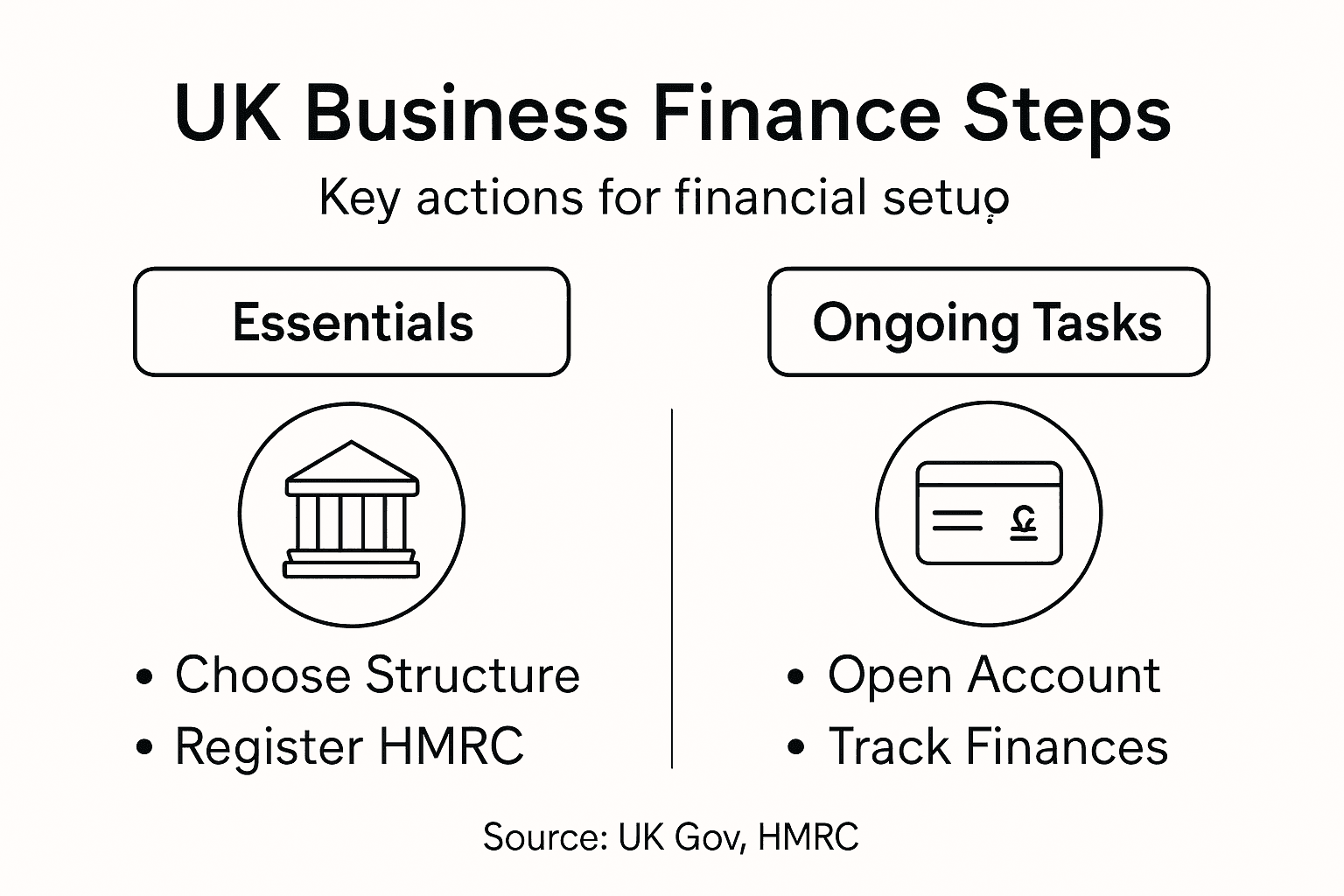
Start by reviewing your bookkeeping records against your bank statements monthly. This reconciliation process is your first line of defence against errors. Compare what your accounting software says about your balance against what your actual bank statement shows. Look for transactions that appear in one place but not the other. Small discrepancies might indicate timing issues where payments have not cleared yet, but larger gaps need investigation. If you discover errors, trace them back to their source and correct them immediately. A business owner in Leeds who catches a £500 mistake in month three can fix it easily. One who discovers it during year-end tax preparation faces hours of detective work and potential complications with HMRC. Set aside thirty minutes each month for this reconciliation. It becomes part of your routine, like checking your email.
Review your income and expenses quarterly to ensure everything is being categorised correctly. Pull a profit and loss statement from your accounting software and read through it carefully. Does every category make sense? Are there expenses recorded under vague labels that need reclassifying? Are there significant transactions you do not recognise? This quarterly review helps you understand your business finances deeply. You will spot trends, such as a particular expense category growing unexpectedly, or identify opportunities to reduce costs. If you operate as a limited company or have employees, you must also verify that payroll is being processed correctly. Check that the right amounts are being deducted for tax and National Insurance, and that payments to HMRC are being made on time. Payroll errors are serious and can trigger HMRC investigations, so accuracy here is non-negotiable.
If you handle customer payments or work in certain sectors, you may have obligations under anti-money laundering regulations. Your responsibilities under the Money Laundering Regulations depend on your business type and risk profile. Most small service businesses have minimal exposure, but if you handle cash payments or deal with high-value transactions, you need to understand what compliance measures apply to you. At minimum, this typically includes knowing who your customers are and keeping records of significant transactions. If you are uncertain whether these rules apply to your business, check the HMRC website or ask your accountant.
Your compliance review should also cover tax deadlines and filings. Create a calendar of all dates you need to submit information to HMRC or Companies House. Self-employed traders file Self Assessment returns by 31 January following the end of the tax year. Limited companies file Corporation Tax returns nine months after their year end and must submit accounts to Companies House within specific timeframes. VAT returns, if applicable, are due quarterly or monthly depending on your scheme. Missing deadlines results in automatic penalties, regardless of whether you owe tax or not. Penalties start at £100 and escalate if you miss multiple deadlines. Mark these dates clearly in your calendar and set reminders weeks in advance.
Use this table as a reference for key UK tax and compliance deadlines for small businesses:
Requirement | Deadline Example | Applies To |
Self Assessment Return | 31 January after tax year ends | Sole traders, partners |
Corporation Tax Return | 9 months after company year end | Limited companies |
VAT Return | 1 month plus 7 days post-VAT period | Businesses over threshold |
Companies House Accounts | Usually 9 months after year end | Limited companies |
Consider conducting a more formal annual review with your accountant. A professional set of eyes will spot issues you might miss and ensure everything aligns with best practice. Your accountant can also advise whether you are claiming all the tax reliefs you are entitled to and identify opportunities to reduce your tax bill legally. This annual review typically happens after your year end, giving you time to put everything in order before your accountant prepares your accounts and tax return.
Tip Create a simple compliance checklist tailored to your business and review it quarterly. Include items like monthly reconciliation, quarterly expense review, payroll accuracy checks, and upcoming deadline reminders. A checklist keeps compliance from slipping through the cracks as your business gets busier.
Achieve Financial Clarity and Compliance with Expert Support
Setting up your business finances correctly in the UK is crucial to avoid costly mistakes and complex compliance challenges. From choosing the right legal structure to managing your bookkeeping and staying on top of HMRC deadlines, the process can feel overwhelming. If you want to protect your personal assets, simplify your tax obligations, and build a foundation for growth, expert guidance is invaluable. Concorde Company Solutions specialises in helping small to medium-sized businesses, sole traders, and partnerships in Garforth and Leeds navigate these exact challenges with personalised solutions.

Take control of your finances now by partnering with professionals who understand the importance of dedicated business bank accounts, Making Tax Digital compliance, and accurate bookkeeping systems. Visit Concorde Company Solutions to explore services like payroll management, company tax returns, and software setup that streamline your financial operations. Don’t let administrative burdens or regulatory risks hold you back. Contact us today and secure a compliant, efficient financial future for your business.
Frequently Asked Questions
What legal structure should I choose for my business in the UK?
Choosing the right legal structure depends on factors like your business size, profit projections, and risk exposure. Start by evaluating whether a sole trader, partnership, or limited company best suits your needs based on these criteria.
How do I register for Self Assessment as a sole trader?
To register for Self Assessment, visit the HMRC website and complete the registration process by 5 October following the end of the tax year in which you started trading. Ensure you have your personal details and business information ready for a smooth registration.
What type of business bank account do I need?
You need a dedicated business bank account to keep your personal and business finances separate and to simplify accounting. Research different banks and choose one that offers features aligned with your business needs, and apply for the account as soon as you establish your business.
How can I implement an effective bookkeeping system?
To implement an effective bookkeeping system, choose software that suits your business needs and establish a routine for recording transactions regularly, ideally weekly. Start logging incoming and outgoing transactions and ensure all receipts and invoices are stored neatly for reference.
What are the key tax deadlines I should be aware of?
Key tax deadlines include the Self Assessment return due by 31 January after the tax year ends and the Corporation Tax return due nine months after your company’s year end. Create a calendar to track these deadlines to avoid penalties for late submissions.
How often should I review my financial compliance?
You should review your financial compliance quarterly to ensure your records are accurate and that you are meeting all regulatory obligations. Schedule this review as a recurring task to stay on top of potential issues and maintain proper financial health.
Recommended


Good read overall, especially for people new to this topic. I recently visited Companies999 while researching birmingham accountants and this article complements that information well.