
Expense claims explained for UK SMEs
- David Rawlinson
- May 24
- 9 min read

TL;DR:
Small and medium-sized UK businesses often struggle with expense claims due to lack of structured processes and misunderstanding HMRC rules. Implementing clear policies, proper record-keeping, and understanding allowable expenses and travel rules can ensure compliance and efficient reimbursements. Regular reviews and detailed documentation are essential to prevent costly mistakes during HMRC audits.
If you run a small or medium-sized business in the UK, expense claims are probably not your favourite part of the job. Many business owners either pay out of pocket and forget to claim, or submit expenses informally and hope for the best. Neither approach is good for your finances or your HMRC compliance. With expense claims explained clearly, the process is far less daunting than most people assume. This guide covers what counts as an allowable expense, how to submit claims properly, and the HMRC rules you need to know to avoid costly mistakes.
Table of Contents
Key takeaways
Point | Details |
Understand what qualifies | Business expenses must pass HMRC’s “wholly and exclusively” test to be allowable and claimable. |
Follow a clear process | A structured workflow from receipt collection to reimbursement prevents errors and delays. |
Know the HMRC rules | Travel and mileage claims carry specific tax conditions that many SMEs get wrong without realising. |
Write a formal policy | A written expense policy reduces disputes, speeds up approvals, and protects you during audits. |
Keep records for six years | HMRC requires limited companies to retain expense records for at least six years after the accounting period end. |
What are expense claims?
An expense claim is a formal request from an employee, director, or sole trader to be reimbursed for costs they have personally paid while carrying out business duties. In simple terms, it is how money spent on behalf of the business gets paid back.
For UK small and medium-sized businesses, the most common types of expenses claimed include:
Travel and accommodation — train fares, hotel stays, and flights for business trips
Mileage — fuel costs when using a personal vehicle for business journeys
Meals and subsistence — food and drink purchased during business travel, within reasonable limits
Office supplies — stationery, printer ink, or small equipment bought for work purposes
Training and professional development — course fees or relevant books and subscriptions
Client entertainment — subject to strict restrictions, as HMRC treats this differently from general expenses
The most important distinction to understand is the difference between a genuine business expense and a personal cost. HMRC applies what is known as the “wholly and exclusively” test. For an expense to be allowable, it must have been incurred wholly and exclusively for business purposes. If you take a client to lunch and discuss a contract, that may qualify. If you take your partner to the same restaurant to celebrate a birthday, it does not, even if you talk shop for five minutes.
This boundary trips up a lot of SME owners, particularly when expenses have a dual purpose. Buying a laptop you use for both personal browsing and client work is a classic example. HMRC may accept a proportion of the cost, but not the full amount, and you need to be able to justify that split if asked.
Pro Tip: Create a simple list of your most common business expenditures and run each one through the “wholly and exclusively” test before building it into your expense policy. It will save you from unnecessary HMRC scrutiny later.
You can also explore business expense categories to get a clearer picture of how to classify different spend types for your business.
The expense claims process, step by step
Understanding expense reimbursements is not just about knowing what you can claim. It is equally about knowing how to submit expense claims correctly. A clear, repeatable process protects both the employer and the employee.
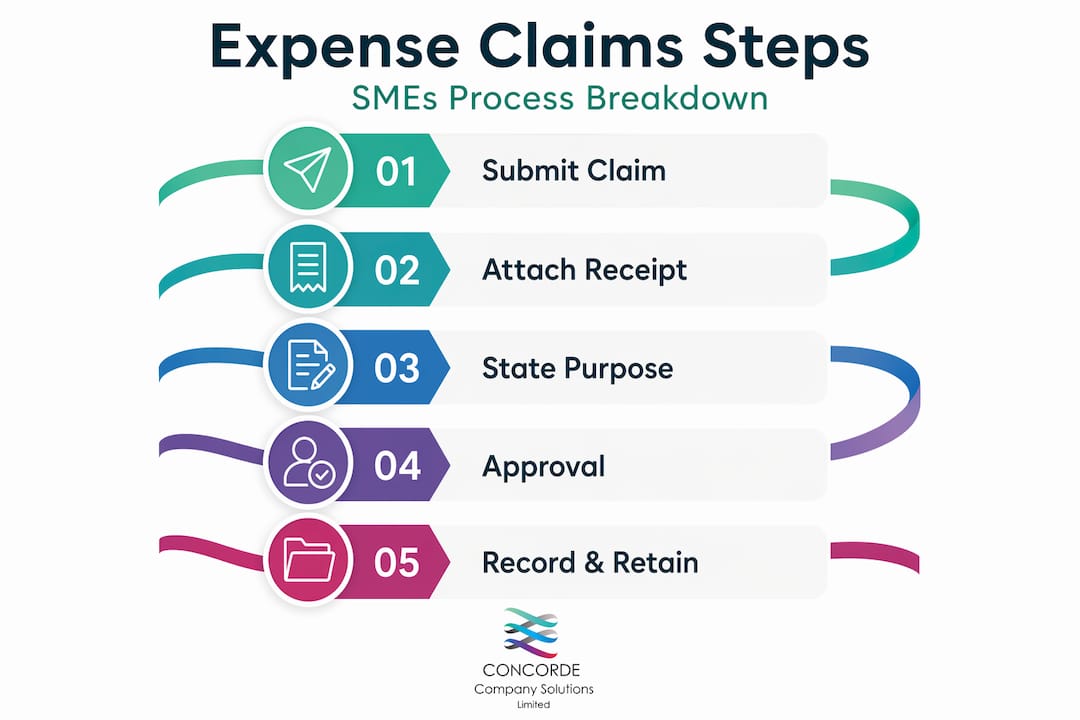
A typical expense workflow follows this sequence:
The expense is incurred. An employee or director pays out of pocket for a legitimate business cost.
Evidence is collected. A receipt, invoice, or other proof of purchase is retained immediately. Waiting until the end of the month to collect receipts is one of the most common and avoidable mistakes.
The claim is submitted. The employee completes an expense form, whether on paper, a spreadsheet, or dedicated software. The submission should include the date, vendor name, amount, expense category, and a clear description of the business purpose.
The claim is reviewed and approved. A manager, finance lead, or business owner checks the claim against the company’s expense policy before authorising it.
Reimbursement is made. Payment is processed, usually through payroll or a separate bank transfer, and recorded in the company’s accounts.
Records are filed and retained. All documentation is stored in a way that can be retrieved during an audit.
Many companies set a 30 to 60-day window from the date of purchase as the deadline for submitting expense claims. If your business does not already have a submission deadline, setting one reduces the risk of forgotten expenses and end-of-year chaos.
One of the most overlooked parts of this process is the description of business purpose. Receipts alone are insufficient without a clear explanation of why the cost was incurred. HMRC and internal auditors want to see context, not just an amount. Some expense management systems automatically prompt for this information before a claim can be submitted, which reduces disputes and rejections.

HMRC requires that expense records are retained for at least six years after the end of the relevant accounting period for limited companies. That includes receipts, mileage logs, and any supporting documentation. Digital storage counts, provided the records are legible and accessible.
Pro Tip: If your team submits expenses by email, create a dedicated expenses inbox and use a simple template so every submission contains the same information. It makes approval far quicker and creates an automatic paper trail.
HMRC rules you need to get right
For many SME owners, the compliance side of expense claims is where confusion turns into real risk. Understanding the key HMRC rules can protect you from unexpected tax bills and payroll headaches.
Travel expenses and the workplace rules
One of the most misunderstood areas is travel expenses. The critical HMRC test is whether travel is genuinely business-related. Commuting from home to a permanent workplace is never allowable, even if the employee’s contract does not specify a fixed location.
HMRC distinguishes between a permanent workplace and a temporary workplace. If an employee works at a site for no more than 24 months and it does not represent more than 40% of their working time, it is treated as temporary. Travel to temporary workplaces can be reimbursed tax-free. Once a workplace becomes permanent under these rules, travel costs must be processed through payroll as a taxable benefit if the employer continues to reimburse them.
Workplace type | Travel claimable tax-free | Notes |
Permanent workplace | No | Commuting costs; taxable if reimbursed |
Temporary workplace | Yes | Must meet the 24-month and 40% rule |
Client site (irregular) | Yes | Must be genuinely business-related |
Home office to other sites | Depends | Needs careful HMRC assessment |
Mileage and HMRC’s approved rates
When employees use their own vehicles for business journeys, employers can reimburse them tax-free under HMRC’s Approved Mileage Allowance Payments, commonly known as AMAPs. AMAP rates cover the majority of associated vehicle costs, including fuel and maintenance, so employers cannot claim these separately on top of the AMAP rate.
For 2026, the approved mileage rates are 45p per mile for the first 10,000 business miles in a car, and 25p per mile thereafter. Motorcycles are reimbursed at 24p per mile, and bicycles at 20p per mile. Paying above these rates without a dispensation agreement creates a taxable benefit for the employee.
Separating qualifying business expenses from non-qualifying claims at the approval stage is the fastest way to avoid payroll and tax reporting errors. If a travel claim does not meet HMRC’s criteria, it must go through PAYE (Pay As You Earn) rather than being paid as a tax-free reimbursement.
Tips for a better expense claims process
A clear expense policy and a few practical habits make a significant difference to how smoothly your expense claims process runs. Here are the practices that actually work for UK SMEs.
Draft a written expense policy. Many small businesses operate on informal agreements, which leads to inconsistent claims and awkward conversations. A written policy covering allowable expense types, spending limits per category, submission deadlines, and the approval process removes ambiguity for everyone.
Standardise your coding. Standardising how expenses are categorised, including cost centre, project code, and expense category, makes finance review far quicker and reduces the risk of duplicates or errors slipping through. This is one of the expense claim best practices that pays dividends as your team grows.
Prompt for business purpose at submission. Systems that prompt for descriptions before submission reduce the number of incomplete claims that bounce back for revision. Whether you are using software or a spreadsheet, make the business purpose field mandatory.
Review claim patterns periodically. If one employee consistently submits claims at the top of every spending limit, or if certain categories are growing faster than expected, that is worth investigating. Regular pattern reviews help you spot anomalies before they become problems.
Avoid these common expense claim mistakes:
Submitting personal costs as business expenses
Claiming commuting costs as business travel
Missing the submission deadline and then scrambling at year end
Losing receipts or submitting claims without supporting documentation
Paying mileage above AMAP rates without accounting for the taxable element
You can find further guidance on tracking business expenses and building habits that hold up under scrutiny throughout the year.
Pro Tip: Review your expense policy at least once a year, particularly after HMRC updates mileage rates or guidance. A policy that was accurate in 2023 may have gaps that create compliance issues today.
My take on expense claims for SMEs
In my experience working with small and medium-sized businesses, the biggest problem with expense claims is not dishonesty. It is a lack of structure. Most errors come from people who genuinely do not know the rules, not from anyone trying to claim something improper.
What I have found consistently is that SMEs underestimate how seriously HMRC takes the “business purpose” question. Owners assume a receipt is enough. It is not. An auditor wants to know why that cost was incurred, who attended a meeting, what was discussed, and why the expenditure was necessary for the business. That level of detail feels excessive until the moment you need it.
The other thing I see all the time is businesses treating their expense approval process as a rubber stamp. A claim comes in, someone signs it off quickly, and it gets paid. But approval is where you catch the misclassified travel claims and the personal costs that have crept in. Taking an extra two minutes to actually review each claim against your policy is not bureaucracy. It protects the business.
My strongest advice is this: write your expense policy as if you are explaining it to someone who has never worked in a business before. The edge cases, such as what happens when an employee books a hotel room that includes breakfast, or how to handle a cancelled trip, are the ones that cause the most confusion. If your policy addresses them clearly, you will spend far less time on disputes and reversals.
Small improvements to your process, such as a proper submission template, a mandatory “business purpose” field, and a firm submission deadline, can save hours every month and protect you completely during an HMRC review.
— David
How Concordecompanysolutions can help
Managing expense claims properly sits at the intersection of payroll, bookkeeping, and tax compliance. That is a lot for any business owner to handle alongside running the actual business.

At Concordecompanysolutions, we work with small and medium-sized businesses across the UK to take the complexity out of employee expense reimbursement and payroll management. Our payroll service handles the distinction between tax-free reimbursements and taxable benefits, so you never accidentally create an HMRC liability by paying the wrong type of claim the wrong way. We also help businesses set up the systems and policies that make expense submission and approval straightforward from day one. If you would like to talk through how we can support your business, get in touch with our team in Garforth, Leeds, and we will start with a conversation about what you actually need.
FAQ
What are expense claims in simple terms?
An expense claim is a formal request for reimbursement when an employee or director pays a business cost out of their own pocket. The employer repays the amount once the claim is reviewed and approved.
What is HMRC’s rule for allowable business expenses?
HMRC requires that expenses are incurred “wholly and exclusively” for business purposes to qualify as allowable. Any personal element in the cost can disqualify it or reduce the claimable amount.
Can employees claim commuting costs as a business expense?
No. Commuting from home to a permanent workplace is not an allowable expense under HMRC rules. If an employer reimburses commuting costs, those payments must be processed through payroll as taxable income.
How long should expense records be kept?
Limited companies must retain expense records, including receipts and mileage logs, for at least six years after the end of the accounting period to which they relate.
What is the approved mileage rate for 2026?
HMRC’s AMAP rate for cars is 45p per mile for the first 10,000 business miles in a tax year, and 25p per mile thereafter. These AMAP rates cover fuel, maintenance, and other associated vehicle costs.
Recommended

Comments