
Benefits of Professional Taxation for UK SMEs
- Richard Ellis
- Feb 12
- 7 min read


Running a business in Garforth means more than just balancing books and filing forms. Every year, changing United Kingdom regulations and the need for accurate tax reporting create new pressures for small and medium-sized enterprises. Understanding professional taxation can help local owners gain clarity, reduce risk, and make smarter choices that directly affect profitability and compliance within the United Kingdom’s tax system.
Table of Contents
Key Takeaways
Point | Details |
Professional Taxation | SMEs should engage professional tax advisers for tailored guidance, enabling compliance and strategic financial planning. |
Tax Relief Opportunities | Accessing various tax reliefs can significantly reduce tax liabilities and improve cash flow for SMEs. |
Maintaining Compliance | Accurate record-keeping and understanding HMRC guidelines are essential to avoid penalties and ensure compliance. |
Common Risks | SMEs must avoid common pitfalls such as misclassification of expenses and incomplete documentation to maintain financial integrity. |
Defining Professional Taxation for SMEs
Professional taxation for small and medium-sized enterprises (SMEs) represents a strategic approach to managing financial obligations and compliance within the United Kingdom’s complex tax framework. Unlike basic tax filing, professional taxation involves comprehensive support from qualified tax experts who provide nuanced guidance tailored to each business’s unique circumstances.
The Chartered Institute of Taxation defines professional taxation as a sophisticated service encompassing multiple critical dimensions:
Detailed tax research and interpretation
Strategic compliance management
Expert legislative navigation
Personalised financial planning
Risk mitigation and penalty prevention
For UK SMEs, professional taxation goes beyond mere number-crunching. It represents a proactive partnership with tax compliance experts who understand the intricate landscape of business taxation. These professionals help entrepreneurs transform potential tax challenges into strategic opportunities by providing insights that extend far beyond standard accounting practices.
Key aspects of professional taxation include comprehensive support in areas such as:
Accurate record-keeping
Expense categorisation
Tax efficiency strategies
Regulatory compliance management
Financial risk assessment
Professional tax advisers play a crucial role in helping SMEs navigate the complexities of UK tax legislation, ensuring businesses remain compliant while optimising their financial performance.

Pro tip: Invest time in selecting a tax professional who not only understands your industry but demonstrates a proven track record of supporting businesses similar to yours.
Types of Tax Reliefs Available in UK
UK small and medium-sized enterprises (SMEs) have access to various strategic tax relief options designed to support business growth, innovation, and financial efficiency. Research and Development (R&D) tax relief represents one of the most valuable mechanisms for businesses investing in technological advancement and creative problem-solving.
The primary categories of tax reliefs available to UK SMEs include:
Research and Development Tax Credits
Capital Allowances
Creative Industry Tax Reliefs
Charitable Donation Reliefs
Business Expense Deductions
Under the government’s comprehensive tax relief framework, businesses can strategically reduce their tax liabilities through carefully structured claims. Capital allowances, for instance, enable companies to write off the cost of qualifying equipment and assets, effectively lowering their taxable profits and encouraging ongoing investment in business infrastructure.
The Association of Taxation Technicians highlights that SMEs can claim tax relief on expenses directly related to business operations, such as:
Staff salaries and associated costs
Office equipment and supplies
Professional consultation fees
Marketing and advertising expenditures
Business travel and transportation expenses
These tax relief mechanisms are designed not just as financial incentives, but as strategic tools to support business growth, encourage innovation, and provide financial flexibility for SMEs navigating the complex UK taxation landscape.
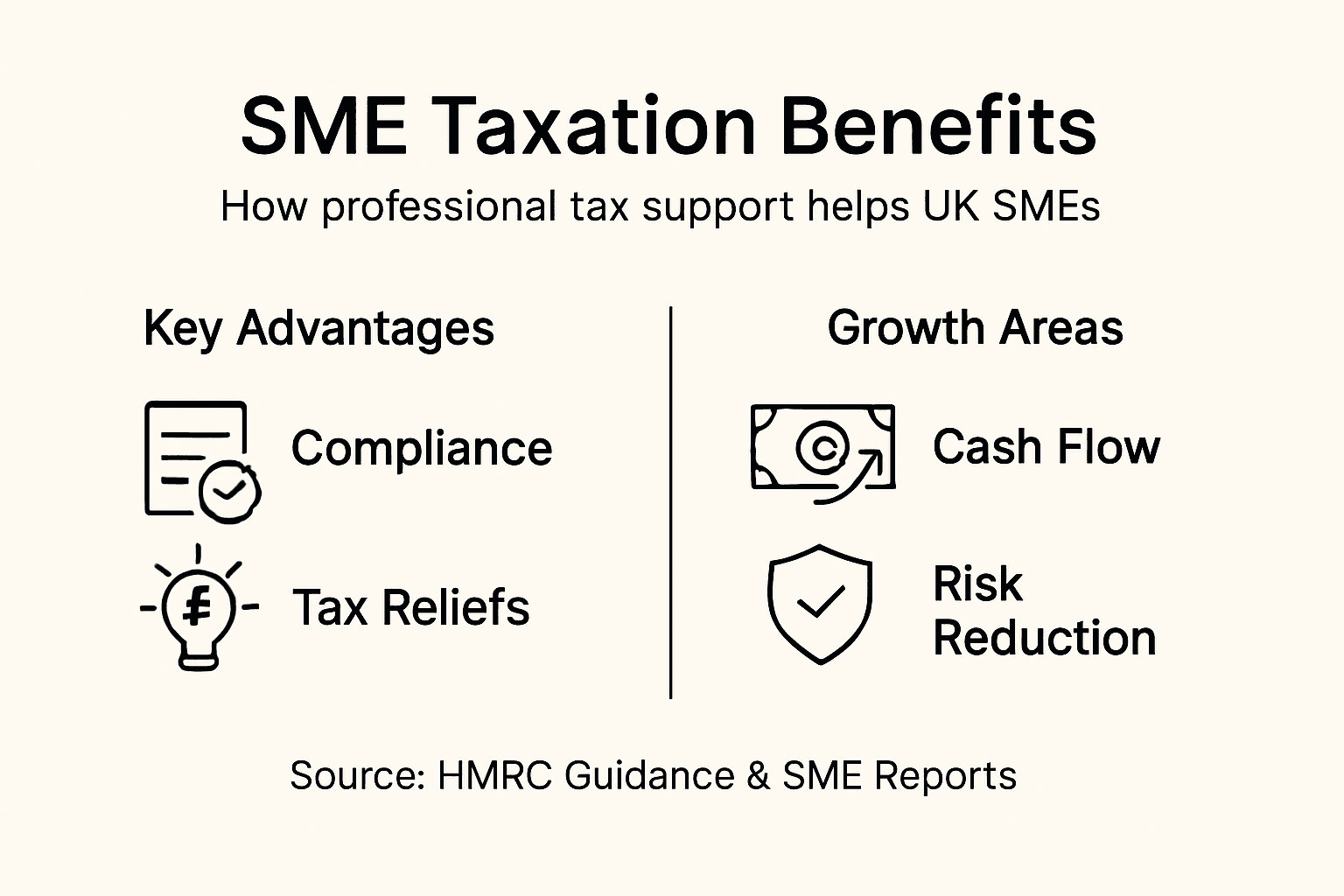
The following table summarises how major tax reliefs benefit UK SMEs in distinct ways:
Tax Relief Type | Strategic Benefit for SMEs | Typical Business Usage |
Research & Development Credits | Supports innovation and projects | Product development and prototyping |
Capital Allowances | Reduces taxable profits via assets | Machinery and IT investment |
Creative Industry Reliefs | Fuels growth in creative sectors | Film, TV, or gaming productions |
Charitable Donation Reliefs | Encourages responsible giving | Donations to registered charities |
Expense Deductions | Improves day-to-day cash flow | General operational costs |
Pro tip: Consult a professional tax adviser to ensure you’re maximising all available tax relief opportunities specific to your business sector and operational model.
How Professional Taxation Aids Compliance
Professional taxation plays a critical role in helping UK small and medium-sized enterprises (SMEs) navigate the complex landscape of regulatory requirements and tax compliance standards. By providing expert interpretation of intricate tax regulations, these professionals ensure businesses remain fully compliant while minimising potential risks and administrative burdens.
The key mechanisms through which professional taxation supports SME compliance include:
Interpreting complex tax legislation
Ensuring accurate financial reporting
Managing timely statutory submissions
Reducing potential errors and penalties
Implementing robust record-keeping systems
Making Tax Digital (MTD) represents a significant challenge for many SMEs, requiring sophisticated digital reporting mechanisms. Professional tax advisers help businesses transition smoothly by implementing appropriate technological solutions and ensuring all digital reporting meets HMRC’s stringent requirements.
The Financial Reporting Council emphasises the importance of proportionate compliance support for SMEs, highlighting that professional taxation services can:
Provide scalable audit and reporting support
Reduce financial administrative complexity
Enhance governance and regulatory understanding
Support sustainable business growth
Mitigate potential compliance risks
By offering specialised guidance tailored to each business’s unique operational context, professional taxation transforms compliance from a potential burden into a strategic advantage for SMEs navigating the UK’s intricate regulatory environment.
Pro tip: Invest in ongoing professional tax support that understands your specific industry sector and can proactively adapt to changing regulatory landscapes.
HMRC Rules for Deductible Expenses
Understanding HMRC deductible expenses is crucial for UK small and medium-sized enterprises seeking to maximise tax efficiency while maintaining strict compliance. Business expenses reporting requires meticulous attention to detail, with HMRC enforcing strict guidelines on what can be legitimately claimed as a business expense.
The fundamental principle for deductible expenses is that they must be:
Incurred wholly and exclusively for business purposes
Directly related to normal business operations
Reasonable and necessary for business function
Accurately documented and recorded
Verifiable through appropriate financial records
Qualifying business expenses encompass a wide range of operational costs, including:
Staff salaries and associated employment costs
Office equipment and supplies
Professional service fees
Business travel and transportation
Marketing and advertising expenditures
The Low Income Tax Reform Group highlights critical distinctions between different expense types, emphasising the importance of understanding capital expenses versus standard deductible expenses. Capital expenses relate to asset purchases and may qualify for separate capital allowances, requiring distinct accounting treatment.
This comparison sheds light on the differences between capital expenses and standard deductible expenses for SMEs:
Expense Type | Accounting Treatment | Example Item |
Capital Expenses | Depreciated over asset lifetime | Company vehicle purchase |
Deductible Expense | Directly reduces taxable profit | Office stationery supplies |
HMRC mandates precise documentation and reporting for all claimed expenses, with potential penalties for incorrect or unsubstantiated claims. Businesses must maintain comprehensive records demonstrating the direct business purpose of each expense to ensure compliance and avoid potential tax investigations.
Pro tip: Maintain a dedicated digital folder for all expense receipts and documentation, categorising them systematically to simplify annual tax reporting and potential HMRC audits.
Risks and Common Mistakes to Avoid
Navigating professional taxation requires understanding the potential pitfalls that can compromise an SME’s financial integrity and compliance. Data protection risks represent a critical area where businesses frequently encounter challenges beyond traditional tax considerations, potentially exposing themselves to significant financial and reputational damage.
The most prevalent risks and common mistakes SMEs encounter include:
Incomplete or inaccurate financial record-keeping
Misclassification of business expenses
Overlooking key tax deduction opportunities
Failing to separate personal and business finances
Inadequate documentation of financial transactions
Compliance failures can manifest in multiple complex ways, often stemming from seemingly minor administrative oversights. These potential errors can result in:
Substantial financial penalties
Unexpected tax assessments
Potential legal investigations
Damage to business reputation
Increased scrutiny from HMRC
Professional taxation support becomes crucial in mitigating these risks by providing structured guidance and proactive monitoring. Businesses must recognise that tax compliance extends beyond simple numerical calculations, requiring comprehensive understanding of evolving regulatory landscapes and intricate reporting requirements.
Moreover, SMEs must remain vigilant about potential cross-regulatory risks, understanding that financial non-compliance can intersect with other critical business governance areas, such as data protection and corporate reporting standards.
Pro tip: Conduct quarterly internal financial audits to identify and rectify potential compliance gaps before they escalate into significant regulatory challenges.
Take Control of Your SME’s Financial Future with Expert Professional Tax Support
Managing UK SME taxation can feel overwhelming with complex rules, strict compliance requirements and strategic tax reliefs at stake. The article highlights common challenges such as navigating Making Tax Digital, maximising reliefs like R&D credits, and avoiding costly mistakes from inaccurate expense claims. These concerns signal the importance of partnering with dedicated professionals who understand your unique sector and can safeguard your business against penalties while unlocking tax efficiency.
At Concorde Company Solutions, we specialise in personalised accountancy services tailored for SMEs across Garforth and Leeds. Our expert team offers reliable assistance with statutory accounts, company tax returns, payroll management and bookkeeping to keep your business compliant and financially optimal. We pride ourselves on building long-term client relationships based on transparency, responsiveness and trust.

Ready to convert professional taxation complexity into confident compliance and growth? Contact us today to discover how our bespoke services can help you meet HMRC requirements with ease and enhance your financial performance. Explore more about our expert accounting and tax services and secure your business’s success now.
Frequently Asked Questions
What is professional taxation for SMEs?
Professional taxation for SMEs refers to the strategic management of financial obligations and compliance within the tax framework, involving support from qualified tax experts for tailored guidance.
How can professional taxation help my business with compliance?
Professional taxation aids compliance by interpreting complex tax legislation, ensuring accurate financial reports, managing timely submissions, and reducing potential errors that can lead to penalties.
What types of tax relief are available for SMEs?
SMEs can access various tax relief options, including Research and Development Tax Credits, Capital Allowances, Creative Industry Tax Reliefs, Charitable Donation Reliefs, and Business Expense Deductions.
What common mistakes should SMEs avoid in professional taxation?
Common mistakes include incomplete financial record-keeping, misclassification of expenses, overlooking tax deductions, failing to separate personal and business finances, and inadequate documentation of transactions.
Recommended
Comments