
Why use expense tracking for your UK business in 2026
- David Rawlinson
- 3 hours ago
- 8 min read

TL;DR:
Expense tracking ensures legal compliance by maintaining detailed transaction records, invoices, and receipts required by HMRC. Regular, categorized expense monitoring reveals hidden costs, improves financial decision-making, and supports accurate budgeting for UK businesses and individuals. Using automated tools and establishing consistent habits simplifies the process, providing lasting financial clarity and control throughout the year.
Expense tracking is the systematic recording and categorisation of every pound you spend, giving you a transparent view of your financial activity and the evidence base HMRC expects. For UK small business owners, sole traders, and individuals, the importance of tracking expenses goes far beyond watching where money goes. It determines whether your tax return is accurate, whether you claim every allowable deduction, and whether you can make confident financial decisions throughout the year. Tools like Smart Expense and official HMRC record-keeping guidance make this process more accessible than ever in 2026.
Why use expense tracking for UK tax compliance
The single most compelling reason to track your expenses is legal obligation. HMRC requires businesses to keep records of all transactions and use that data to complete Self Assessment tax returns correctly. Without organised records, you are guessing at figures that carry legal weight.
Official UK guidance makes clear that invoices, receipts, and bank statements are not optional paperwork. They are the evidence that proves money moved in and out of your business. Without them, you cannot substantiate a claim, and HMRC can disallow it.
Categorisation matters just as much as collection. Not every expense you record will reduce your tax bill. Non-allowable expenses must be added back when calculating taxable profit, which means a poorly categorised record can either overstate your deductions or cause you to miss legitimate ones. Both outcomes cost you money.
Mixed business and personal costs add another layer of complexity. If you use your car for both work and personal journeys, business proportion must be recorded with a clear rationale to qualify as an allowable expense. Vague notes will not satisfy an HMRC enquiry.
Pro Tip: Set up your expense categories to mirror the boxes on your Self Assessment tax return. Consistent classification aligned with tax return boxes cuts filing time significantly and reduces errors when your accountant prepares your return.
Key categories to track for UK tax purposes include:
Allowable business expenses: office costs, travel, stock, professional fees, marketing
Non-allowable expenses: client entertainment, personal purchases, fines
Mixed-use costs: vehicle mileage, home office, phone bills (business proportion only)
Capital expenditure: equipment and assets (treated differently from revenue expenses)
What are the financial benefits of regular expense tracking?
The benefits of expense tracking reach well beyond tax season. Tracking your spending creates a factual record of your financial behaviour, and that record is far more honest than memory.
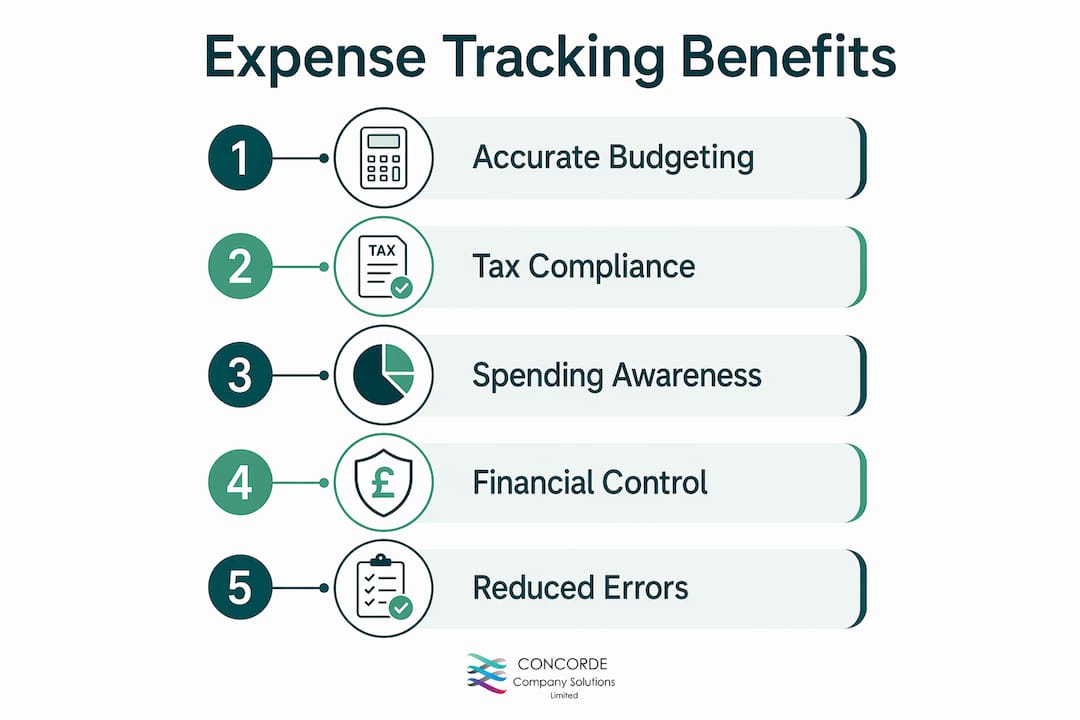
Most people significantly underestimate what they spend in specific categories. Subscriptions renew quietly, small purchases accumulate, and irregular costs like annual insurance or professional memberships get forgotten until the bank statement arrives. Tracking reveals hidden subscriptions and unnecessary spending, freeing up an average of £450 per year. That figure represents real money that was leaving accounts unnoticed.
The psychological impact is equally significant. Daily expense tracking produces 15% higher life satisfaction by increasing financial control and reducing money-related stress. Financial anxiety is often rooted in uncertainty. When you know exactly where you stand, the anxiety shrinks.
For small business owners, the financial benefits compound over time. Here is how systematic tracking improves your position:
Spending visibility: You see exactly where revenue is going, which categories are growing, and which are out of proportion with your income.
Budget accuracy: Budgets built on real historical data are far more reliable than estimates. You stop budgeting optimistically and start budgeting accurately.
Unnecessary cost reduction: Once you can see every line item, cutting waste becomes straightforward. Unused software licences, duplicate services, and inflated supplier costs become visible.
Debt and savings acceleration: Freed-up cash from reduced waste can be redirected to debt repayment or a business reserve fund.
Financial discipline: The act of recording spending creates a natural pause before purchases, which reduces impulsive decisions.
Consistent expense capture also reduces memory risk. Relying on recollection to reconstruct months of spending at year-end is unreliable and stressful. A habit of regular recording removes that risk entirely.
How do modern tools simplify expense tracking in 2026?
The gap between manual and automated expense tracking has widened considerably. Understanding the trade-offs helps you choose the right approach for your situation.

Method | Speed | Accuracy | Best for |
Manual spreadsheet | Slow | Dependent on user | Sole traders with low transaction volume |
Bank feed integration | Fast | High, with review | Small businesses using accounting software |
AI-powered mobile app | Very fast | High, with minor corrections | Busy owners tracking receipts on the go |
Accountant-managed system | Varies | Very high | Businesses wanting full compliance assurance |
AI-powered apps like Smart Expense parse receipts and emails to categorise expenses automatically, without requiring you to link a bank account. This matters for privacy-conscious users who want the efficiency of automation without sharing banking credentials. The accuracy is high, though a quick human review remains good practice.
The most important factor is not which tool you use. It is whether you use it consistently. A basic spreadsheet updated weekly outperforms a sophisticated app opened twice a year.
Pro Tip: A five-minute weekly review to verify categories and correct errors prevents backlogs from forming. Schedule it on the same day each week, treat it as a non-negotiable appointment, and it becomes effortless within a month.
Real-time tracking is increasingly necessary in 2026. Inflation and changing economic conditions mean that spending patterns shift faster than they did five years ago. A quarterly review that was adequate in 2020 may now leave you reacting to problems rather than preventing them.
How to implement effective expense tracking for your business
Starting a tracking system is straightforward. Maintaining it requires structure. The following approach works for both sole traders and small to medium-sized businesses.
Choose your method first. Match the tool to your transaction volume and technical comfort. A sole trader with 30 transactions per month does not need enterprise software. A growing business with employees, suppliers, and mixed-use assets needs something more capable, such as Xero or QuickBooks integrated with a receipt-scanning tool.
Set up categories that reflect your goals. Generic categories like “miscellaneous” are useless. Align your categories with your tax return boxes and your budget headings. If you want to reduce travel costs, track mileage, fuel, and public transport separately so you can see the breakdown.
Build a weekly review habit. Batch-processing a week of expenses takes five to ten minutes. Batch-processing a year of expenses takes days and introduces errors. The weekly habit is the single most impactful change most business owners can make to their financial management.
Link tracking to your broader financial workflow. Expense data feeds your budget, informs your cash flow forecast, and prepares your tax return. When these systems connect, the effort you put into tracking multiplies in value. You can read more about tracking business expenses effectively to build a workflow suited to UK SMEs.
Key habits to build from day one:
Photograph receipts immediately rather than storing paper copies
Record the business purpose of every expense at the point of capture, not weeks later
Reconcile your records against your bank statement monthly
Flag mixed-use costs with a note explaining the business proportion
Review your category totals against your budget at the end of each month
Understanding why maintaining business records matters gives you the full compliance picture alongside the practical tracking habits above.
Key takeaways
Expense tracking is the foundation of accurate tax compliance and financial control for UK businesses and individuals, and neglecting it costs money in both missed deductions and unnecessary stress.
Point | Details |
Legal compliance is non-negotiable | HMRC requires detailed transaction records to support Self Assessment returns and allowable expense claims. |
Categorisation determines your tax bill | Non-allowable expenses must be identified and added back; poor categorisation leads to incorrect tax calculations. |
Tracking reveals hidden spending | Regular monitoring uncovers unnecessary costs and subscriptions, freeing up significant cash over time. |
Automation reduces the burden | AI-powered tools like Smart Expense categorise receipts automatically, making consistent tracking achievable for busy owners. |
Weekly habits beat annual scrambles | A five-minute weekly review prevents backlogs, reduces errors, and keeps records audit-ready throughout the year. |
The habit that changed how I think about money
Most business owners I speak with treat expense tracking as a chore they do for their accountant. I understand that view, but it misses the point entirely.
The first time I sat down with a properly categorised year of expenses, the data told me things I genuinely did not know about my own spending. Not vague impressions. Specific numbers. A software subscription that had doubled in price without triggering any review. A category of costs that had grown 40% year-on-year without any corresponding growth in output. These were not small oversights. They were decisions I had been making by default rather than by choice.
The shift I would encourage every business owner to make is this: stop thinking of expense tracking as record-keeping for HMRC and start thinking of it as intelligence for yourself. The tax compliance benefit is real and significant. But the financial clarity you gain from knowing exactly where every pound goes is what actually changes behaviour.
Perfection is not the goal. Consistency is. A system you use imperfectly every week is worth more than a perfect system you abandon by February. Start with the simplest method that covers your transaction volume, build the weekly review habit, and let the data guide your decisions. The stress reduction alone is worth the effort.
Working with a trusted local accountant, like the team at Concorde Company Solutions Limited, takes this further. When your records are clean and consistent, your accountant can focus on strategy and tax planning rather than reconstruction. That is where the real value of a professional relationship lies.
— David
How Concorde Company Solutions Limited can help

Concorde Company Solutions Limited is the number one accountancy firm in Garforth, Leeds, and a trusted partner for small to medium-sized businesses and individuals across the region. The firm’s bookkeeping and payroll services are built around the kind of accurate, audit-ready record-keeping that makes expense tracking genuinely useful rather than just compliant. Whether you need help setting up a categorisation system, preparing for Self Assessment, or managing payroll records that satisfy HMRC requirements, Concorde brings the expertise and personal attention that larger firms simply do not offer. Contact Concorde Company Solutions Limited today to discuss a tailored approach to your financial management.
FAQ
What does expense tracking mean for UK businesses?
Expense tracking is the process of recording and categorising every business transaction to support accurate tax returns and financial management. HMRC requires businesses to maintain these records to complete Self Assessment correctly and evidence allowable expense claims.
How long must I keep expense records in the UK?
HMRC requires self-employed individuals and businesses to keep records for at least five years after the Self Assessment deadline for the relevant tax year. Keeping digital copies alongside paper originals is the safest approach.
Are all tracked expenses tax-deductible?
No. Only allowable expenses that are wholly and exclusively for business purposes reduce your taxable profit. Non-allowable costs, such as client entertainment or personal purchases, must be identified and excluded from your tax calculations.
What is the easiest way to start tracking expenses?
The easiest starting point is a dedicated business bank account combined with a receipt-scanning app like Smart Expense. Keeping business and personal finances separate from day one removes the most common source of confusion and error.
How does expense tracking help with budgeting?
Tracking creates a factual record of actual spending, which makes budgets far more accurate than estimates. Once you can see your real spending patterns, you can set realistic targets, identify waste, and redirect funds towards savings or growth with confidence.
Recommended
Comments