
Examples of business expenses: a practical UK guide
- David Rawlinson
- 1 hour ago
- 8 min read

TL;DR:
Proper categorization and documentation of business expenses help small UK businesses reduce taxable profits and avoid HMRC inquiries.
Key practices include claiming overlooked costs like software subscriptions, home office expenses, and vehicle mileage, while maintaining clear records of mixed-use items.
Business expenses are the costs a business incurs in the course of earning income, and understanding clear examples of business expenses is the fastest route to accurate tax returns and tighter budgets. For small business owners and self-employed individuals in the UK, HMRC allows you to deduct costs that are wholly and exclusively for business purposes, reducing your taxable profit directly. Getting this right matters. Miss a category and you overpay tax. Misclassify a personal cost and you risk an enquiry. This guide covers the most common and most overlooked types of business expenses, with practical examples aligned to real tax categories.
1. Common examples of business expenses to track
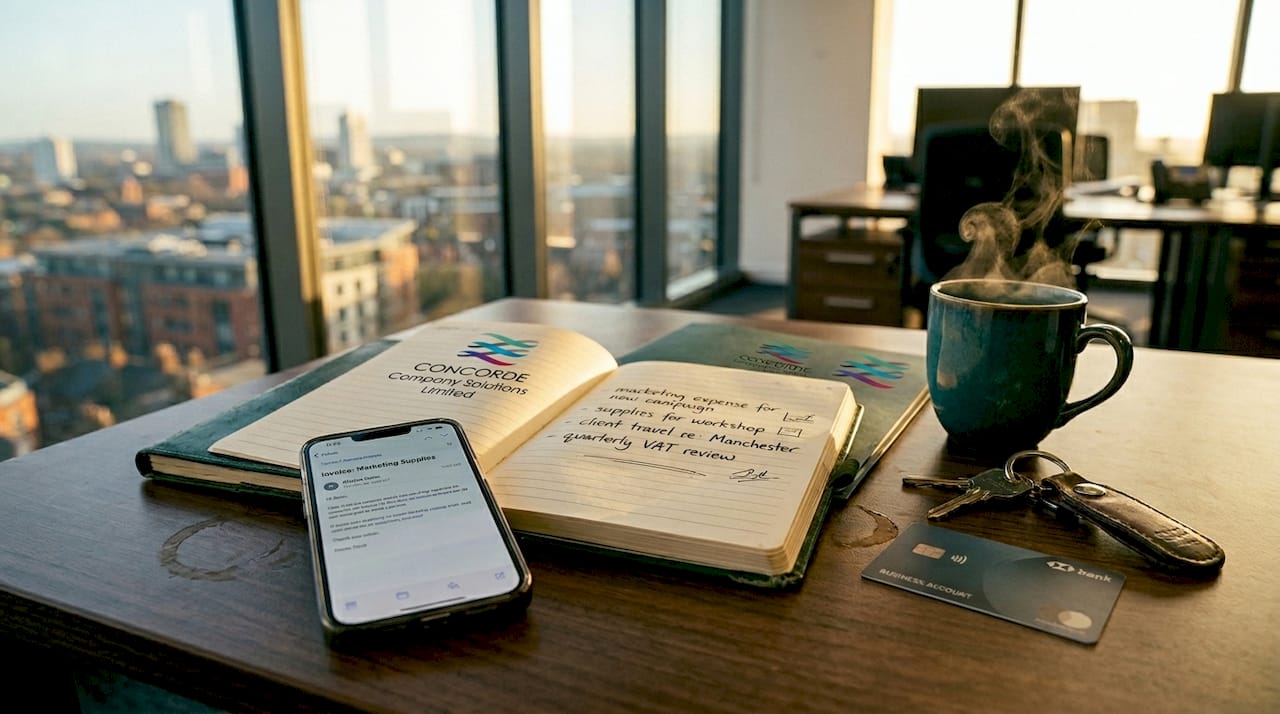
Small businesses commonly track advertising, software, office supplies, professional services, rent, insurance, travel, and wages for both budgeting and tax purposes. These categories map directly to HMRC allowable expenses and form the backbone of any self-assessment or company tax return.
Advertising and marketing covers digital ads on Google and Meta, print materials, sponsorships, and website costs. Advertising deductions scale significantly from around £1,000 for smaller businesses to over £14,000 for those earning above £100,000 annually, which means this category grows in importance as your business does.
Office supplies and equipment includes stationery, printer ink, computers, and furniture used solely for work. Professional services covers accountancy fees, legal advice, and consultancy costs. Both are straightforward to claim, provided you keep receipts and can demonstrate the business purpose.
Employee wages and contractor payments are fully deductible as operating costs. Insurance premiums for public liability, professional indemnity, and employers’ liability all qualify. Notably, only 22% of small businesses claim liability insurance deductions, which means a significant number are leaving money on the table.
Pro Tip: Categorise every expense at the point of purchase, not at year end. Assign it to a tax-aligned category immediately and add a brief note on business purpose. This single habit prevents the scramble that causes missed deductions.
2. Capital expenditure vs operating expenses
Capital expenditure and operating expenses are treated differently for tax purposes, and confusing the two is one of the most common errors in small business bookkeeping.
Operating expenses are day-to-day costs consumed within the accounting period: rent, utilities, software subscriptions, and wages. These are deducted in full in the year they arise.
Capital expenditure covers assets with a lifespan beyond one year. Examples include:
Machinery and manufacturing equipment
Company vehicles
Computers and servers
Office furniture and fixtures
Leasehold improvements to business premises
Capital assets are not deducted in full immediately. Instead, their cost is spread across their useful life through depreciation. In the UK, HMRC uses a system of capital allowances rather than straight-line depreciation, with the Annual Investment Allowance (AIA) allowing most small businesses to deduct the full cost of qualifying plant and machinery in the year of purchase.
Type | Treatment | Examples |
Operating expense | Deducted in full in the current tax year | Rent, software, wages, stationery |
Capital expenditure | Depreciated over asset life or claimed via AIA | Machinery, vehicles, computers |
The practical implication is clear: a £3,000 laptop claimed under AIA gives you the full deduction this year, whereas the same laptop treated as a balance sheet asset only gives you a fraction annually. Understanding which route applies to each purchase is worth discussing with your accountant before the tax year closes.
3. Challenges in categorising and documenting expenses
The biggest categorisation challenge is not knowing what qualifies. It is proving that what you claim genuinely relates to the business. HMRC and the IRS both test whether an expense is ordinary and necessary for operating the business, placing the burden of proof on documentation rather than category labels alone.
The most problematic areas for small business owners are:
Vehicle and phone costs: If you use a personal car or mobile phone for both work and private purposes, you can only claim the business proportion. Without a mileage log or call records, HMRC will challenge the split.
Meals and entertainment: Only 33% of small businesses claim meals despite partial deductibility. The reason is documentation. You need the date, attendees, and business purpose recorded for every claim.
Mixed personal and business purchases: Buying a new desk for a home office is deductible. Buying a sofa for the same room is not. The line is the purpose, not the location.
Separating business from personal use requires careful documentation, particularly for vehicles, meals, and home office costs. The risk of getting this wrong is not just a disallowed claim. It can trigger a wider review of your records.
Pro Tip: Keep a dedicated business bank account and business credit card. When every business transaction flows through a separate account, categorisation becomes mechanical rather than guesswork, and your records are audit-ready by default.
For a deeper look at how to structure your records, the guide on tracking business expenses from Concordecompanysolutions covers the practical steps for UK SMEs in detail.
4. Overlooked business expense examples worth claiming
Several legitimate business expense categories are consistently underclaimed, often because owners are unaware they qualify. These represent real tax savings that most small businesses miss.
Education and professional development: Courses, books, and training directly related to your current trade are deductible. A freelance graphic designer paying for an Adobe Illustrator masterclass qualifies. A plumber taking a business management course does not, because it relates to a new skill rather than an existing one.
Software subscriptions and SaaS tools: Adobe Creative Cloud, Microsoft 365, accounting software, and cloud storage services all qualify as recurring operating costs. These are frequently forgotten at year end because they are small monthly charges that blend into the background.
Home office deductions: If you work from home, you can claim a proportion of heating, electricity, and broadband costs. HMRC offers a simplified flat rate, or you can calculate the actual business proportion based on the number of rooms and hours worked. A 150 sq ft home office using the simplified method yields a meaningful annual deduction, and the actual method often produces more.
Business mileage: The HMRC approved mileage rate for cars is 45p per mile for the first 10,000 miles and 25p thereafter. Many self-employed individuals undercount their mileage simply because they do not log it consistently.
Bank charges and interest: Business account fees, overdraft charges, and interest on business loans are all deductible. These are small individually but add up across a year.
For a full breakdown of what HMRC permits, the Concordecompanysolutions article on allowable expenses for UK businesses is a useful reference.
5. Using expense examples to improve tax preparation and budgeting
Listing business expenses is not just a tax exercise. It is the foundation of a functioning budget. Breaking costs into fixed and variable categories gives you a clearer picture of your financial commitments and where you have room to adjust.
Fixed costs include rent, insurance premiums, and software subscriptions. These do not change month to month and should be the first line in any budget. Variable costs include travel, materials, and advertising spend. These fluctuate with activity and are where most overspending occurs.
A practical workflow for aligning expenses with tax preparation:
Map your bookkeeping categories directly to HMRC allowable expense headings from the start of the tax year
Record the business purpose for every meal, travel claim, and mixed-use item at the time of purchase
Maintain contemporaneous mileage logs throughout the year rather than reconstructing them in January
Use tools like ReceiptSync to automate receipt capture and categorisation, reducing manual data entry
Review your expense categories quarterly to catch anything that has drifted into the wrong bucket
Mapping bookkeeping categories to tax form line items is a best practice that makes year-end reporting faster and reduces the risk of errors that attract HMRC attention. The Concordecompanysolutions guide on business expense categories explains how to structure this in practice.
For business owners who also want to reduce their overall tax liability, the SME tax optimisation steps article from Concordecompanysolutions covers four practical approaches worth reviewing before your next return.
Key takeaways
Correctly categorising and documenting business expenses is the single most effective way for small business owners to reduce taxable profit and avoid HMRC enquiries.
Point | Details |
Categorise at purchase | Assign every expense to a tax-aligned category immediately, with a note on business purpose. |
Separate capital from operating costs | Capital assets like machinery and vehicles are treated differently from day-to-day operating costs. |
Claim overlooked categories | Software subscriptions, home office costs, and business mileage are consistently underclaimed. |
Document mixed-use expenses | Vehicle, phone, and meal claims require clear records showing the business proportion. |
Align categories with HMRC headings | Mapping bookkeeping categories to HMRC allowable expense lines reduces errors at year end. |
Why most small businesses get their expenses wrong
In my experience working with sole traders and small limited companies, the problem is rarely ignorance of the big categories. Everyone knows rent and wages are deductible. The real losses happen in the margins. The £49 monthly software subscription that never gets logged. The 200 miles of business travel reconstructed from memory in January. The professional development course paid from a personal card and forgotten entirely.
The businesses that manage this well share one habit: they treat expense recording as a live process, not an annual task. They use a dedicated business account, they photograph receipts on the day, and they write a two-word note about the business purpose before they put their phone away. That discipline, applied consistently, is worth more than any clever tax strategy.
I also think the distinction between capital and operating expenses is underappreciated. Many small business owners buy a piece of equipment, expense it incorrectly, and either miss the Annual Investment Allowance or claim something they should not. A brief conversation with an accountant at the point of purchase, rather than at year end, prevents this entirely.
The overlooked categories matter too. Disability and income protection insurance for business owners is a legitimate business cost that very few sole traders claim. If you rely on your ability to work to generate income, disability insurance for business owners is both a sensible financial protection and a deductible expense worth understanding.
The bottom line is that good expense management is not about finding obscure loopholes. It is about claiming everything you are genuinely entitled to, with the records to back it up.
— David
How Concordecompanysolutions supports your expense management

Managing payroll and expenses alongside running a business is a significant administrative burden for most small UK business owners. Concordecompanysolutions, based in Garforth, Leeds, provides payroll management, bookkeeping, and tax return services specifically designed for sole traders, SMEs, and limited companies. The firm helps clients set up bookkeeping systems that align directly with HMRC categories, so that expense tracking feeds cleanly into tax preparation without duplication or errors. If you want your payroll and expense records handled accurately and on time, explore the payroll services Concordecompanysolutions offers and get in touch directly to discuss your requirements.
FAQ
What counts as a business expense in the UK?
A business expense is any cost incurred wholly and exclusively for the purpose of your trade or business. HMRC allows deductions for costs like advertising, professional fees, travel, wages, and office supplies, provided you can demonstrate the business purpose.
Can I claim expenses paid from a personal account?
Yes. HMRC does not require expenses to be paid from a business account to qualify for deduction. You must keep receipts and records showing the amount, date, and business purpose for each claim.
What is the difference between capital and revenue expenditure?
Revenue expenditure covers day-to-day running costs deducted in the current tax year. Capital expenditure covers assets with a lifespan beyond one year, which are claimed through capital allowances such as the Annual Investment Allowance rather than as an immediate deduction.
How do I calculate a home office deduction?
HMRC offers a simplified flat rate based on hours worked from home each month, or you can calculate the actual proportion of household costs attributable to your workspace. The actual method typically produces a higher deduction for those with a dedicated room used exclusively for work.
Which business expenses are most commonly missed?
Software subscriptions, business mileage, home office costs, professional development, and bank charges are the categories most frequently underclaimed by small business owners and self-employed individuals.
Recommended