
Complete Workflow for Financial Year End: Step-by-Step Guide
- David Rawlinson
- Dec 7, 2025
- 7 min read

Most British companies face a tightly monitored financial year end, where even small errors can lead to costly complications. With over 1.5 million annual filings submitted to Companies House, getting each step right is crucial for compliance and peace of mind. Understanding how to methodically prepare, check, and submit your records helps you avoid mistakes that catch many off guard and ensures your business is ready for review.
Table of Contents
Quick Summary
Key Point | Explanation |
1. Gather All Financial Records | Compile bank statements, invoices, receipts, and payroll records for accurate reporting. This foundational step is essential for year-end processing. |
2. Reconcile Your Accounts Carefully | Systematically match bank statements with internal records to check for discrepancies. This ensures accuracy before final reporting. |
3. Prepare Year-End Adjustments | Review and adjust all balance sheet entries, including accruals and prepayments, to ensure accurate financial statements. |
4. Compile Statutory Accounts Diligently | Create a detailed balance sheet and profit and loss account to meet regulatory requirements, ensuring your financial health is clearly presented. |
5. Verify Figures for Compliance | Perform rigorous checks against accounting standards to ensure that all entries are classified correctly and are compliant with regulations. |
Step 1: Gather Essential Financial Records
Successfully preparing for your financial year end requires meticulous collection of all relevant financial documents. This critical first step ensures accurate reporting and smooth processing of your annual accounts.
Start by systematically compiling key financial records that will form the foundation of your year end reporting. Gather all income and expense documentation including bank statements, invoices, receipts, payroll records, and transaction logs. The UK government requires limited companies to maintain comprehensive financial documentation that reflects a true and fair view of the business’s financial position.
Pay special attention to categorising your records precisely. Group documents by type: sales invoices, purchase receipts, bank statements, payroll records, and asset documentation. Digital records work best - scan physical documents and create a secure, organised digital filing system. Pro tip: create separate folders for each document category to streamline your year end process and make future audits significantly easier.
Your next step will involve reviewing these gathered records for accuracy and completeness, preparing you for the detailed financial analysis that follows.
Step 2: Reconcile Accounts and Review Transactions
Reconciling your accounts is a crucial phase in the financial year end process, allowing you to verify the accuracy of your financial records and identify any discrepancies before final reporting.

Begin by systematically comparing your bank statements with internal financial records, matching each transaction meticulously. Focus on cross-referencing every income and expense entry, ensuring that every transaction is correctly recorded and categorised. Look for any unexplained differences, such as bank charges, unrecorded transactions, or potential errors in data entry. Pay special attention to large or unusual transactions that might require additional investigation or documentation.
Create lead schedules for each account type, documenting the reconciliation process step by step. This approach not only helps you track your work but also provides a clear audit trail that demonstrates the thoroughness of your financial review. Digital accounting tools can significantly streamline this process, automatically flagging potential discrepancies and helping you maintain precise financial records. Pro tip: allocate sufficient time for this process and consider breaking it down into manageable chunks to maintain accuracy and reduce stress.
Once you have completed your account reconciliation, you will be ready to move forward with preparing your comprehensive financial statements.
Step 3: Prepare and Adjust Year-End Entries
Preparing year-end entries is a critical process that ensures your financial statements accurately reflect your business’s true financial position and comply with accounting standards.
Review and reconcile your balance sheet accounts with meticulous attention to detail. This involves carefully checking opening balances, confirming fixed asset additions and disposals, and performing comprehensive analytical reviews. Focus on key areas such as accounts receivable, examining each entry to identify and address any discrepancies or potential write-offs. Verify that merchant clearing accounts reflect recent receipts and ensure all undeposited funds are correctly accounted for.
Pay special attention to complex accounting adjustments that might impact your financial statements. This includes accruals, prepayments, depreciation calculations, and potential provisions for doubtful debts. Create detailed documentation for each adjustment to provide clear evidence of your accounting rationale. Pro tip: use spreadsheet templates or accounting software to track these adjustments systematically, reducing the risk of errors and making the process more manageable.
Once you have completed these critical adjustments, you will be well-prepared to move forward with generating your final financial statements.
Step 4: Compile Statutory Accounts and Reports
Compiling statutory accounts is a critical process that transforms your financial data into a comprehensive report required by UK regulatory bodies, providing a transparent snapshot of your company’s financial performance.
Prepare the essential components of your statutory accounts with precision and care. This includes drafting a detailed balance sheet, profit and loss account, comprehensive notes about your accounts, and a director’s report. Ensure each document is meticulously cross-referenced, with clear documentation of transactions, outstanding debtors, and creditors. Pay special attention to listing all financial movements, ensuring every entry can be traced and validated.
Organise your accounts to meet the specific requirements set by Companies House and HMRC. This means presenting your financial information in a clear, logical format that demonstrates your business’s financial health and compliance. Pro tip: create a standardised checklist to track each required document, helping you maintain consistency and avoid last-minute omissions. Digital accounting tools can significantly streamline this process, reducing the potential for errors and saving valuable time.
With your statutory accounts now compiled, you are ready to proceed with the final steps of your financial year end process.
Step 5: Verify Figures and Ensure Compliance
Verifying your financial figures and ensuring regulatory compliance is the crucial final checkpoint in your year-end accounting process, protecting your business from potential financial and legal complications.
Follow systematic procedures for reconciling key control accounts with rigorous attention to detail. This involves conducting comprehensive analytical reviews that scrutinise every financial entry, identifying and investigating any unexplained variances. Look beyond surface numbers to understand the underlying transactions, cross-referencing documentation and challenging any inconsistencies that might indicate reporting errors or potential compliance risks.
Develop a structured approach to compliance verification that goes beyond mere numerical accuracy. Examine your financial statements against current accounting standards, ensuring every transaction is properly classified, valued, and documented. Pro tip: create a compliance checklist that covers regulatory requirements specific to your business size and sector, which will help you systematically validate each aspect of your financial reporting. Consider engaging an independent financial professional for a secondary review if you have complex transactions or want an additional layer of verification.
With your figures verified and compliance confirmed, you are now prepared to submit your final financial documents to the relevant authorities.
Step 6: Submit Returns and Archive Documentation
Submitting your financial returns and archiving documentation marks the final critical stage of your financial year end process, ensuring legal compliance and creating a robust record for future reference.
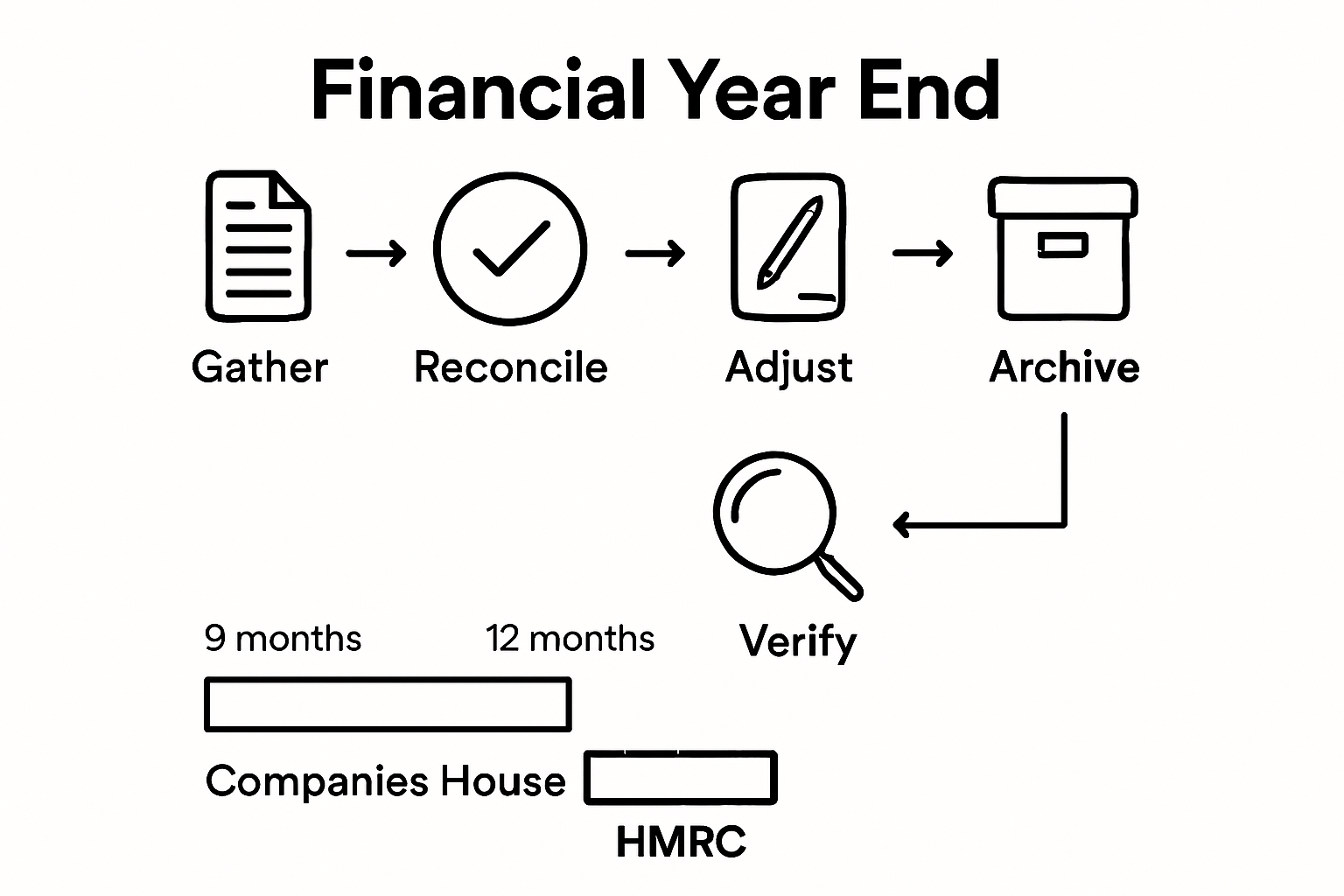
Navigate the submission process for statutory accounts with precision, paying close attention to specific deadlines set by Companies House and HMRC. Immediately after finalising your financial documents, prepare your digital and physical submission packages. This involves compiling all required documents including your balance sheet, profit and loss statement, director’s report, and notes to the accounts. Ensure every document is accurately completed, signed, and formatted according to regulatory requirements.
Establish a systematic archiving strategy that goes beyond mere compliance. Create both digital and physical backup systems for your financial documentation, with secure cloud storage and organised physical files. Pro tip: develop a standardised naming convention for your archived documents that includes the financial year and document type, making future retrieval straightforward. Consider maintaining records for at least six years to meet HMRC and Companies House requirements, storing them in a manner that preserves their integrity and accessibility.
With your returns submitted and documentation carefully archived, you have successfully completed your financial year end workflow.
Simplify Your Financial Year End with Expert Support
Completing a thorough financial year end workflow can feel overwhelming, especially when managing tasks like account reconciliation, statutory account preparation, and compliance verification. You need precision, organisation, and clear guidance to avoid costly errors and last-minute stress. Concorde Company Solutions understands these challenges and offers tailored accounting services designed to ease your burden. From accurate bookkeeping to expert preparation of your statutory accounts and company tax returns, we help you navigate every step with confidence and clarity.

Take control of your financial year end process today. Visit Concorde Company Solutions to discover how our personalised support and transparent pricing provide a reliable partner for your business. Whether you need help with payroll management, software setup, or detailed financial reporting, our dedicated team in Garforth, Leeds is ready to guide you. Contact us now to streamline your accounting and ensure full compliance. Learn more about our comprehensive services including statutory accounts preparation and efficient bookkeeping support designed to keep your financial affairs in perfect order.
Frequently Asked Questions
What financial records should I gather for my year-end process?
You should collect all income and expense documentation, including bank statements, invoices, receipts, payroll records, and transaction logs. Start by creating a digital filing system where you can securely organise these documents into categories, like sales invoices and purchase receipts.
How do I reconcile my accounts during the financial year-end?
Begin by systematically comparing your bank statements with your internal financial records. Focus on cross-referencing each transaction, identifying any discrepancies, and documenting the reconciliation process step by step to ensure accuracy and clarity.
What are the key components of statutory accounts I need to prepare?
The essential components of your statutory accounts include a balance sheet, profit and loss account, comprehensive notes about your accounts, and a director’s report. Ensure each document is meticulously cross-referenced and that all financial movements are accurately listed for transparency.
How can I verify my financial figures before submission?
Verify your financial figures by conducting comprehensive analytical reviews of your accounts and by cross-referencing all transactions against your documentation. Develop a compliance checklist to confirm that each aspect of your reporting meets the required standards before you submit your final documents.
What steps should I take to archive my financial documentation?
Establish a systematic archiving strategy that includes both digital and physical backups of your financial documents. Use a standardised naming convention for easy retrieval, and ensure your records are stored securely for at least six years, as required for compliance.
Recommended


Comments