
Why Choose Fixed Fee Accounting in Leeds
- Richard Ellis
- Feb 26
- 11 min read


Every small business owner knows the frustration of unpredictable invoices, especially when accounting costs seem to change without warning. For sole traders in Garforth and Leeds, the need for transparent, predictable pricing is more than just a convenience—it is key to confident financial planning and smoother operations. Fixed fee accounting delivers certainty by offering a clear, flat rate for specific services, helping you budget reliably while ensuring compliance and reducing financial stress.
Table of Contents
Key Takeaways
Point | Details |
Fixed Fee Model | Provides predictable pricing for accounting services, eliminating unexpected costs and simplifying budgeting. |
Defined Services | Ensure clarity on included services in your fixed fee arrangement to prevent potential misunderstandings about what extra work entails. |
Proactive Support | Fixed fee accounting encourages accountants to offer more strategic, proactive advice without the pressure of hourly billing. |
Enhanced Client Experience | A dedicated accountant offers personalised support, reducing stress through compliance management and fast response times, enhancing overall business growth. |
What Fixed Fee Accounting Means
Fixed fee accounting is straightforward: you pay a flat, predictable rate for specific accounting services rather than being charged by the hour. Your accountant agrees on a set price upfront, and that’s what you pay—no surprises, no escalating invoices at month’s end.
This model works differently from hourly billing. With hourly rates, you never quite know the final cost until the invoice arrives. A complex month might balloon your fees unexpectedly. Fixed fee removes that uncertainty entirely.
Fixed fee accounting provides predictable, flat-rate pricing for specific services, helping businesses budget with confidence and eliminate unexpected cost fluctuations.
Here’s what you’re actually paying for with fixed fee accounting:
Defined scope of work: Your accountant specifies exactly which services the fee covers (statutory accounts, payroll, bookkeeping, tax returns)
No hidden charges: Additional work outside the agreed scope costs extra, but basic services stay fixed
Monthly or annual billing: You know precisely what to budget each month or year
Transparent cost planning: No guessing game about final expenses
Why does this matter to you specifically? Small business owners in Garforth and Leeds often struggle with cash flow unpredictability. You need to know your outgoings. When accounting costs fluctuate wildly, it becomes difficult to plan your business finances effectively.
Fixed fee accounting eliminates that stress. You’re not second-guessing whether to ask your accountant questions because you’re worried about running up the clock. You ask what you need to ask. Your fee stays the same.
The clarity extends to decision-making too. When you know your accounting cost is £300 per month, you can factor that confidently into your business plan. You can allocate resources properly and forecast accurately.
Compare this to hourly billing, where a busy month might cost £450 and a slow month £200. That variability makes budgeting genuinely difficult for growing businesses juggling multiple financial pressures.
Fixed fee also encourages proactive support. Your accountant isn’t watching the clock whilst helping you solve problems. They’ve committed to delivering value within the agreed fee, which often means they’re invested in your success and provide bespoke accounting support tailored to your business needs.
Pro tip: When discussing fixed fee arrangements, ask your accountant specifically which services are included and what constitutes extra work—this prevents billing disputes and ensures both parties understand the agreement clearly.
Key Features and Service Inclusions
When you sign up for fixed fee accounting, you need to know exactly what you’re getting. Most packages designed for small business owners and sole traders in Leeds include a core set of services that cover your essential compliance and financial management needs.
The typical fixed fee package includes these core services:
Bookkeeping and transaction recording: All your income and expenses are logged and categorised properly
Statutory accounts preparation: Year-end accounts compiled in line with Companies House requirements
Tax returns and submissions: Your personal or corporation tax return prepared and submitted to HMRC
HMRC compliance: All submissions to tax authorities handled on your behalf
VAT management (if applicable): Quarterly or annual VAT returns managed and filed
Payroll services: Processing wages, managing PAYE, and submitting to HMRC
Fixed fee packages typically include bookkeeping, tax returns, year-end accounts, and HMRC submissions as standard inclusions, ensuring complete compliance within the agreed scope.
Most fixed fee arrangements provide dedicated account management and fast responses, meaning you’re not treated as a ticket number in a queue—you get consistent, personal support.
Beyond the basics, look for additional features that add real value to your arrangement:
Dedicated account manager: One person knows your business inside out
Fast response times: Questions answered quickly, not after weeks of waiting
Software integration: Your accounting software connected to your accountant’s systems for real-time visibility
No hidden fees: Everything is transparent; extras are discussed beforehand
Why this matters: Many sole traders worry that fixed fee means limited access to their accountant. It doesn’t. The fee covers the services listed. If you need strategic tax planning beyond basic compliance, that’s discussed separately. You’re never left wondering whether something costs extra.

Your accountant should clarify exactly what falls within your fixed fee and what doesn’t. Some firms charge extra for ad-hoc consultancy, business advice, or complex tax planning. Others bundle these into the package for certain service tiers.
Understanding service inclusions prevents frustration later. You’ll know whether your fee covers quarterly management accounts, business planning support, or just compliance work.
Different businesses need different things. A sole trader might need basic bookkeeping and tax returns. A limited company needs statutory accounts, corporation tax returns, and PAYE. Your fixed fee package should reflect your specific structure and requirements.
Pro tip: Request a written service schedule from your accountant that lists every service included, frequency of delivery (monthly, quarterly, annually), and any services charged separately—this becomes your contract and prevents misunderstandings.
Predictable Costs and Transparent Pricing
Budgeting is hard enough without wondering what your accountant will charge each month. Fixed fee accounting solves this problem entirely. You know the exact cost before you commit, and that number stays the same throughout your contract period.
This predictability transforms how you manage your business finances. Instead of setting aside a vague “accounting budget” with a wide range, you allocate a precise figure. Your cash flow forecasts become accurate. Your profit projections become reliable.
Consider the alternative. With hourly billing, a straightforward month might cost £300, but a complex tax quarter could run £800. That unpredictability makes it genuinely difficult to plan ahead as a growing business.
Transparent pricing with fixed fees removes uncertainty and enables confident budgeting for your business, whereas hourly models create cost variability that complicates financial planning.
When you know your accounting cost won’t change, you stop worrying about whether to contact your accountant for advice—you simply ask the questions you need answered.
Fixed fee pricing typically aligns with your business structure and activity level. Here’s how most accountants structure it:
Sole trader packages: Based on expected annual turnover and transaction volume
Limited company packages: Scaled by company size and complexity of accounts needed
Activity-based tiers: Low, medium, high activity levels priced accordingly
Annual or monthly billing: Choose what suits your cash flow best
The fairness factor matters here. Your accountant isn’t charging you the same fee as a £10 million turnover business. The fee reflects your actual needs and workload. That’s transparent pricing done right.
What transparency really means in practice: Before signing anything, you receive a detailed breakdown of what you’re paying for and why. You understand how they calculated your fee. You know exactly which services are included and which aren’t.
Many sole traders in Garforth report that switching from hourly to fixed fee actually reduced their costs. How? Because they stopped rationing their questions. They asked for advice freely, and their accountants actually helped them make better financial decisions. The relationship improved alongside the cost clarity.
Pricing should reflect your business stage too. As you grow, your needs change. A good fixed fee arrangement allows adjustments annually, so you’re never paying for services you don’t need or neglecting areas that demand attention.
Here’s a summary of how fixed fee pricing aligns with different business types:
Business Type | Typical Package Structure | Key Benefit |
Sole Trader | Based on turnover, transactions | Simplicity in budgeting |
Limited Company | Scaled to company size, complexity | Comprehensive compliance |
High Activity Firm | Activity-based tiering | Costs correspond to needs |
Growing Business | Annual review and adjustment | Flexibility as you scale |
Transparent pricing builds trust. You’re not second-guessing invoices or wondering if you were overcharged. You know exactly what you agreed to pay.
Pro tip: Ask your accountant whether their fixed fee increases annually and by how much—most tie increases to inflation or the Retail Prices Index, so understanding the adjustment mechanism prevents surprises when your renewal comes due.
Compliance, Support, and Client Experience
Fixed fee accounting isn’t just about costs—it’s about having a reliable partner who handles your compliance obligations so you can focus on running your business. When you choose this model, you’re gaining access to dedicated professionals committed to your success.
Compliance is non-negotiable. Miss a deadline, file incorrectly, or misunderstand a regulation, and you face penalties or worse. Fixed fee arrangements typically include all necessary submissions to HMRC, ensuring nothing falls through the cracks.
Your accountant becomes your compliance guardian. They track deadlines, manage submissions, and ensure your records meet UK tax law requirements. You’re protected by their expertise and experience.
Dedicated accounting professionals provide tailored support ensuring compliance with UK tax laws and fast communication whilst handling all HMRC submissions, reducing your administrative burden significantly.
A good fixed fee arrangement means your accountant is invested in understanding your business deeply—not just processing transactions, but genuinely supporting your growth.
The client experience difference is substantial. Here’s what you actually get:
Single point of contact: One person knows your business history and context
Fast response times: Questions answered within days, not weeks
Proactive advice: Your accountant spots opportunities and risks before they become problems
Reduced stress: Compliance handled by experts, not something keeping you awake at night
Clear communication: Complex tax matters explained in language you understand
This matters because small business owners often wear multiple hats. You’re managing operations, sales, customers, staff. Accounting shouldn’t add anxiety to your day. When your accountant is responsive and knowledgeable, it genuinely improves your wellbeing.
Fixed fee arrangements encourage this relationship-focused approach. Your accountant isn’t clock-watching. They’re invested in delivering value within the agreed fee, which often means being genuinely helpful beyond the bare minimum.
Compliance support extends beyond just filing returns. It includes guidance on tax-efficient structures, help understanding allowable expenses, and advice on record-keeping requirements. You’re not left confused about what HMRC expects.
The administrative burden shrinks too. Your accountant handles submissions, chasing deadlines, managing correspondence with tax authorities. You provide information; they manage the complexity.
This creates confidence. You know your business complies with regulations. You know deadlines won’t be missed. You know someone professional is managing your financial obligations.
For sole traders in Leeds and Garforth specifically, this support becomes invaluable as your business grows. What worked when you were starting becomes inadequate. Your accountant evolves with you.
Pro tip: Establish a regular communication schedule with your accountant—monthly or quarterly calls discussing your business performance, not just compliance matters, transform them from a service provider into a genuine business advisor.
Comparing Fixed Fee to Alternative Models
Accounting pricing comes in three main flavours. Understanding how they differ helps you choose what actually suits your business. Each model has distinct advantages and drawbacks worth considering.
The most common alternatives are hourly billing, value-based pricing, and fixed fee. Each represents a different relationship between you and your accountant.
Hourly Billing
Your accountant tracks time and charges you by the hour. Sounds straightforward, but it creates genuine problems for small business owners. A straightforward month might cost £400; a complex month £900. That variability makes budgeting nearly impossible.
Hourly billing also creates perverse incentives. You hesitate to contact your accountant because every question costs money. You might withhold information to “save time.” Your accountant doesn’t have time to think strategically about your business—they’re optimising for billable hours.
Value-Based Pricing
Some accountants charge based on the value they deliver. If they save you £5,000 in tax, they might charge 20% of that saving. The theory sounds good: everyone shares in the success.
In practice, it’s complicated. How do you measure value? Disagreements arise. Your accountant has incentives to find expensive solutions rather than simple ones.
Fixed Fee
Fixed fee accounting offers predictable, flat rates providing cost certainty and reducing financial stress from variable billing compared to hourly or value-based alternatives. Your accountant commits to delivering defined services for one agreed price.
This approach works because it aligns incentives properly. Your accountant is motivated to work efficiently and help you succeed. You’re not watching the clock. You ask questions freely.
Fixed fee pricing provides simplicity and clear budgeting compared to hourly or value-based methods, making it the preferred choice for UK small and medium businesses seeking cost predictability.
Here’s how they compare:
Aspect | Fixed Fee | Hourly | Value-Based |
Cost predictability | Excellent | Poor | Unclear |
Budget planning | Easy | Difficult | Complex |
Incentive alignment | Good | Questionable | Mixed |
Access to advice | Unrestricted | Restricted | Conditional |
Best for | Stable businesses | Very irregular needs | High-value projects |
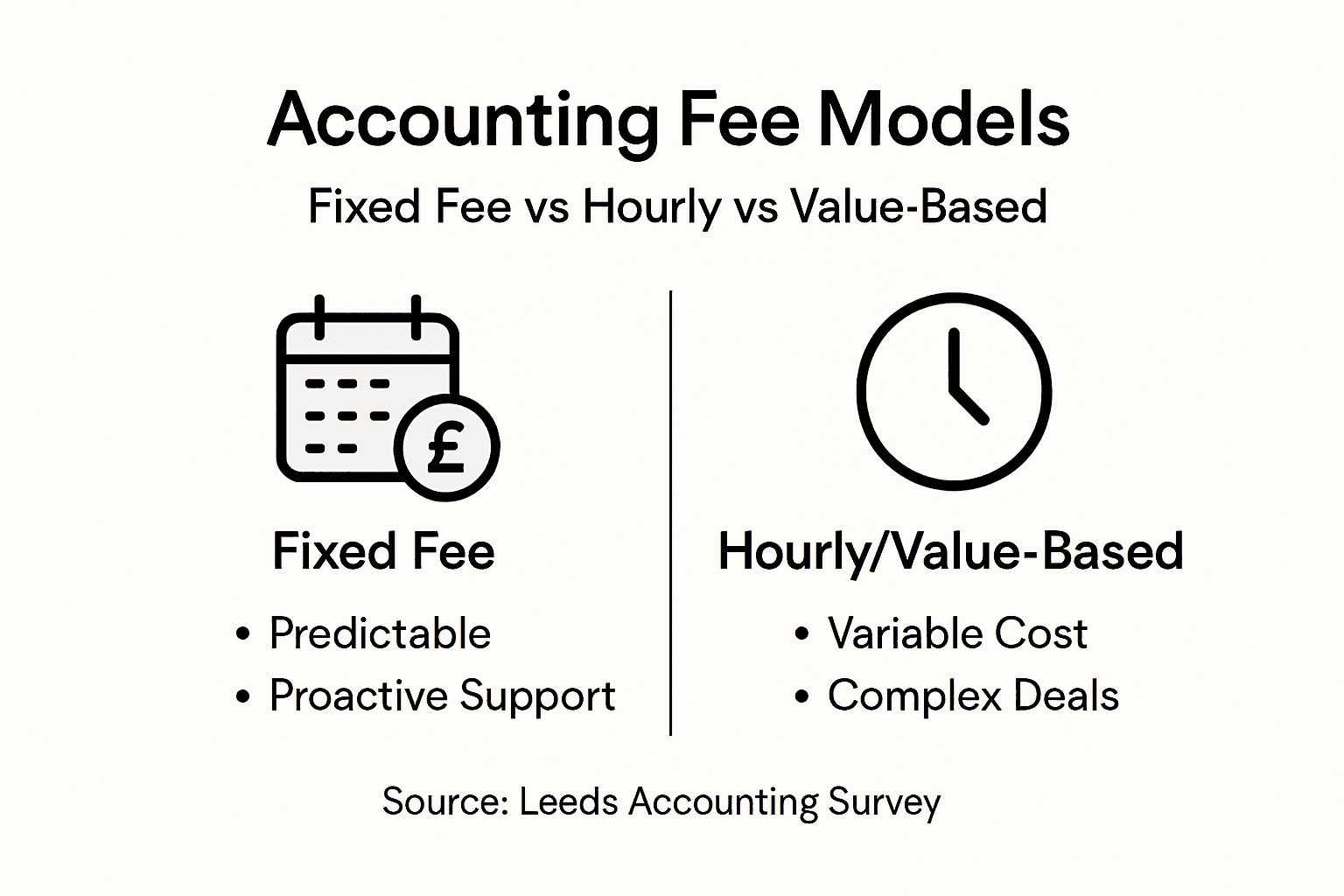
Fixed fee works best when your accounting needs are reasonably predictable. If your business is stable and your annual turnover and transaction volume don’t fluctuate wildly, fixed fee removes all budgeting stress.
Hourly billing might make sense if your needs are genuinely erratic—perhaps you’re a startup with minimal accounting work one month and complex matters the next. But most small business owners find this scenario rare.
Value-based pricing rarely benefits small businesses. It favours accountants over clients and creates unnecessary complexity. You’re better off elsewhere.
For sole traders and small businesses in Leeds and Garforth, fixed fee is almost always the right choice. It provides certainty, encourages better relationships, and eliminates the anxiety of unpredictable bills.
To help you choose the best accounting pricing model, see this comparison of practical considerations:
Consideration | Fixed Fee Model | Hourly Billing |
Upfront Clarity | Full cost agreed early | Total cost unpredictable |
Encourages Consultation | All advice included | Questions raise cost |
Ideal For | Consistency needed | Irregular, one-off tasks |
Risk of Hidden Charges | Very low | High if work overruns |
Pro tip: When comparing fixed fee quotes from different accountants, ensure you’re comparing identical service scopes—one firm’s comprehensive package might cost more than another’s basic offering, so read the detail carefully before deciding.
Take Control of Your Accounting Costs with Concorde Company Solutions
Managing unpredictable accounting fees can disrupt your business planning and increase stress. If you are a sole trader or small business owner in Leeds or Garforth struggling with fluctuating expenses and uncertain billing, fixed fee accounting offers a clear solution. By paying a flat, transparent rate for essential services such as statutory accounts, tax returns, payroll management, and bookkeeping, you gain financial certainty and free yourself from the worry of surprise invoices.

Choose Concorde Company Solutions for personalised, fixed fee accounting support tailored to your business needs. Our dedicated team prioritises transparent pricing and responsive communication to ensure you never hesitate to ask questions or seek advice. Take the next step towards predictable costs and expert financial management by visiting our main website. Discover how our comprehensive services for small businesses and sole traders can streamline your compliance and empower your financial decisions today.
Frequently Asked Questions
What is fixed fee accounting?
Fixed fee accounting is a pricing model where you pay a flat rate for specific accounting services, providing predictable and transparent costs without unexpected charges.
How does fixed fee accounting benefit budgeting for small businesses?
Fixed fee accounting allows small businesses to budget effectively by providing a clear understanding of monthly or annual accounting costs, eliminating uncertainty associated with hourly billing.
What services are typically included in a fixed fee accounting package?
Common services included in a fixed fee package often cover bookkeeping, statutory accounts preparation, tax returns, VAT management, and payroll services, ensuring comprehensive compliance.
Is fixed fee accounting suitable for all types of businesses?
While fixed fee accounting works best for businesses with stable and predictable accounting needs, it can be tailored to various structures, including sole traders and limited companies, accommodating their specific requirements.
Recommended
Comments