
Why Update Accounting Software for UK SMEs in 2026
- Richard Ellis
- Feb 17
- 7 min read

Managing the finances of a small business in Garforth or Leeds often means juggling endless paperwork and staying alert to new compliance rules. As UK accounting standards evolve, business owners face rising pressure to keep their records accurate and up-to-date. Modern accounting software now needs to deliver real-time data processing and full compliance with Make Tax Digital and the changing UK GAAP. Discover how the right choice today could simplify both your daily operations and long-term financial health.
Table of Contents
Key Takeaways
Point | Details |
Adoption of Modern Accounting Software | UK SMEs should prioritise updated accounting solutions to meet regulatory demands and enhance financial insights. |
Compliance with Making Tax Digital | Ensuring compliance with MTD regulations is crucial for all UK businesses starting from April 2026. |
Cloud Accounting Benefits | Embracing cloud technologies can significantly improve operational efficiency and collaboration for SMEs. |
Risks of Outdated Systems | Legacy accounting systems expose companies to compliance failures, operational inefficiencies, and cybersecurity threats. |
Defining Updated Accounting Software Today
Modern accounting software for UK small and medium enterprises (SMEs) in 2026 represents far more than a digital ledger. It’s a sophisticated financial management ecosystem designed to meet increasingly complex regulatory demands and provide real-time business insights. UK accounting standards are undergoing significant transformations that require software to be adaptive, intelligent, and compliant.
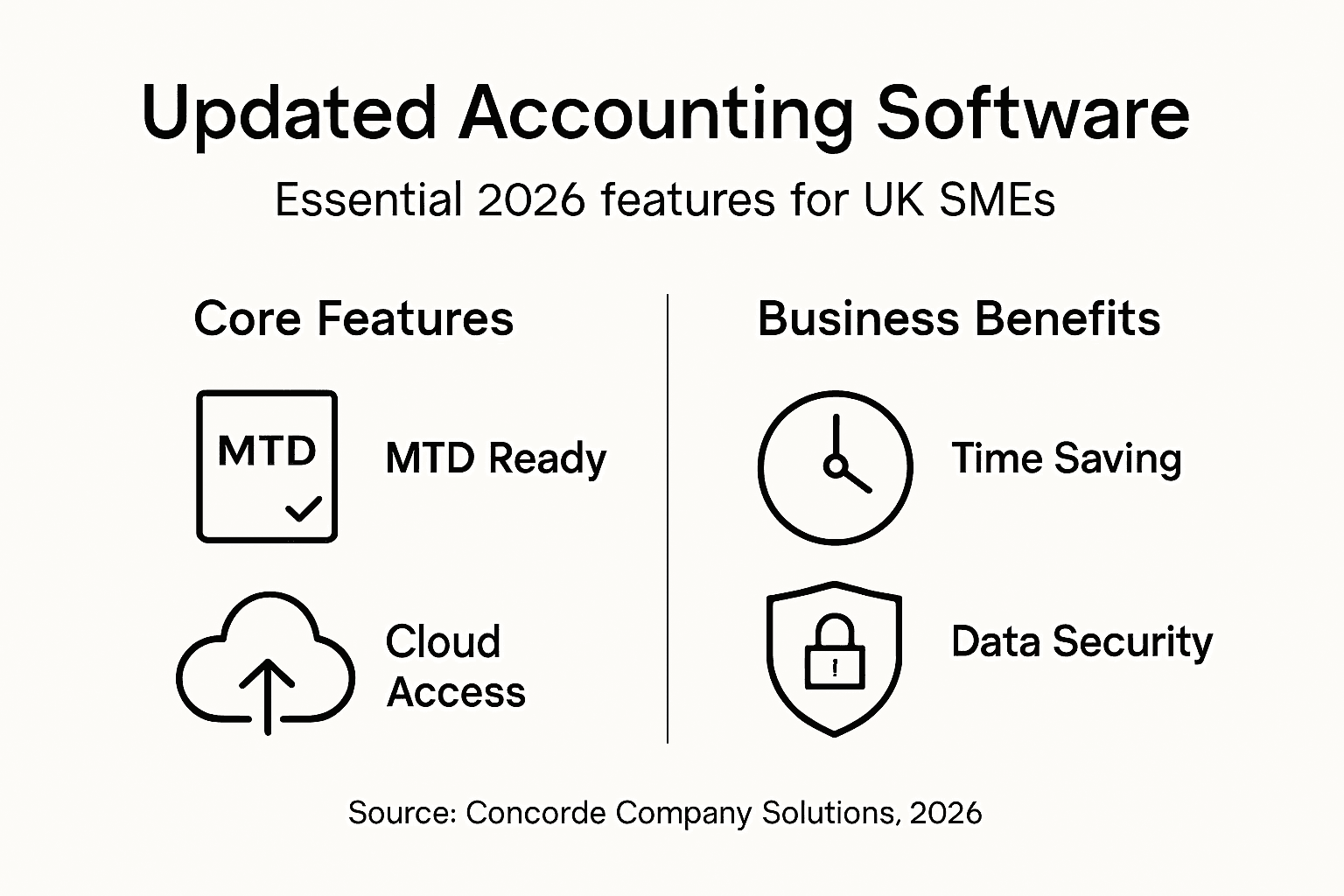
The key characteristics of updated accounting software today include several critical features:
Real-time data processing enabling instantaneous financial reporting
Seamless integration with tax compliance workflows
Advanced revenue recognition capabilities
Comprehensive lease accounting support
Cloud-based accessibility for remote financial management
Automated compliance with UK GAAP and IFRS standards
These technological advancements reflect the evolving needs of UK businesses. Accounting software in 2026 must handle complex regulatory requirements while providing actionable financial intelligence. Modern solutions go beyond traditional bookkeeping, transforming into strategic business tools that help SMEs make informed decisions.
Companies must now view accounting software not as an optional expense, but as a critical infrastructure for financial management. The right software can streamline operations, reduce compliance risks, and provide unprecedented visibility into financial performance.
Pro tip: Conduct a comprehensive software audit annually to ensure your accounting technology remains aligned with the latest regulatory standards and business requirements.
Types of Software and Key Features
Accounting software for UK small and medium enterprises (SMEs) has evolved dramatically, offering a range of solutions tailored to different business needs. Accounting platforms now provide comprehensive functionality that extends far beyond traditional bookkeeping, transforming financial management into a strategic business tool.
The primary types of accounting software available in 2026 include:
Cloud-based systems
Multi-user accessibility
Real-time data synchronisation
Mobile app integration
Desktop solutions
Localised data storage
Enhanced security controls
One-time purchase options
Hybrid platforms
Flexible deployment
Combination of cloud and local storage
Customisable infrastructure
Key features that UK SMEs should prioritise in their accounting software selection include:
Making Tax Digital (MTD) compliance
Automated VAT reporting
Bank reconciliation capabilities
Integrated payroll management
Advanced invoicing tools
Expense tracking functionality
Accounting software selection requires careful consideration of specific business requirements, scalability, and long-term strategic alignment. The right platform can dramatically streamline financial processes, reduce manual errors, and provide actionable insights that drive business growth.

To help distinguish the main software options, here is a comparison of accounting software types and their practical suitability:
Software Type | Best For | Key Advantage | Long-term Consideration |
Cloud-based | Growing, mobile SMEs | Access from any location | Automatic updates and scaling |
Desktop | Security-focused firms | Local data control | Manual updates often required |
Hybrid | Customised operations | Combines online and local benefits | Flexible, needs IT oversight |
Modern accounting solutions are no longer just record-keeping tools. They represent intelligent financial ecosystems that enable SMEs to make data-driven decisions, maintain regulatory compliance, and optimise their financial operations.
Pro tip: Schedule quarterly reviews of your accounting software’s performance and features to ensure continued alignment with your evolving business needs.
Making Tax Digital and Legal Compliance
The UK’s tax landscape is undergoing a significant digital transformation, with Making Tax Digital (MTD) representing a crucial regulatory shift for small and medium enterprises. Digital tax submission requirements mandate specific compliance standards that fundamentally change how businesses manage their financial reporting.
Key MTD compliance requirements for UK businesses include:
Mandatory digital record-keeping
Quarterly tax information submissions
Use of HMRC-approved software
Digital tax return filing
Automated data tracking
Real-time financial reporting
MTD regulations will impact sole traders and landlords with specific income thresholds, requiring them to adopt digital accounting practices. The implementation timeline is critical, with full enforcement expected from April 2026. Businesses must proactively prepare by:
Evaluating current accounting systems
Identifying MTD-compatible software
Training staff on new digital reporting processes
Ensuring data integrity and security
Implementing seamless digital record-keeping
The primary objective of Making Tax Digital is to reduce errors, improve tax accuracy, and create a more transparent financial ecosystem for UK businesses. By mandating digital tools and processes, HMRC aims to streamline tax administration and provide businesses with more sophisticated financial management capabilities.
Pro tip: Conduct a comprehensive software compatibility audit at least six months before the April 2026 deadline to ensure smooth MTD transition.
Efficiency, Integration, and Cloud Benefits
Cloud accounting technologies are revolutionising financial management for UK small and medium enterprises, offering unprecedented operational advantages. Cloud accounting adoption transforms business efficiency by providing flexible, intelligent solutions that streamline complex financial processes.
Key efficiency benefits of cloud accounting include:
Anywhere-accessibility
Work from multiple locations
Real-time data synchronisation
24/7 financial information access
Automated workflows
Reduced manual data entry
Automatic reconciliation
Error minimisation
Seamless integration
Connected business ecosystems
Multi-tool compatibility
Centralised financial management
The technological advantages extend far beyond simple record-keeping. Modern cloud platforms enable businesses to:
Collaborate in real-time
Generate instant financial reports
Implement robust security protocols
Scale technological infrastructure effortlessly
Reduce operational technology costs
By embracing cloud-based accounting solutions, UK SMEs can transform their financial management from a reactive administrative task to a strategic business intelligence function. These platforms provide actionable insights, improve decision-making capabilities, and create a more agile business environment.
Pro tip: Conduct a comprehensive cost-benefit analysis of cloud accounting solutions, focusing on integration capabilities and long-term scalability.
Financial Risks of Outdated Systems
Outdated accounting systems represent a critical threat to UK small and medium enterprises, exposing businesses to multifaceted financial and operational vulnerabilities. Accounting system risks extend far beyond simple technological limitations and can potentially compromise an entire organisation’s financial integrity.
The primary financial risks associated with legacy accounting systems include:
Compliance Failures
Breach of new accounting regulations
Potential significant financial penalties
Non-compliance with Making Tax Digital mandates
Operational Vulnerabilities
Increased manual error rates
Delayed financial reporting
Inefficient workflow management
Cybersecurity Threats
Outdated security protocols
Higher vulnerability to data breaches
Increased ransomware risks
Cybersecurity risks in unsupported software can create substantial financial exposure. Businesses might encounter unexpected challenges such as:
Emergency technology replacement costs
Potential legal liabilities from data breaches
Reputation damage from security incidents
Loss of customer trust
Potential business interruption
UK SMEs must recognise that their accounting software is not merely a technological tool but a critical financial infrastructure that directly impacts operational resilience, regulatory compliance, and strategic decision-making. Investing in modern, secure, and adaptable accounting systems is no longer optional but a fundamental business necessity.
The following table summarises the main risks of outdated accounting systems and their business consequences:
Risk Category | Business Impact | Typical Outcome |
Compliance Failures | Regulatory penalties and investigations | Increased costs, potential fines |
Operational Issues | Slower processing, more errors | Inefficient and delayed reporting |
Cybersecurity Threats | Data breaches, ransomware exposure | Loss of trust, possible lawsuits |
Pro tip: Schedule a comprehensive technology audit annually to identify potential system vulnerabilities and ensure ongoing compliance with evolving regulatory standards.
Choosing and Implementing the Right Update
Selecting the appropriate accounting software represents a critical strategic decision for UK small and medium enterprises in 2026. Successful software implementation requires comprehensive planning that goes beyond simple technological considerations, encompassing organisational culture, workflow transformation, and long-term business objectives.
Critical factors to consider during software selection include:
Compliance Requirements
HMRC recognition
Making Tax Digital compatibility
Automated VAT reporting
Functional Capabilities
Bank integration
Payroll management
Multi-user accessibility
Technical Considerations
Cloud vs desktop options
Scalability potential
Security infrastructure
Accounting software selection involves multiple strategic steps that businesses must methodically navigate:
Conduct comprehensive needs assessment
Research HMRC-approved platforms
Evaluate integration capabilities
Schedule detailed vendor demonstrations
Plan phased implementation strategy
Implementation success hinges on thorough staff training, careful data migration, and gradual system rollout. Companies must view this process as a strategic transformation rather than a mere technological upgrade, ensuring that new systems align with broader organisational goals and enhance operational efficiency.
Pro tip: Involve key finance team members throughout the software selection process to ensure user-centric implementation and maximise system adoption.
Secure Your Financial Future with Expert Accounting Support
Updating your accounting software to meet the latest 2026 standards is not just a technical upgrade but a vital step to avoid compliance risks, costly errors, and data security threats. Concorde Company Solutions understands the challenges UK SMEs face with Making Tax Digital requirements and complex regulatory changes. Our team offers personalised support to help you select and implement the ideal accounting software that ensures full HMRC compliance and streamlines your financial operations.

Don’t risk penalties or operational setbacks because of outdated systems. Visit Concorde Company Solutions now to discover how our expert bookkeeping, payroll management, and software setup services can transform your business. Act today to secure tailored solutions that keep your accounts accurate, compliant, and strategically aligned with your growth objectives.
Frequently Asked Questions
Why is it essential to update accounting software for SMEs in 2026?
Updating accounting software is crucial for SMEs to comply with evolving regulatory requirements, such as Making Tax Digital, and to leverage advanced features for real-time financial insights and improved operational efficiency.
What are the key features to look for in accounting software for SMEs in 2026?
Key features include real-time data processing, compliance with UK GAAP and IFRS standards, MTD compatibility, advanced invoicing tools, automated VAT reporting, and cloud-based accessibility for flexible financial management.
How does cloud accounting differ from desktop solutions for SMEs?
Cloud accounting offers benefits such as multi-user accessibility, real-time data synchronisation, and automatic updates, while desktop solutions allow localised data storage and enhanced security controls, often requiring manual updates.
What are the risks associated with using outdated accounting systems?
Using outdated accounting systems exposes SMEs to compliance failures, operational inefficiencies, and increased cybersecurity threats, which can lead to significant financial penalties, delayed reporting, and potential data breaches.
Recommended


Comments