
Self Assessment Tax Explained: What Small Businesses Must Know
- Richard Ellis
- Feb 20
- 21 min read


Sorting out your taxes can feel like an extra job when running a business in Garforth, especially if part of your income isn’t taxed automatically. Understanding Self Assessment tax requirements matters because missing a step or deadline could cost you with penalties or extra charges. Here, you’ll discover what counts as untaxed income, who needs to file, and how record-keeping can protect your business from costly mistakes and keep you on the right side of HM Revenue and Customs.
Table of Contents
Key Takeaways
Point | Details |
Self Assessment Responsibility | Business owners must register for Self Assessment and calculate their own tax liabilities, as income is often untaxed at source. |
Filing Deadline Importance | The deadline for submitting the tax return is 31 January; late submissions incur automatic penalties. |
Record-Keeping Necessity | Maintaining accurate records is crucial for justifying claims and defending against HMRC queries. |
Upcoming Digital Changes | From April 2026, digital record-keeping and quarterly updates will be required, impacting how taxes are reported. |
What Is Self Assessment Tax UK?
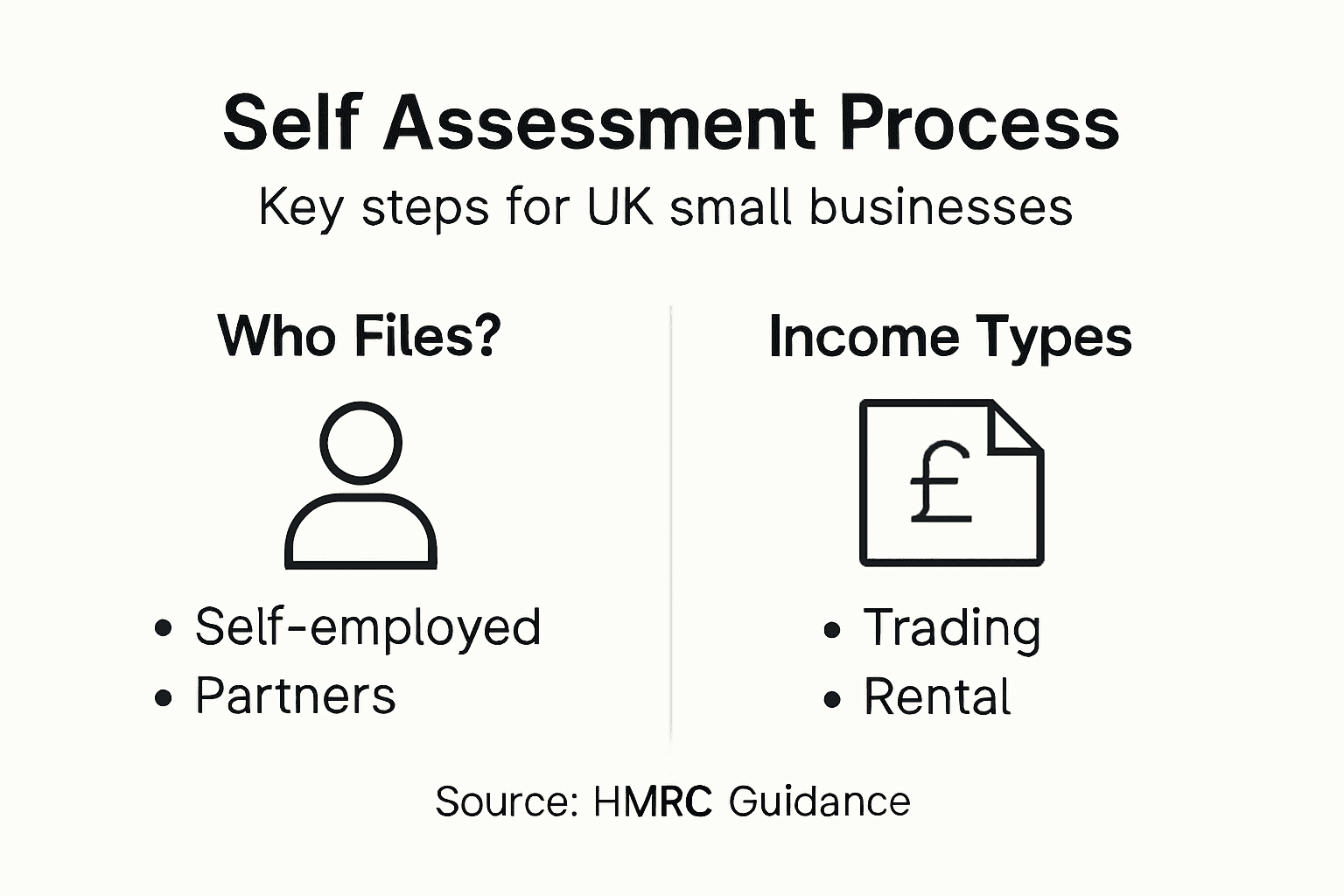
Self Assessment is the system that HMRC uses to collect Income Tax from individuals and businesses whose income isn’t automatically taxed through PAYE (Pay As You Earn). If you’re self-employed, run a limited company, own rental property, or have other untaxed income sources, you’ll almost certainly need to file a Self Assessment tax return. It’s essentially your formal declaration to HMRC of how much you’ve earned and what tax you owe for that year.
For business owners like yourself, Self Assessment means you’re responsible for calculating your own tax liability rather than relying on your employer or an automated system to do it for you. This applies to sole traders, partnerships, and directors of limited companies (though limited company directors also file corporate tax returns separately). The system is designed to be straightforward on paper, but the devil lives in the details—especially when it comes to what you can and cannot claim as business expenses.
How Self Assessment Works
HMRC requires you to register for Self Assessment and submit a tax return each year, typically by 31 January following the end of the tax year (which runs from 6 April to 5 April). The process follows a clear pattern:
You report all your business income for the financial year
You deduct allowable business expenses and reliefs
HMRC calculates your tax liability based on your return
You pay any tax owed, often in two instalments if you’ve filed online
You can file your return online through HMRC’s Self Assessment online service, or by paper form if you absolutely must, though HMRC strongly prefers digital submissions. Filing online gives you immediate feedback and is far less prone to errors than paper forms. The deadline isn’t flexible—file after 31 January and you’ll face automatic penalties, regardless of your reasons.
Where many small business owners trip up is with the concept of “income not taxed at source.” This is the key phrase that determines whether you need Self Assessment. If you’re self-employed, your income arrives without any tax deducted. If you’re a landlord renting out property, the rental income isn’t automatically taxed. These untaxed income streams create your Self Assessment obligation.
Self Assessment requires you to report income by 31 January each year, or face automatic penalties—there are no exceptions for being busy or disorganised.
Why This Matters for Your Business
Getting Self Assessment wrong doesn’t just mean paying more tax than necessary. It opens you to penalties for late filing, interest charges on unpaid tax, and in serious cases, investigation by HMRC. Small business owners who underestimate their obligations often find themselves facing cumulative penalties that turn what should have been a straightforward tax bill into a financial problem.
The filing deadline also affects your cash flow planning. You need to set aside funds to pay your tax bill by the due date, which usually arrives just months after your year-end. Many businesses use the gap between their accounting year-end and the tax payment deadline to build up the necessary funds, but failing to budget for this can create serious cash flow issues.
Understanding Self Assessment also helps you make better business decisions throughout the year. Knowing which expenses are deductible, how tax bands work, and what records HMRC expects you to keep means you can optimise your tax position legally and avoid costly mistakes. This is why keeping meticulous records—invoices, receipts, bank statements—isn’t just good bookkeeping; it’s essential evidence if HMRC ever asks questions about your return.
Getting the Basics Right
You must register for Self Assessment if you’re self-employed and earning more than the National Insurance threshold (currently around £12,570 per year, though this changes annually). Even if you’re earning less, you might still need to register if you have other taxable income. HMRC will usually contact you about this, but it’s your responsibility to ensure you’re registered correctly.
Once registered, you’ll receive a Self Assessment tax return, either by post or online, asking you to report your income and expenses. The form itself isn’t complicated—it’s a straightforward declaration. The complexity comes from knowing which figures to include and how to support them with evidence.
Most small business owners benefit from working with an accountant to navigate Self Assessment properly. An accountant ensures your return is accurate, claims all legitimate expenses and reliefs you’re entitled to, and keeps you on the right side of HMRC’s rules. For Garforth-based businesses, having local support means you get advice tailored to your specific circumstances rather than generic guidance.

Pro tip: Keep a dedicated folder (digital or physical) for all business receipts, invoices, and bank statements throughout the year—don’t wait until January to gather them, as missing records can cost you thousands in missed deductions.
Who Needs to File and Income Types
Not every business owner needs to file a Self Assessment tax return, but the rules are more inclusive than many assume. The key question is whether you have income that isn’t taxed automatically at source. If you’re self-employed, you almost certainly need to file. If you’ve got rental income, dividend payments, or foreign earnings, you’ll need to file. HMRC doesn’t leave much room for grey areas—the rules are fairly clear-cut, but understanding which income types trigger your filing obligation means you won’t accidentally slip into non-compliance.
The threshold that matters most for self-employed traders is simple: you must file if your self-employment earnings exceed £1,000 before expenses in any tax year. This is a relatively low bar, which means most small business owners in Garforth will find themselves submitting a return. Even if you’re earning below this threshold, you might still be required to file if you have other income sources—rental income, dividends from shareholdings, or capital gains from selling assets all push you toward a filing obligation. The complexity increases when you start combining different income types, as each has its own rules and reporting requirements.
Income Types That Require Self Assessment
Your Self Assessment return must capture several distinct income categories, each with its own supplementary pages and calculation methods. Understanding what falls into each category helps you prepare accurate records and claim everything you’re entitled to.
The main income types that trigger Self Assessment filing include:
Self-employment income from running your business as a sole trader or partner
Property rental income from residential or commercial properties you own
Partnership income when you’re a partner in a business partnership
Dividend income from shareholdings in companies
Savings and investment income including interest from bank accounts and bonds
Foreign income such as earnings from overseas work or rental properties abroad
Capital gains when you sell assets like property (excluding your main home), shares, or business equipment at a profit
Other untaxed income including certain pension income, inheritance, or trust distributions
Each of these income streams requires different documentation and calculations. Self-employment income, for instance, requires you to report turnover and deduct allowable business expenses to arrive at your profit figure. Rental income requires a different approach—you’re reporting the rent received and deducting mortgage interest, repairs, and lettings agent fees. Dividend income sits in its own category with specific allowances and tax rates. You must send a tax return if any of these income types apply to you, even if you only have income from one source.
If your self-employment earnings exceed £1,000 before expenses, or you have any untaxed income, you almost certainly need to file a Self Assessment return.
Who’s Caught by the Rules
Beyond the basic thresholds, certain situations automatically trigger a filing requirement regardless of how much you’ve earned. If you needed to pay the High Income Child Benefit Charge (which applies when your household income exceeds £50,000), you must file even if PAYE hasn’t collected the tax. If you had to pay Capital Gains Tax on the sale of an asset, HMRC requires you to declare it through Self Assessment rather than dealing with it separately.
Partners in business partnerships face a filing requirement if the partnership itself had profits above £1,000 (before expenses), regardless of their personal income. This means you can’t avoid filing by claiming your share was small. Directors of limited companies face a different situation—they file both a Self Assessment return (for personal income) and the company files a Corporation Tax return separately, which is why the rules can feel complicated when you’re running a limited company alongside freelance work or rental properties.
The filing deadline doesn’t shift based on these different circumstances. Everyone with a filing obligation must submit by 31 January following the end of the tax year, and the penalties for missing this deadline are automatic—there’s no discretion built in. This creates a hard deadline you cannot ignore, which is why many business owners work backwards from this date to ensure their records are ready in time.
Multiple Income Streams: When It Gets Complex
If you’ve got multiple income sources, your Self Assessment return becomes more involved. You might be self-employed running a plumbing business whilst also owning a rental property and holding shares in a friend’s company. Each income stream requires separate reporting, and the tax you owe is calculated on your total income from all sources combined. This is where tax bands and allowances become important, as you might find one income stream is taxed at a higher rate because your total income pushes you into a higher tax bracket.
Most small business owners with multiple income streams benefit from working with an accountant. Not only does this ensure accuracy, but an accountant can spot tax planning opportunities—perhaps restructuring how you extract profits from your business, or timing capital gains strategically across tax years. This kind of strategic advice is worth far more than the accountancy fees you’ll pay.
Pro tip: List all your income sources before the tax year ends, so you know what documents you’ll need to gather when it’s time to file your Self Assessment return.
How the Self Assessment Process Works
The Self Assessment process isn’t a single event that happens in January—it’s a year-long cycle that starts with record-keeping and ends with payment. Understanding the sequence of steps, the deadlines involved, and what you need to have ready at each stage removes much of the anxiety around tax returns. Most business owners find the process straightforward once they’ve done it once and established a routine.
The cycle begins on 6 April each year, the start of the UK tax year, and continues until 5 April the following year. Throughout this twelve-month period, you’re responsible for keeping accurate records of all your income and business expenses. This isn’t a formality—HMRC can request evidence for any figures you claim on your return, and without proper documentation, you’ll struggle to defend yourself if questioned. Once the tax year ends on 5 April, you have until 31 January of the next calendar year to submit your completed return and pay any tax owed. That’s roughly ten months to gather information, complete the return, and settle your bill. Most business owners compress this into a few weeks, which is why starting early makes the process far less stressful.
The Step-by-Step Process
The actual filing process follows a predictable sequence, whether you’re filing online or by paper. You’ll need to gather income and expense information from your records, complete the main tax return form (SA100), and include any supplementary pages relevant to your income types.
Here’s how the process unfolds:
Receive your tax return notice - HMRC sends you a notice to file, either by post or through your online account, typically in April after the tax year ends
Gather your records - Collect invoices, receipts, bank statements, and expense documentation for the entire tax year
Calculate your income and expenses - Work out your profit or loss for each income source
Complete the SA100 form - Fill in your personal details and the summary of your income
Add supplementary pages - Include specific pages for self-employment, property, partnerships, or other income types as needed
File online or by post - Submit your return through HMRC’s online service or by posting the paper form
Receive your tax calculation - HMRC calculates your tax liability and notifies you of the amount due
Pay by the deadline - Settle your tax bill by 31 January to avoid penalties
Online filing offers distinct advantages over paper returns. You can save your progress mid-way through and return to it later, you’ll get immediate feedback if information is missing or incorrect, and you can amend your return up to twelve months after submission if you spot errors. Paper returns require posting to HMRC’s address and offer no opportunity to check for errors before submission arrives. HMRC strongly encourages online filing, and the online platform is straightforward enough that many business owners complete their own returns without help.
Here’s a quick comparison of online versus paper Self Assessment tax returns:
Aspect | Online Submission | Paper Submission |
Error Checking | Instant feedback on mistakes | No automatic checks; manual review |
Amendment Window | Can amend up to 12 months later | Amendments require postal submission |
Deadline | 31 January | 31 October (earlier deadline) |
User Experience | Save progress, guided prompts | Manual form completion, less guidance |
HMRC Preference | Strongly encouraged | Accepted only if necessary |
Record-Keeping: The Foundation of Everything
You cannot file an accurate Self Assessment return without proper records, and you cannot defend your figures if HMRC questions them without evidence. Record-keeping isn’t optional—it’s a legal requirement, and HMRC expects you to maintain receipts and documentation for at least six years.
The records you need to keep include:
All invoices issued to clients or customers
Receipts for business expenses (supplies, equipment, services)
Bank statements showing income and outgoings
Payroll records if you employ staff
VAT records if you’re VAT registered
Asset purchase and disposal records
Documentation supporting any claim or deduction you make
Most Garforth business owners find that using accounting software makes record-keeping automatic rather than laborious. Instead of manually tracking expenses and invoices, software logs everything as transactions happen, calculates running totals, and generates the figures you need for your return. This approach also reduces the risk of error—software won’t accidentally duplicate entries or misclassify expenses the way manual spreadsheets might.
Proper record-keeping throughout the year transforms your Self Assessment return from a stressful scramble in January into a straightforward reporting exercise.
After You File
Submitting your return isn’t the end of your obligations. Once filed, HMRC processes your return and calculates your tax liability. If you’ve overpaid tax during the year (perhaps through incorrect PAYE deductions), you’ll receive a refund. If you’ve underpaid, a bill arrives showing the amount due and the payment deadline.
You have twelve months from the filing deadline to amend your return if you discover errors or missed information. This is a safety net, but it’s not an excuse to file incomplete returns hastily. File accurately from the start, and you’ll avoid the stress of corrections later. Some business owners also need to make payments on account—these are advance payments for the following year’s tax, paid in two instalments. The system tries to smooth out large tax bills across the year, rather than leaving you with one massive payment in January.
If you can’t pay your full tax bill by the deadline, contact HMRC to discuss a payment plan before the deadline passes. Ignoring the bill only triggers automatic penalties and interest, making your debt worse. HMRC is usually willing to work with taxpayers who communicate honestly about cash flow difficulties.
Pro tip: Set up a separate business bank account and use accounting software from the start of the tax year, so by December you’ll have all your figures ready to hand to your accountant without scrambling for missing receipts.
Digital Changes and 2026 Requirements
Self Assessment is about to change significantly. From April 2026, the tax system is shifting from the familiar annual return model to something called Making Tax Digital for Income Tax (MTD for ITSA). This isn’t a minor update—it’s a fundamental redesign of how self-employed traders and landlords report their income to HMRC. If your qualifying income exceeds £50,000, you’ll be caught by the first wave of this change, which means you need to start preparing now rather than waiting until 2026 arrives. Even if you’re below this threshold, the rules are expanding progressively, so understanding what’s coming helps you plan ahead.
The core principle behind this change is straightforward: spread your tax reporting throughout the year rather than cramming everything into a single return in January. Instead of one annual submission, you’ll be required to maintain digital records and submit quarterly updates to HMRC. This approach should reduce errors (fewer figures to remember, more time to organise information) and smooth out the workload. HMRC argues this modernises tax administration and makes it easier for businesses to stay compliant rather than facing a massive year-end scramble. For your business, this means adopting new software, learning new processes, and fundamentally changing when and how you interact with the tax system.
What MTD for Income Tax Means for You
Making Tax Digital for Income Tax will be introduced in phases, starting with sole traders and landlords earning over £50,000 in April 2026. The threshold drops to £30,000 in 2027 and £20,000 in 2028, meaning eventually most small business owners will be affected. You cannot opt out—if you meet the income threshold, compliance is mandatory.
The key changes you’ll need to implement include:
Digital record-keeping - You must use MTD-compatible software to maintain your records throughout the year
Quarterly updates - Submit information summaries to HMRC every quarter instead of one annual return
Real-time data - Your software must connect directly to HMRC’s systems to submit data
End-of-year finalisation - Complete a final submission after the tax year ends, confirming all quarterly information
No paper returns - Paper returns will no longer be accepted for MTD taxpayers
This structure fundamentally changes the rhythm of your tax year. Rather than working frantically in January to pull together twelve months of information, you’ll be reporting regularly throughout the year. This means staying on top of your records continuously, but it also means catching errors or missing information sooner rather than discovering problems when submitting your final return.
Making Tax Digital launches in April 2026 with a £50,000 income threshold—if you’re above this, start preparing your digital systems now.
Getting Ready Before 2026
You don’t need to wait until 2026 to prepare. The earlier you start, the smoother the transition will be when the new rules launch. Begin by auditing your current record-keeping systems. If you’re still using spreadsheets and paper receipts, you’re not ready for MTD. You’ll need accounting software that’s been approved by HMRC as MTD-compatible, which can connect directly to HMRC’s systems and produce the quarterly summaries they’ll require.
Many Garforth business owners find this transition easier when working with an accountant from the start. An accountant can recommend compatible software, set up your accounts in the right format for MTD reporting, and guide you through the process of submitting quarterly summaries. They’ll also help you understand how MTD affects your specific business structure and ensure you’re not accidentally exposed to penalties by misunderstanding the rules.
The software you choose matters. MTD-compatible software must be approved by HMRC and capable of submitting data directly to their systems. Not all accounting packages are yet fully approved for MTD submission, though most major providers are building this functionality. Before purchasing or switching software, verify that it’s MTD-approved and that the supplier offers adequate support for quarterly submissions.
Another crucial step is planning your quarterly reporting schedule. You’ll need to agree with HMRC when your quarterly updates are due—typically quarterly, but potentially on a different schedule depending on your business circumstances. Build this reporting schedule into your business calendar now, so it becomes routine rather than a surprise administrative burden when 2026 arrives.
The Phased Rollout and What It Means
The government isn’t switching everyone to MTD simultaneously. The three-phase approach gives smaller businesses time to adapt:
Below is a summary of Making Tax Digital (MTD) rollout milestones and requirements:
Year | Income Threshold | Affected Users | Key Requirement |
2026 | Over £50,000 | Sole traders, landlords | Mandatory digital record-keeping |
2027 | Over £30,000 | More sole traders, landlords | Quarterly digital tax updates |
2028 | Over £20,000 | Most small business owners | No paper returns allowed |
April 2026 - Sole traders and landlords with qualifying income over £50,000
April 2027 - Threshold drops to £30,000
April 2028 - Threshold drops to £20,000
If you’re currently below the £50,000 threshold, you have until 2027 or 2028 before MTD becomes mandatory. However, HMRC is encouraging early adoption, and some business owners may find it beneficial to switch to MTD systems before the deadline. Early adoption can reveal any teething problems with your software or processes while you still have time to adjust, rather than discovering issues when you’re forced to comply.
Partnerships and limited companies face different rules. Limited companies aren’t included in the initial MTD for Income Tax rollout, though they already file Company Tax Returns through different systems. Partnerships have specific guidance about whether MTD applies, depending on how they’re structured. If you operate through a partnership or limited company structure, check your specific position with HMRC or your accountant, as the rules differ from sole traders.
Planning Your Transition
Start your preparation now by identifying which software you’ll use. Download the list of MTD-approved software providers from HMRC and evaluate options based on your business needs, budget, and technical comfort. Set up your accounts in the new system before April 2026 arrives—don’t wait until the new tax year to learn the software.
If you employ an accountant, discuss the transition with them. They’ll help ensure your records are set up correctly for MTD reporting and can advise on the best quarterly reporting schedule for your business. Having professional support through this change reduces stress and ensures you’re compliant from day one.
Finally, understand the penalties for non-compliance. HMRC takes MTD seriously and has significant penalties for late or incorrect quarterly submissions. The best way to avoid penalties is staying organised throughout the year, submitting your quarterly summaries on time, and keeping digital records that back up everything you submit.
Pro tip: Start evaluating MTD-approved software now and run both your current system and the new MTD system in parallel for a few months before April 2026, so you understand the process and can resolve any problems before your first mandatory submission.
Common Mistakes and Compliance Risks
Most Self Assessment problems don’t stem from complex tax rules—they come from straightforward mistakes that could have been avoided with better planning. The good news is that these errors are predictable and preventable. Understanding the pitfalls that catch other business owners means you can sidestep them entirely. The bad news is that HMRC doesn’t distinguish between honest mistakes and careless oversights when applying penalties. A late filing is a late filing, regardless of your reasons, and incorrect expense claims trigger investigations whether the error was intentional or accidental.
The consequences of getting Self Assessment wrong extend beyond simply paying more tax. Late submissions trigger automatic penalties starting at £100, increasing to £1,000 if the return remains outstanding after three months. Underpaid tax attracts interest charges that compound daily, turning a small error into a meaningful additional cost. HMRC enquiries consume time and stress as you scramble to locate documentation years after transactions occurred. In serious cases, repeated non-compliance can lead to investigations for tax fraud, which carries criminal penalties and reputational damage. This isn’t scaremongering—it’s the reality facing business owners who treat Self Assessment carelessly.
The Most Common Filing Mistakes
Certain errors appear repeatedly in Self Assessment returns. Understanding why they happen helps you put safeguards in place. Common mistakes in Self Assessment include filing late, underestimating income, failing to keep adequate records, and errors in expense claims. Each of these mistakes carries different consequences, but all are avoidable with proper systems.
The mistakes that cause the most grief include:
Missing the filing deadline - Submitting after 31 January triggers automatic penalties, even by a single day
Incomplete income reporting - Forgetting to include one income source or underreporting figures you can’t fully explain
Incorrect expense deductions - Claiming expenses that aren’t allowable, or failing to support claims with receipts
Missing supplementary pages - Forgetting to include the specific forms required for your income types
Mathematical errors - Simple calculation mistakes that lead to incorrect tax figures
Failing to update HMRC - Not informing HMRC of changes to your circumstances, business structure, or contact details
Not keeping records - Being unable to produce evidence when HMRC asks questions about your return
The filing deadline is non-negotiable. HMRC applies penalties automatically—you don’t get a warning or grace period. File on 30 January and you’re fine. File on 1 February and you’ve incurred a £100 penalty, regardless of circumstances. This is why so many accountants insist on deadlines weeks before the actual HMRC deadline—it builds a safety buffer into the process.
Late filing triggers automatic penalties that HMRC applies without discretion or exceptions. There are no excuses that exempt you from this consequence.
Income Underreporting and Documentation Gaps
Underestimating income is surprisingly common. Business owners sometimes forget about small income streams—occasional freelance work, cash payments from customers, or dividend income from shareholdings they don’t think about regularly. Each of these needs declaring, even if the amounts seem trivial. HMRC matches income information from third parties (clients, employers, banks) against your return, so undeclared income often gets detected, triggering penalties on top of the unpaid tax.
The documentation problem runs deeper than most business owners realise. You might remember earning £50,000 last year, but can you prove it? If HMRC questions your figures, you need evidence—invoices, bank statements, contracts, payment confirmations. Without this documentation, you cannot defend your return. HMRC doesn’t accept “I’m pretty sure” or “My accountant said so.” They want original records showing transactions occurred. Many business owners discover they lack adequate records only when facing an HMRC enquiry, at which point it’s too late to go back and find evidence from years earlier.
Expense claims present a particular minefield. Claiming expenses you’re not entitled to is a compliance risk that can escalate quickly. Business meal expenses seem deductible, but HMRC has strict rules about what qualifies. Entertainment expenses for clients are generally not allowable. Personal expenses disguised as business costs trigger enquiries and penalties. The solution is simple: only claim expenses that are genuinely for business purposes, and keep receipts for everything. If you’re uncertain whether something is allowable, ask before claiming it rather than discovering years later that you claimed incorrectly.
Record-Keeping Failures and HMRC Enquiries
HMRC has legal powers to investigate any taxpayer. Smaller businesses are less frequently investigated than larger ones, but investigations do happen. When HMRC selects you for an enquiry, they’ll request documentation supporting the figures on your return. If you cannot produce this documentation, you cannot defend your position. HMRC will estimate what they believe you owe, and you’ll have limited ability to argue otherwise.
Record-keeping failures create vulnerability. Storing receipts in a shoebox, keeping invoices in multiple locations, and maintaining no systematic backup of financial information makes it impossible to respond quickly to HMRC enquiries. You’ll spend weeks searching for documents, may fail to locate key evidence, and will struggle to prove your position. Contrast this with structured digital record-keeping using accounting software—everything is organised, searchable, and easily produced when needed.
The legal requirement is to keep records for at least six years. This means maintaining not just the final figures on your tax return, but all the underlying documentation—invoices, receipts, bank statements, payroll records, contracts. Paper records deteriorate and get lost. Digital records with proper backup systems survive indefinitely. If you operate with paper records, you’re relying on luck to keep your documents intact across six years.
Responding to HMRC Communications
When HMRC contacts you about your return, the instinct to ignore the letter is understandable but dangerous. Every communication from HMRC includes a deadline for your response. Missing this deadline escalates the situation—HMRC will make decisions about your tax based on whatever information they have, which may not be in your favour. Responding promptly and providing the information HMRC requests is your best protection.
If HMRC asks questions about your return, treat this seriously. They may be making routine enquiries, or they may suspect errors or fraud. Either way, responding thoroughly with supporting documentation demonstrates good faith and co-operation. If you don’t understand the enquiry, seek professional advice from an accountant or tax adviser rather than guessing at responses. The cost of professional advice is negligible compared to the cost of responding incorrectly and triggering further investigation.
Pro tip: Create a simple compliance checklist each January: verify all income sources are included, confirm expense claims are documented, ensure supplementary pages are complete, and submit at least a week before the deadline to avoid technical delays.
Take Control of Your Self Assessment with Expert Support
Navigating Self Assessment tax obligations can be overwhelming, especially with complex income streams and looming deadlines. Many small business owners struggle with keeping accurate records, meeting HMRC filing requirements, and preparing for upcoming changes like Making Tax Digital. The pressure of automatic penalties for late submissions and the risk of costly errors make it essential to have dependable guidance tailored to your circumstances.

At Concorde Company Solutions, we specialise in helping businesses in Garforth and beyond master the Self Assessment process. From setting up your bookkeeping systems to ensuring every allowable expense is claimed correctly, our personalised approach helps you stay compliant and avoid unnecessary stress. Don’t wait for penalties or HMRC enquiries to disrupt your business. Reach out today at Concorde Company Solutions and discover how our expert accountants can simplify your Self Assessment tax returns and prepare you for future changes. Get in touch now and secure your financial peace of mind.
Frequently Asked Questions
What is Self Assessment Tax and who needs to file it?
Self Assessment Tax is a system used by HMRC to collect Income Tax from individuals and businesses whose income isn’t automatically taxed. Generally, if you’re self-employed, have rental income, or receive other untaxed income, you will need to file a Self Assessment tax return.
What are the key deadlines for submitting a Self Assessment return?
The deadline for submitting your Self Assessment tax return is 31 January following the end of the tax year, which runs from 6 April to 5 April. Missing this deadline can lead to automatic penalties.
How can I reduce my tax liability or ensure I claim all allowable expenses?
To reduce your tax liability, keep meticulous records of all income and expenses, and consult with an accountant to ensure you’re claiming all allowable business expenses and reliefs you’re entitled to under HMRC rules.
What are the consequences of filing my Self Assessment late or incorrectly?
Filing late results in automatic penalties starting at £100, with more severe consequences for continued delays. Incorrect filings can lead to audits or investigations, potential fines, and added interest on unpaid taxes.
Recommended
Comments