
Role of Payroll Management in UK SMEs Success
- David Rawlinson
- Dec 26, 2025
- 7 min read

Payroll errors cost British small businesses an estimated £700 million annually, putting both reputations and finances at risk. Many Garforth business owners feel the pressure of running accurate payroll while keeping up with ever-changing HMRC rules. Clear and reliable payroll management not only ensures every employee in Leeds gets paid on time, but also keeps your company protected from costly mistakes and legal issues. Discover practical solutions that simplify payroll for local British SMEs.
Table of Contents
Key Takeaways
Point | Details |
Importance of Payroll Management | Payroll management is essential for UK SMEs, ensuring compliance with legal requirements and precise employee compensation. |
In-House vs. Outsourced Solutions | SMEs must evaluate the benefits of in-house payroll for control versus outsourcing for expertise and efficiency. |
Legal Responsibilities | Employers are obligated to adhere to HMRC regulations, including accurate payroll documentation and timely submissions. |
Risks of Payroll Errors | Common payroll mistakes can lead to significant financial penalties and operational disruptions; thus, robust systems and audits are necessary. |
Payroll Management Defined for UK SMEs
Payroll management represents a critical financial function for small and medium-sized enterprises (SMEs) across the United Kingdom, involving comprehensive processes for compensating employees while maintaining strict compliance with legal requirements. At its core, payroll management encompasses calculating wages, processing payments, and managing statutory deductions through the PAYE system.
For UK SMEs, effective payroll management means navigating a complex landscape of regulatory obligations. This includes precise calculation of gross wages, applying correct tax codes, deducting National Insurance contributions, and ensuring timely submission of reports to Her Majesty’s Revenue and Customs (HMRC). The process requires meticulous attention to detail, as errors can result in significant financial penalties and potential legal complications.
The fundamental responsibilities of payroll management for UK SMEs include maintaining accurate employee records, processing monthly or weekly wage payments, generating detailed payslips, calculating and deducting income tax and National Insurance contributions, and submitting regular reports to HMRC. Businesses must also keep comprehensive records of all payroll transactions, ensuring they can provide documentation if requested during an audit or investigation.
Expert Tip: Invest in reliable payroll software or consider professional outsourcing to minimise errors and ensure consistent compliance with rapidly changing HMRC regulations.
Key Processes: From PAYE to Payslips
Payroll management in UK SMEs involves a series of intricate processes that begin with the Pay As You Earn (PAYE) system and culminate in the generation of comprehensive payslips. The PAYE system serves as the primary mechanism for collecting income tax and National Insurance contributions directly from employee wages, ensuring real-time tax processing and compliance with Her Majesty’s Revenue and Customs (HMRC) regulations.
The core processes include precise wage calculation, which requires careful consideration of gross pay, contractual hours, and any additional earnings such as overtime or bonuses. Employers must apply the correct tax codes, calculate statutory deductions including income tax, National Insurance contributions, and potential student loan repayments. These calculations form the foundation of accurate payroll processing, with each step demanding meticulous attention to detail to prevent potential financial discrepancies.
Legislative requirements mandate that employers provide detailed, itemised payslips to all workers, highlighting the critical nature of transparency in payroll management. These documents must comprehensively break down gross pay, net earnings, and all individual deductions. Since April 2019, additional regulations require employers to specify hours worked for workers with variable pay rates, further enhancing the complexity and accountability of the payroll process for UK SMEs.
Expert Tip: Implement a robust digital payroll system that automatically updates with the latest HMRC tax codes and regulations to minimise manual calculation errors and ensure consistent compliance.
In-House Versus Outsourced Payroll Solutions
Small and medium-sized enterprises in the United Kingdom face a critical strategic decision when managing payroll: whether to maintain an in-house payroll system or outsource the function. Each approach presents distinct advantages and challenges that can significantly impact a business’s operational efficiency, financial accuracy, and regulatory compliance.
In-house payroll management offers UK SMEs direct control over sensitive financial processes and employee data. This approach allows for immediate access to payroll information, greater customisation of payment systems, and potentially lower long-term costs. However, it demands substantial internal expertise, continuous staff training, and investment in specialised payroll software to navigate the complex landscape of HMRC regulations and tax code updates.

Conversely, outsourcing payroll to professional services provides access to specialised expertise and can free up valuable internal resources. Professional payroll providers bring comprehensive knowledge of current legislation, reducing compliance risks and minimising the potential for costly errors. The trade-off involves relinquishing some direct control and potentially higher per-transaction costs, though many SMEs find the reduced administrative burden and expert oversight outweigh these considerations.
The following table compares in-house and outsourced payroll management approaches for UK SMEs:
Aspect | In-House Payroll | Outsourced Payroll |
Control | Direct oversight of operations | Relinquished to external provider |
Cost Structure | Higher set-up, lower ongoing | Lower set-up, higher per-transaction |
Compliance Expertise | Internal responsibility | Expert guidance and advice |
Resource Impact | Requires continuous staff input | Frees internal resources |
Data Security | Managed internally | Subject to provider’s protocols |
Expert Tip: Conduct a comprehensive cost-benefit analysis comparing your internal resources, payroll complexity, and potential compliance risks before deciding between in-house and outsourced payroll management.
Legal Essentials: HMRC and Employer Duties
UK small and medium-sized enterprises face a complex landscape of legal obligations when managing payroll, with Her Majesty’s Revenue and Customs (HMRC) establishing stringent requirements for employer responsibilities. These legal essentials form the backbone of compliant payroll management, encompassing a wide range of critical duties that extend far beyond simple wage processing.
Employers must meticulously register for the PAYE system, which serves as the primary mechanism for collecting income tax and National Insurance contributions. This involves precise calculation and timely deduction of taxes from employee wages, alongside mandatory reporting of payroll information to HMRC through regular submissions. The legal framework demands not just financial accuracy, but also comprehensive record-keeping, with businesses required to maintain detailed payroll documentation for a minimum of three years and provide itemised payslips that transparently outline all wage components and deductions.
Beyond financial reporting, HMRC regulations mandate compliance with broader employment standards, including adherence to statutory minimum wage policies, sick pay regulations, and employee rights protections. Non-compliance can result in significant financial penalties, potential legal action, and reputational damage. SMEs must therefore develop robust internal processes that not only meet immediate payroll requirements but also anticipate potential regulatory changes and maintain a proactive approach to compliance management.
Expert Tip: Implement a comprehensive compliance checklist that tracks HMRC reporting deadlines, tax code updates, and legislative changes to ensure continuous payroll regulatory alignment.
Risks, Costs, and Common Payroll Pitfalls
UK small and medium-sized enterprises face a complex array of financial and regulatory risks when managing payroll, with potential consequences that extend far beyond simple administrative errors. Data protection and compliance challenges represent significant potential vulnerabilities that can dramatically impact business operations and financial stability.
Payroll errors manifest in multiple critical dimensions, ranging from computational mistakes to systemic regulatory non-compliance. Common pitfalls include incorrect tax code applications, miscalculated overtime payments, inconsistent record-keeping, and inadequate data security protocols. Such errors can trigger substantial financial penalties, compromise employee trust, and potentially expose businesses to legal challenges that might severely disrupt operational continuity.
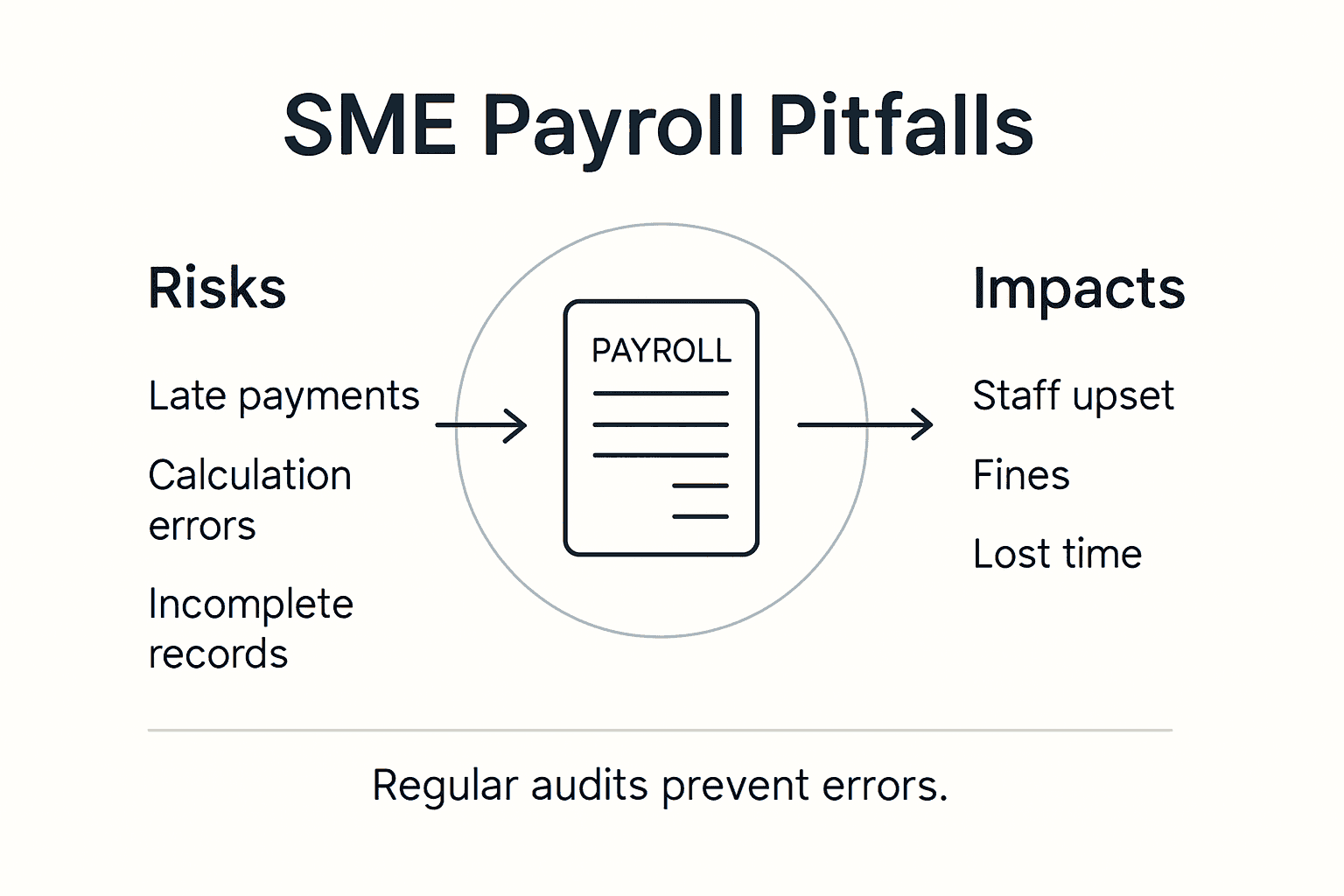
The financial implications of payroll mismanagement are profound. Research indicates that SMEs frequently underestimate the comprehensive costs associated with payroll mistakes, which can include direct monetary penalties, increased administrative burden, potential legal expenses, and long-term reputational damage. Digital technology adoption and robust internal processes emerge as critical strategies for mitigating these risks, enabling more accurate, transparent, and compliant payroll management approaches that protect both employee interests and organisational integrity.
Here is a summary of key payroll errors and their consequences for UK SMEs:
Common Error | Business Impact | Preventive Strategy |
Incorrect tax code usage | Financial penalties | Regular code validation |
Miscalculated overtime | Employee dissatisfaction | Automated calculation tools |
Poor record-keeping | Audit complications | Digital record management |
Data security lapses | Legal and reputational risk | Secure payroll systems |
Expert Tip: Conduct quarterly comprehensive payroll audits and invest in ongoing staff training to proactively identify and mitigate potential compliance and computational risks.
Strengthen Your SME’s Success with Expert Payroll Management
Navigating the complexities of payroll management in UK SMEs can be daunting. Challenges such as complying with HMRC regulations, avoiding costly payroll errors, and choosing between in-house or outsourced solutions often cause stress and uncertainty. This article highlights key pain points like accurate tax code application, detailed payslip requirements, and the risk of compliance penalties that can threaten your business’s financial stability.
At Concorde Company Solutions, we understand these challenges and offer tailored payroll management services designed to ensure accuracy, transparency, and peace of mind. Our expertise helps your business maintain proper PAYE submissions, meet all statutory obligations, and streamline payroll processing to save valuable time and resources. Discover how partnering with a local firm committed to personalised support can protect you from common pitfalls while fostering long-term business growth.
Transform your payroll worries into confidence today with professional payroll management solutions.

Explore how we can support your SME with expert payroll, bookkeeping and compliance services at Concorde Company Solutions. Take the next step by contacting us now for transparent pricing and a customised approach that suits your business needs. Visit our homepage to learn more and secure your SME’s financial success.
Frequently Asked Questions
What is payroll management in SMEs?
Payroll management in SMEs involves the processes of calculating employee wages, processing payments, and managing tax deductions while ensuring compliance with legal requirements.
Why is payroll management important for UK SMEs?
Effective payroll management is crucial for UK SMEs as it ensures timely and accurate employee compensation, compliance with tax regulations, and reduces the risk of financial penalties associated with payroll errors.
Should SMEs handle payroll in-house or outsource it?
Deciding between in-house and outsourced payroll management depends on the business’s internal resources, expertise, and compliance needs. In-house management allows for greater control, while outsourcing offers specialised expertise and reduces administrative burdens.
What are common payroll pitfalls that SMEs should avoid?
Common payroll pitfalls for SMEs include incorrect tax code applications, miscalculating overtime payments, poor record-keeping, and data security lapses, all of which can lead to financial penalties and reputational damage.
Recommended

Comments