
Role of Payroll in Small Business Success
- David Rawlinson
- Jan 4
- 7 min read

For small business owners in Garforth and Leeds, managing british payroll can quickly become a source of stress. The challenge comes from balancing accurate wage calculations with strict regulatory demands while avoiding costly mistakes. Over £700 million in payroll penalties were issued to british businesses last year alone. This guide clarifies the payroll essentials, types of systems available, and compliance rules, helping you lay a solid financial foundation for your business.
Table of Contents
Key Takeaways
Point | Details |
Importance of Compliance | Small businesses must adhere to UK payroll regulations to avoid substantial penalties and legal issues. Accurate reporting to HMRC and maintaining detailed records is essential. |
Payroll System Choices | Selecting the right payroll system, whether manual, software-based, or outsourced, is crucial for efficiency and compliance. Evaluate your business’s size and needs before deciding. |
Common Errors and Risks | Frequent payroll mistakes, such as late submissions or incorrect tax calculations, can lead to significant financial penalties. Implementing robust internal controls is vital to minimise these risks. |
Professional Support | Investing in professional payroll services or software can streamline processes and reduce compliance errors, allowing business owners to focus on core operations. |
Payroll in Small Business Defined
Payroll represents the comprehensive financial process through which small businesses manage employee compensation, ensuring accurate and timely payment while maintaining strict compliance with United Kingdom tax regulations. At its core, payroll involves calculating wages, processing statutory deductions, and submitting essential financial reports to HM Revenue and Customs (HMRC).
The payroll process encompasses multiple critical components for small businesses, including wage calculation, tax withholding, National Insurance contributions, and statutory payment management. Employers must meticulously track employee earnings, apply correct tax codes, and report payments to HMRC through regular Full Payment Submissions (FPS). This systematic approach ensures legal compliance and maintains transparent financial records.
Small business payroll requires understanding several key elements: gross wages, net pay calculations, tax code management, pension contributions, and statutory payment frameworks. Businesses must accurately track hours worked, apply appropriate tax rates, and process deductions for National Insurance, income tax, and potential workplace pension schemes. The complexity of these requirements highlights why many small businesses seek professional payroll support to navigate regulatory landscapes effectively.
Pro tip: Invest in reliable payroll software or consult with professional accountants to streamline your payroll processes and minimise the risk of costly compliance errors.
Types of Payroll Systems and Approaches
Small businesses in the United Kingdom have multiple approaches to managing payroll, ranging from manual processing to sophisticated digital solutions. Each method offers distinct advantages and challenges, requiring careful consideration of the business’s size, complexity, and technological capabilities. Different payroll management strategies can accommodate varying organisational needs, ensuring accurate and compliant employee compensation.
The primary payroll systems include manual record-keeping, computerised software solutions, and professional outsourcing services. Manual systems involve traditional paper-based tracking and calculations, which can be time-consuming and prone to human error. Computerised approaches leverage technology to automate wage calculations, tax deductions, and statutory reporting. These systems range from basic spreadsheet tracking to comprehensive payroll software that integrates direct reporting to HMRC.

Outsourcing represents another sophisticated payroll approach, particularly beneficial for small businesses with limited administrative resources. Professional payroll services handle complex tasks such as tax code management, National Insurance contributions, pension scheme calculations, and regulatory compliance. This method allows business owners to focus on core operational activities while ensuring precise and legally compliant employee payments.
Below is a comparison of common payroll systems for small businesses in the UK:
Payroll Approach | Core Advantages | Main Drawbacks | Ideal For |
Manual Record-Keeping | Low cost, simple setup | High error risk, time-consuming | Very small teams |
Payroll Software | Automated calculations, HMRC integration | Subscription costs, setup required | Growing businesses |
Outsourced Services | Expert support, compliance assurance | Less control, higher ongoing costs | Firms lacking in-house expertise |
Pro tip: Evaluate your business’s complexity and administrative capacity before selecting a payroll system, considering factors like employee numbers, payment frequency, and technological infrastructure.
Key UK Payroll Compliance Requirements
Payroll compliance in the United Kingdom represents a complex landscape of legal obligations that small businesses must carefully navigate. Employers must adhere to stringent reporting requirements established by HM Revenue and Customs (HMRC), which mandate precise documentation and timely submission of employee payment information. These regulations encompass multiple critical aspects of financial reporting and employee compensation management.
The primary compliance requirements include registering as a PAYE employer, maintaining accurate tax code records, calculating correct National Insurance contributions, and submitting Full Payment Submissions (FPS) on or before each payroll cycle. Businesses must provide detailed payslips to employees, track and report statutory payments such as sick pay and parental leave, and ensure all financial calculations align with current tax legislation. The complexity of payroll legislation varies across different UK jurisdictions, requiring businesses to remain adaptable and informed about regional regulatory nuances.
Small businesses must also maintain comprehensive records of all payroll transactions, including gross wages, tax deductions, pension contributions, and any additional benefits. These records must be maintained for a minimum of three years and be readily available for potential HMRC audits. Employers are legally responsible for accurate reporting, with potential financial penalties for non-compliance, incorrect submissions, or late reporting. This emphasises the critical importance of implementing robust payroll systems that can handle complex regulatory requirements while maintaining precise financial documentation.
Pro tip: Invest in professional payroll training or software that automatically updates with the latest HMRC regulatory changes to minimise compliance risks and administrative burdens.
Employer Obligations and Legal Risks
Small businesses must carefully navigate a complex landscape of employer obligations to mitigate potential legal risks associated with payroll management. Employers face significant legal responsibilities when reporting employee payments and deductions to HM Revenue and Customs (HMRC), with potential financial penalties for non-compliance, incorrect submissions, or late reporting.
The legal risks extend beyond mere financial reporting, encompassing broader employment rights and regulatory compliance. Businesses must understand evolving employment legislation, including requirements around employee rights, pay structures, dismissal procedures, and statutory leave entitlements. Failure to comply with these regulations can result in employment tribunal claims, substantial financial penalties, and potential reputational damage that could critically impact a small business’s operational stability.
Key legal obligations include maintaining accurate employee records, protecting personal data under GDPR regulations, ensuring fair wage calculations, and providing transparent payslip information. Employers must also stay current with changing tax codes, National Insurance contribution rates, and statutory payment requirements. This demands a proactive approach to continuous learning and systematic record-keeping, with meticulous attention to detail to prevent inadvertent legal breaches that could compromise the business’s financial and operational integrity.
Pro tip: Establish a regular compliance review process, consulting with professional accountants or legal experts to stay updated on the latest regulatory changes and mitigate potential legal risks.
Cost, Penalties, and Common Mistakes
Payroll management in small businesses involves navigating a complex financial landscape where errors can result in significant monetary consequences. Penalties for payroll mistakes can quickly escalate, with HMRC imposing substantial fines for late submissions, inaccurate reporting, and missed statutory deadlines. These financial penalties can range from fixed amounts to percentage-based charges that compound over time, potentially creating severe financial strain for small businesses.
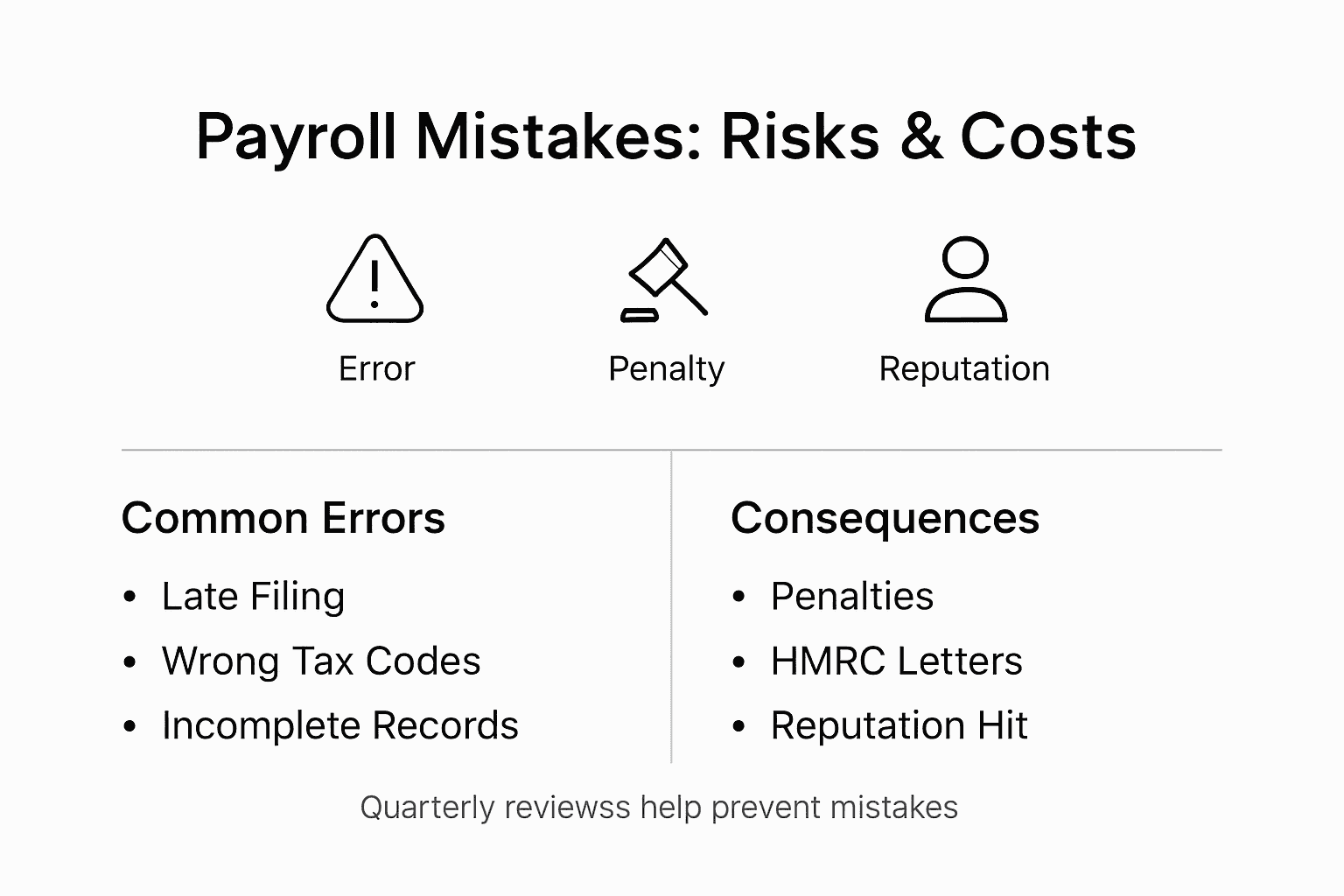
Common payroll errors can trigger significant regulatory penalties, including late or missed Full Payment Submissions (FPS), incorrect tax calculations, and improper National Insurance contribution reporting. Specific mistakes that attract penalties include underpaying taxes, failing to submit accurate employee data, neglecting to update tax codes, and poor record-keeping practices. These errors not only incur direct financial penalties but can also lead to increased administrative costs and potential legal complications.
Here is a summary of frequent payroll errors and their impacts on small UK businesses:
Common Error | Regulatory Impact | Business Consequence |
Late FPS Submission | HMRC financial penalties | Increased running costs |
Incorrect Tax Calculations | PAYE underpayment notices | Staff dissatisfaction |
Outdated Tax Codes | Compliance breach warnings | Legal disputes possible |
Poor Record Keeping | Potential audit investigations | Reputation damage |
The financial risks extend beyond immediate monetary penalties, potentially impacting a business’s reputation and future compliance assessments. Small businesses must implement robust internal controls, invest in ongoing staff training, and consider professional payroll support to mitigate these risks. Proactive error prevention strategies include regular internal audits, staying updated on regulatory changes, maintaining meticulous records, and implementing automated payroll systems that reduce human error and ensure timely, accurate reporting.
Pro tip: Establish a quarterly internal payroll compliance review to catch and correct potential errors before they trigger HMRC penalties, and consider investing in professional payroll training for key staff members.
Simplify Payroll Management for Your Small Business Success
Managing payroll for a small business in the United Kingdom can be overwhelming, especially with strict HMRC compliance requirements, complex tax codes, and the risk of costly penalties. This article highlights the challenges of accurate wage calculations, timely reporting, and staying up to date with evolving legislation. If you are aiming to minimise errors, reduce administrative burdens, and ensure employee payments are handled with expert precision, it is time to get professional support.

Take control of your payroll process today with dedicated assistance from Concorde Company Solutions. We specialise in payroll management tailored for small to medium-sized businesses, helping you navigate legal obligations and avoid common pitfalls. Discover how our personalised services can provide peace of mind and save you time by visiting our Payroll Management solutions. Don’t let compliance complexity stall your growth. Contact us now at Concorde Company Solutions to safeguard your business’s financial success.
Frequently Asked Questions
What is the importance of payroll in small business management?
Payroll is essential for small businesses as it ensures accurate and timely employee compensation, compliance with tax regulations, and effective financial management. Proper payroll processes help in maintaining transparent financial records and reducing the risk of legal issues.
What are the main components of a payroll system for small businesses?
Key components include wage calculation, tax withholding, National Insurance contributions, statutory payments management, and regular reporting to HM Revenue and Customs (HMRC). These elements ensure compliance with financial regulations while managing employee payments accurately.
How can small businesses ensure payroll compliance?
Small businesses can ensure compliance by registering as a PAYE employer, maintaining accurate records, submitting Full Payment Submissions (FPS) punctually, and staying informed about changes in tax codes and statutory obligations. Investing in payroll software or consulting professional accountants can also help.
What are the common payroll mistakes that small businesses should avoid?
Common mistakes include late submissions of Full Payment Submissions (FPS), incorrect tax calculations, outdated tax codes, and poor record-keeping practices. These errors can lead to financial penalties, increased administrative costs, and potential legal complications.
Recommended

Comments