
Payroll Management: Ensuring Compliance for UK Businesses
- David Rawlinson
- Jan 11
- 7 min read

Over 60 percent of British small businesses have faced payroll errors that result in fines or staff disputes. For owners in Garforth, Leeds, the challenge goes far beyond cutting paychecks on time. Getting payroll right safeguards your reputation and protects your business from costly HMRC penalties. Learn how modern payroll management tailored for British regulations can simplify compliance, reduce risk, and keep your employees paid accurately every time.
Table of Contents
Key Takeaways
Point | Details |
Effective Payroll Management | Critical for compliance and involves precise wage calculations, tax deductions, and adherence to HMRC regulations. |
In-house vs Outsourced Payroll | Weigh the benefits of direct control with in-house systems against the expertise and lower administration load of outsourced services. |
Legal Obligations | Employers must register with HMRC and comply with PAYE systems, ensuring timely submissions and accurate reporting to avoid penalties. |
Risk Mitigation | Implement regular audits and invest in training to manage risks such as data protection breaches and inaccurate reporting, essential for maintaining compliance. |
Payroll Management Defined for UK Employers
Payroll management represents a critical operational function for UK businesses, involving the systematic processing of employee compensation and statutory requirements. At its core, this process encompasses calculating wages, managing tax deductions, and ensuring compliance with Her Majesty’s Revenue and Customs (HMRC) regulations.
The fundamental responsibilities of payroll management include reporting employee payments and deductions to HMRC through precise mechanisms like Full Payment Submissions (FPS). Employers must meticulously track employee earnings, apply appropriate tax codes, process National Insurance contributions, and maintain accurate records of all financial transactions related to workforce compensation.
Successful payroll management demands technical expertise and strategic oversight. Payroll managers are responsible for overseeing complex administrative processes, ensuring legislative compliance, and managing a team of payroll professionals. This role requires exceptional technical knowledge, advanced organisational skills, and a comprehensive understanding of UK employment legislation.
Pro tip: Invest in robust payroll management software that automatically updates with the latest HMRC tax regulations to minimise compliance risks and streamline your administrative processes.
Core Processes and How Payroll Works
Payroll processing in the United Kingdom involves a complex series of systematic financial activities designed to manage employee compensation accurately and legally. Calculating employee pay and managing statutory deductions forms the foundational framework of this critical business function, requiring meticulous attention to detail and comprehensive understanding of tax regulations.
The core payroll workflow typically encompasses several key stages. First, employers must determine gross pay by calculating total earnings, including regular wages, overtime, bonuses, and other compensation elements. Next, precise deductions are calculated, including income tax, National Insurance contributions, pension contributions, and any additional statutory payments. These calculations must account for each employee’s individual tax code, current earnings threshold, and specific employment circumstances.

Reporting to HMRC represents a crucial component of the payroll process. Real-time information (RTI) submissions enable organisations to provide accurate and immediate financial data about employee earnings and tax contributions. This system ensures transparency and allows tax authorities to maintain up-to-date records of workforce compensation across different business sectors. Employers must submit Full Payment Submissions (FPS) on or before each payday, detailing precise information about employee earnings and deductions.
Pro tip: Implement a robust digital payroll system that automatically updates with the latest HMRC tax regulations and provides comprehensive reporting capabilities to minimise compliance risks and streamline administrative processes.
Types of Payroll Systems Available
UK businesses have several options when selecting a payroll system, each designed to meet different organisational needs and complexity levels. Payroll software ranges from basic solutions to comprehensive platforms that integrate seamlessly with broader human resources management systems, offering varying degrees of automation and functionality.
Two primary approaches dominate the payroll management landscape: in-house payroll teams and outsourced payroll services. In-house systems provide organisations with direct control and immediate oversight of financial processes, requiring substantial internal expertise and technological infrastructure. Conversely, outsourced payroll services offer specialised technical knowledge and can significantly reduce administrative burdens, though they demand careful vendor selection and ongoing collaboration.
Here is a comparison of in-house payroll management and outsourced payroll services in the UK:
Aspect | In-house Payroll Management | Outsourced Payroll Services |
Control and Oversight | Direct, immediate internal control | Relies on third-party vendor expertise |
Expertise Required | Significant internal knowledge | Access to external specialists |
Initial Investment | Higher due to software and staff | Typically lower, pay per service |
Administration Load | High, all duties handled in-house | Reduced, most tasks managed externally |
Scalability | May require additional resources | Vendor can scale up services easily |
Compliance Risk | Dependent on internal processes | Vendor expertise mitigates some risk |
The most sophisticated payroll systems typically include advanced features such as automated tax calculations, real-time reporting, HMRC submission capabilities, and comprehensive record-keeping functionalities. Organisations must carefully evaluate their specific requirements when selecting a system, considering factors like company size, budget constraints, technological capabilities, and compliance requirements. Small businesses might opt for cloud-based solutions with straightforward interfaces, while larger enterprises may require more complex, customisable platforms with extensive reporting and integration features.
Pro tip: Conduct a thorough audit of your current payroll processes and future growth projections before selecting a payroll system to ensure scalability and long-term compatibility.
Legal Duties and HMRC Compliance Requirements
UK employers face a complex landscape of legal obligations when managing payroll, with stringent requirements designed to ensure transparent and accurate financial reporting. Registering as an employer with HMRC represents the foundational step in establishing a compliant payroll system, triggering a series of mandatory reporting and financial management responsibilities.
The primary legal duties encompass multiple critical aspects of workforce compensation and taxation. Employers must meticulously operate Pay As You Earn (PAYE) systems, submit Full Payment Submissions (FPS) on or before each payday, and maintain comprehensive records of employee earnings, tax codes, and statutory deductions. These obligations extend to processing accurate National Insurance contributions, adhering to minimum wage regulations, managing statutory payments such as maternity and sick pay, and ensuring timely pension auto-enrolment.
Employers have explicit legal responsibilities that include precise reporting of employee compensation, correct tax calculations, and maintaining transparency with HMRC. Failure to comply can result in significant financial penalties, ranging from fixed penalties to potential legal prosecution. These requirements apply universally, whether managing payroll through in-house teams or outsourced services, with the ultimate accountability always resting with the employer.
Pro tip: Establish a robust internal compliance checklist and schedule regular audits to proactively identify and rectify potential payroll reporting discrepancies before HMRC intervention.
Risks, Costs, and Common Payroll Pitfalls
Payroll management presents numerous financial and legal risks for UK businesses, with potential consequences that extend far beyond simple administrative errors. Complex legislative landscape and compliance challenges create significant operational vulnerabilities that can result in substantial financial penalties and reputational damage.
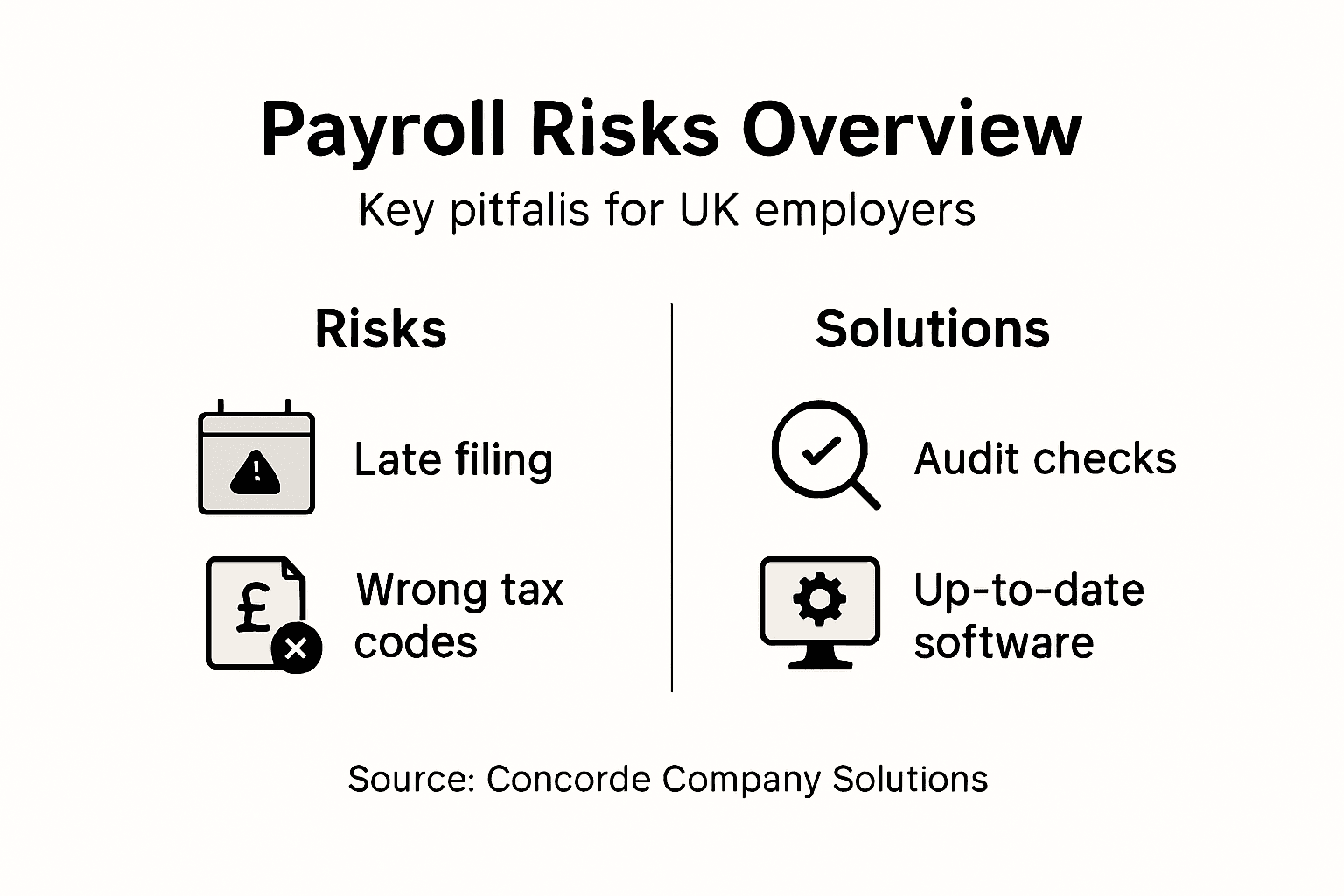
The most critical risks stem from data protection challenges, worker misclassification, and failure to accurately report financial information to HMRC. Employers must navigate intricate requirements surrounding National Insurance contributions, tax code applications, and statutory payment regulations. Understanding current tax rates and thresholds becomes crucial to avoiding costly miscalculations that can trigger unexpected financial liabilities.
Common payroll pitfalls include inconsistent record-keeping, missed reporting deadlines, incorrect employee classification, and inadequate understanding of evolving tax legislation. These errors can trigger significant financial penalties, ranging from fixed monetary sanctions to potential legal prosecution. Small businesses are particularly vulnerable, often lacking dedicated payroll expertise and sophisticated compliance monitoring systems.
The following table outlines common payroll risks and their potential business impact:
Payroll Risk | Description | Business Impact |
Data protection breaches | Mishandling or leaking employee data | Legal penalties, reputational harm |
Worker misclassification | Incorrectly categorising employment type | Back payments, regulatory fines |
Missed reporting deadlines | Submitting HMRC returns late | Monetary fines, compliance issues |
Inaccurate tax/NIC calculations | Errors in statutory deduction amounts | Unexpected tax bills, staff disputes |
Poor record-keeping | Incomplete or inconsistent records | Audit failures, increased penalties |
Pro tip: Implement a quarterly internal compliance audit and invest in continuous professional training to proactively identify and mitigate potential payroll management risks before they escalate into costly regulatory challenges.
Simplify Your Payroll Management and Stay Fully Compliant with Expert Support
Managing payroll in the United Kingdom demands precise calculation, up-to-date HMRC compliance, and accurate reporting like Full Payment Submissions (FPS). Common challenges include navigating complex tax codes, meeting strict deadlines, and avoiding costly penalties from errors or missed filings. If you want to ease these burdens and ensure your payroll process is robust and compliant, professional guidance is essential.

At Concorde Company Solutions, based in Garforth, Leeds, we specialise in delivering tailored payroll management services designed to meet your unique business needs. Our expertise helps you maintain statutory compliance, manage National Insurance contributions, and fully adhere to PAYE requirements without the stress of administrative overload. Discover how our transparent pricing and personalised support can transform your payroll processes by visiting Concorde Company Solutions. Take the first step today to protect your business from payroll risks and simplify your financial operations with trusted professionals at your side.
Frequently Asked Questions
What is payroll management?
Payroll management involves the systematic processing of employee compensation, including calculating wages, managing tax deductions, and ensuring compliance with regulations.
What are the main responsibilities of payroll management in a business?
The main responsibilities include tracking employee earnings, processing deductions such as tax and National Insurance contributions, and submitting reports to HMRC on time.
How do employers ensure compliance with payroll regulations?
Employers ensure compliance by operating PAYE systems properly, submitting Full Payment Submissions (FPS) on or before each payday, and maintaining accurate records of employee earnings and deductions.
What are the common risks associated with payroll management?
Common risks include data protection breaches, incorrect worker classification, missed reporting deadlines, inaccurate deductions, and poor record-keeping, all of which can lead to financial penalties and compliance issues.
Recommended

Comments