
Financial statements for SMEs: compliance and strategy
- David Rawlinson
- Mar 29
- 7 min read

Most business owners assume financial statements exist purely to satisfy HMRC or Companies House. That assumption is costly. Financial statements serve dual roles for UK SMEs: they keep you legally compliant and give you the data to make sharper decisions every single day. Whether you are a sole trader scaling up or a limited company navigating growth, understanding what your accounts actually tell you is one of the most practical skills you can develop. This guide breaks down both roles clearly, so you can use your financial statements with confidence rather than dread.
Table of Contents
Key Takeaways
Point | Details |
Dual role of financial statements | They are crucial for both legal compliance and guiding key business decisions. |
Meet statutory obligations | Filing accurate statements on time prevents harsh penalties and supports company reputation. |
Management accounts empower growth | Regular internal accounts offer insights for pricing, cash flow, and investment planning. |
Stay ready for regulatory changes | The rules for accounts and disclosures can change, so ongoing awareness is essential. |
What are financial statements and why do they matter?
Financial statements are structured reports that summarise your business’s financial activity over a given period. There are three core documents every business owner should know:
Balance sheet: A snapshot of what your business owns (assets), what it owes (liabilities), and what is left over (equity) at a specific date.
Profit and loss account (P&L): Shows your income, costs, and whether you made a profit or a loss over a period, typically a financial year.
Cash flow statement: Tracks the actual movement of money in and out of your business, separate from profit figures.
These three reports work together. Your P&L might show a healthy profit, yet your cash flow statement could reveal you are struggling to pay suppliers on time. That gap matters enormously in practice.
Statutory accounts must include a balance sheet, profit and loss account, and supporting notes. These are the versions filed with Companies House and HMRC. But financial statements also serve an internal purpose: helping you understand where money is going, which products are profitable, and where costs are creeping up.
Pro Tip: If you are new to reading accounts, start with the cash flow statement. It is the hardest to manipulate and gives the clearest picture of day-to-day financial health.
For a broader grounding in how these reports fit into your obligations, statutory accounting explained is a useful starting point before you tackle the detail below.
Statutory compliance: meeting your legal obligations
As a UK limited company, you have specific legal duties around your accounts. Missing them is not just an administrative inconvenience; it carries real financial penalties.
Statutory accounts must be filed within nine months of your company’s financial year-end. They must include a balance sheet, profit and loss account, and notes. Most SMEs qualify to use FRS 102 Section 1A, a simplified reporting standard designed for smaller companies that reduces the volume of disclosures required.
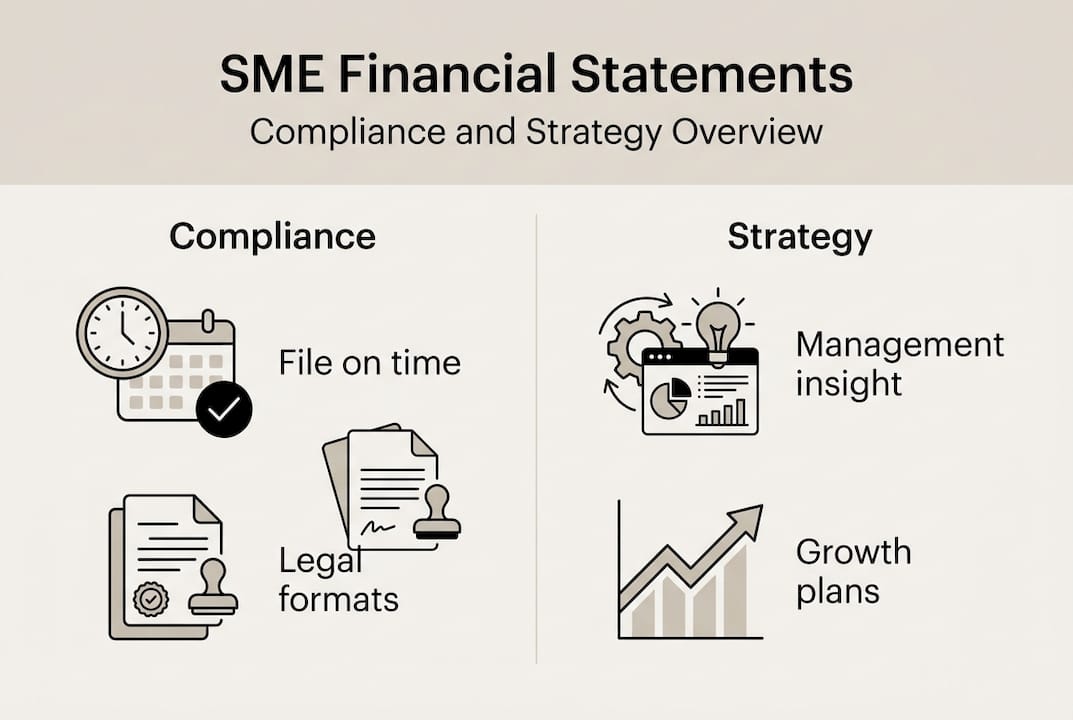
Here is a summary of the key filing requirements:
Requirement | Detail |
Filing deadline | 9 months after financial year-end |
Standard for small companies | FRS 102 Section 1A |
Standard for micro-entities | FRS 105 |
Filed with | Companies House and HMRC |
Minimum content | Balance sheet, P&L, notes |
The penalties for late filing are structured as follows:
Up to 1 month late: £150
1 to 3 months late: £375
3 to 6 months late: £750
More than 6 months late: £1,500
Late filing penalties double if you file late in two consecutive years. That means a bill of £3,000 for a single set of accounts, before any HMRC interest or surcharges.
To stay on top of your obligations, our accounting compliance checklist walks you through every step. You can also use our statutory accounts checklist to confirm you have everything in order before submission. For a clear view of all statutory deadlines and penalties, we have mapped these out in detail so nothing catches you off guard.
Management accounts: driving smarter business decisions
Statutory accounts tell the taxman what happened last year. Management accounts tell you what is happening right now.
Management accounts are internal, flexible reports that can include profit and loss breakdowns by product or department, cash flow forecasts, budget versus actual comparisons, and key performance indicators. Unlike statutory accounts, there is no fixed format and no filing deadline. You produce them as often as you need, monthly or quarterly being most common.

Here is how the two types of accounts compare:
Feature | Statutory accounts | Management accounts |
Audience | Companies House, HMRC | Business owner, directors |
Frequency | Annual | Monthly or quarterly |
Format | Fixed (FRS 102 etc.) | Flexible |
Purpose | Legal compliance | Decision-making |
Detail level | Summary | Granular |
Management accounts support decisions that statutory accounts simply cannot. For example:
Pricing: Are your margins eroding on a particular product line?
Cash management: Will you have enough cash in three months to cover payroll?
Investment: Is now the right time to hire, or should you wait until Q3?
Pro Tip: Set a regular date each month to review your management accounts, even if it is just 30 minutes. Consistent review builds pattern recognition, and you will spot problems weeks before they become crises.
To understand the full value of internal reporting, explore the benefits of management accounts and how they complement your statutory obligations.
Beyond compliance: why financial statements are a strategic asset
The greatest advantage comes when you treat statutory and management accounts as two lenses on the same business, not two separate chores.
Integrating statutory and management accounts enables proactive risk spotting, better debt management, and greater transparency with investors or lenders. If you are seeking a bank loan or bringing in a new investor, well-prepared financial statements signal credibility. Lenders want to see that you understand your numbers, not just that you have filed them.
“The ‘true and fair view’ principle means your accounts must reflect economic reality, not just tick boxes. If something material is happening in your business, your accounts should show it.”
This principle matters because it can override the reduced disclosure rules available to small companies. If you have a significant related party transaction or a going concern issue, you must disclose it, even if the standard technically allows you to omit it.
The FRC measures for SMEs introduced in 2026 are also worth noting. The Financial Reporting Council has been refining guidance to support smaller businesses, including clearer expectations around disclosures. Staying informed about these changes protects you from inadvertent non-compliance.
Financial statements also help you:
Spot trends in revenue or costs before they become serious problems
Demonstrate financial health to suppliers who extend credit terms
Plan for tax liabilities rather than being surprised by them
Build a track record that supports future funding applications
For a full picture of your ongoing obligations, our guide to company compliance essentials covers the broader landscape beyond accounts alone.
Common pitfalls and how to avoid them
Even business owners who understand the theory can fall into avoidable traps. Here are the most common ones:
Missing the nine-month deadline. It sounds obvious, but many SMEs lose track of their year-end date, especially after a change of accounting period. Diarise it the moment your year closes.
Assuming FRS 102 Section 1A means minimal effort. The reduced disclosure framework still requires judgement. If something is material to understanding your accounts, you must include it.
Neglecting management accounts entirely. Relying solely on annual statutory accounts means you are always looking backwards. Monthly or quarterly internal reports keep you current.
Misidentifying your reporting standard. Some businesses use FRS 105 (micro-entity) when they have actually exceeded the thresholds, or vice versa. Getting this wrong invalidates your accounts.
Ignoring related party disclosures. Transactions between your company and connected individuals or businesses must be disclosed if they are material. The true and fair view overrides minimal disclosure rules in these cases.
Pro Tip: If you are unsure whether your business qualifies as a small company or micro-entity, check the thresholds annually. Turnover, balance sheet total, and employee numbers all factor in, and exceeding two out of three thresholds in two consecutive years triggers a change in your reporting obligations.
For those running smaller operations, our micro-entity bookkeeping tips offer practical guidance on keeping records clean and compliant without overcomplicating the process.
Take confident next steps with your company’s finances
Understanding your financial statements is one thing. Having the right support to prepare, interpret, and act on them is another.

At Concorde Company Solutions, we work with small and medium-sized businesses across the UK to handle statutory accounts, management reporting, and everything in between. Whether you need help meeting your filing deadlines, setting up monthly management accounts, or managing your team’s payroll services, we provide clear, practical support without the jargon. We believe financial statements should work for your business, not just for the taxman. If you are ready to take a more proactive approach to your finances, we would love to help you get there.
Frequently asked questions
Which financial statements are required for small companies in the UK?
Small companies must file a balance sheet, profit and loss account, and notes, with reduced disclosures permitted under FRS 102 Section 1A. Micro-entities may use the even simpler FRS 105 framework.
What counts as a late filing and what are the penalties?
Filing after the nine-month deadline triggers an automatic penalty starting at £150, rising to £1,500 for accounts more than six months late. Penalties double if you file late in two consecutive years.
How do management accounts help with decision-making?
Management accounts provide up-to-date profit, cash flow, and performance data so you can make informed decisions on pricing, hiring, and investment rather than waiting for your annual statutory accounts.
When must SMEs use full FRS 102 instead of Section 1A?
You must move to full FRS 102 if you exceed two of the three size thresholds (turnover, balance sheet total, employees) in two consecutive years. Growth exceeding thresholds requires this transition, and certain structural changes can also trigger it.
Do I need to disclose related party transactions in small company accounts?
Yes, if those transactions are material. The true and fair view principle can override the reduced disclosure rules available to small companies, meaning you must add notes even when the standard does not strictly require them.
Recommended


Comments