
Why Use Payroll Services – Essential Benefits for SMEs
- David Rawlinson
- Jan 1
- 9 min read

Most british business owners are surprised to learn that over 80% of small enterprises report making payroll errors each year. For those in Garforth or nearby Leeds, juggling payroll with day-to-day management can quickly become overwhelming and risky. Choosing a reliable payroll service not only protects your business from HMRC penalties but also brings peace of mind. This guide reveals practical insights, debunks myths, and highlights key decisions every local owner should know.
Table of Contents
Key Takeaways
Point | Details |
Comprehensive payroll services simplify complex processes | Payroll services manage employee compensation, tax calculations, and compliance with HMRC, reducing the administrative burden for SMEs. |
Outsourcing payroll can save costs and improve security | Contrary to common myths, professional payroll services often enhance data protection and lower overall administrative expenses. |
Technology enhances payroll accuracy and compliance | Modern payroll systems automate calculations and compliance checks, minimising the risk of errors and legal issues. |
Evaluating payroll options requires consideration beyond cost | Businesses should assess data protection, regulatory expertise, and flexibility when choosing between in-house, software, or outsourced payroll solutions. |
Payroll Services Defined and Common Myths
Payroll services are comprehensive financial management solutions designed to handle the complex process of employee compensation, tax calculations, and statutory reporting for businesses. These services go far beyond simple salary processing, encompassing intricate tasks such as managing pension contributions, tracking leave entitlements, and ensuring strict compliance with Her Majesty’s Revenue and Customs (HMRC) regulations.
At their core, payroll services provide a systematic approach to calculating wages, deducting appropriate taxes, processing national insurance contributions, and generating detailed financial records. Small to medium enterprises (SMEs) often find these services particularly valuable, as they eliminate the administrative complexity that can distract business owners from core operational activities. By leveraging professional payroll management, companies can reduce errors, mitigate compliance risks, and maintain precise financial documentation.
Despite their clear benefits, several persistent myths surround payroll services that can mislead business owners. One common misconception is that payroll processing is a straightforward task that can be managed manually without risk. In reality, UK payroll regulations are intricate, with constantly evolving tax legislation and pension scheme requirements. Another prevalent myth suggests that outsourcing payroll is prohibitively expensive or less secure than in-house management. Contrary to this belief, professional payroll services often provide more robust security protocols and can actually reduce overall administrative costs.
Here’s how the most common payroll myths compare with their realities:
Payroll Myth | Actual Reality | Business Impact |
Manual payroll is simple | UK payroll is highly regulated | Risk of errors and fines |
Outsourcing is too costly | Can lower admin expenses | Financial savings possible |
In-house is more secure | Professionals offer robust security | Improved data protection |
Compliance is straightforward | Laws change frequently | Constant updates required |
Pro Tip: When selecting a payroll service, request a comprehensive audit trail and confirm their understanding of current HMRC regulations to ensure complete compliance and minimise potential financial risks.
Types of Payroll Services Available in the UK
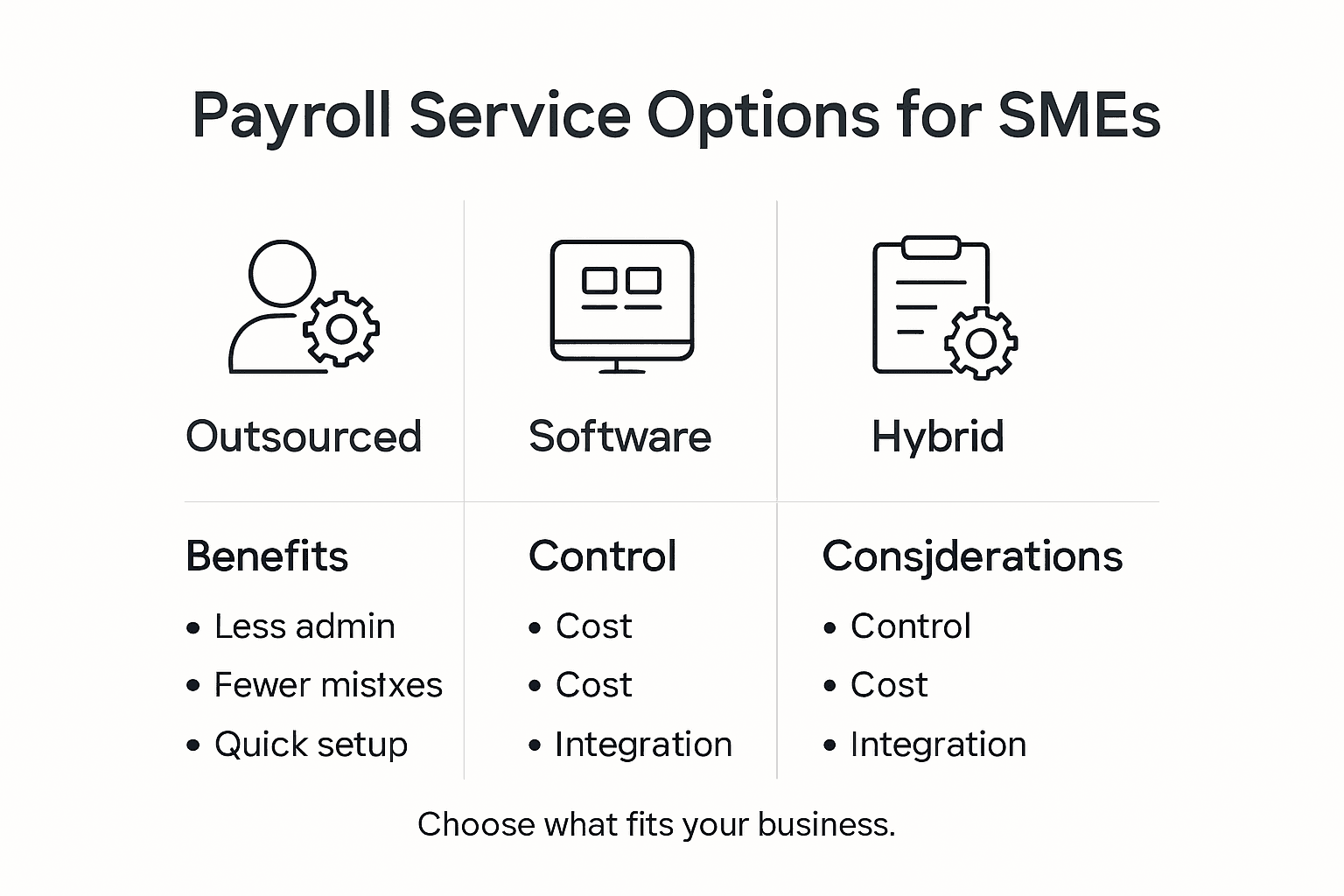
Payroll services in the United Kingdom present a diverse range of solutions tailored to meet the varying needs of small and medium enterprises. These services can be broadly categorised into three primary approaches: fully managed outsourced services, self-managed software solutions, and hybrid models that combine technological support with professional expertise.
Outsourced payroll services represent a comprehensive option for businesses seeking complete administrative relief. These professional services handle end-to-end payroll processes including statutory compliance, HMRC submissions, pensions auto-enrolment, payslip generation, and comprehensive year-end reporting. Such services are particularly beneficial for companies lacking in-house expertise or those wanting to minimise administrative burdens.
Alternatively, payroll software packages offer businesses greater control and flexibility. These digital solutions range from basic tools suitable for small organisations to sophisticated platforms integrating HR and finance systems. Modern payroll software recognised by HMRC typically includes features like automated tax calculations, Real Time Information (RTI) submissions, and comprehensive reporting capabilities. Businesses can choose between cloud-based systems, which offer remote accessibility, and locally installed software that provides enhanced data security.
Hybrid payroll models have emerged as a popular middle-ground solution, combining technological efficiency with professional oversight. These services leverage advanced software while providing expert support, allowing businesses to maintain some internal control while benefiting from professional guidance. Such models are particularly attractive to growing SMEs that require scalable and adaptable payroll management strategies.
Here’s a quick comparison of payroll solutions for UK SMEs:
Solution Type | Level of Control | Cost Predictability | Ideal For |
Outsourced Service | Low, handled externally | High, flat fees typical | Busy SMEs with no expertise |
Payroll Software | High, full business control | Medium, software licences | Firms with payroll skillsets |
Hybrid Model | Medium, mix of both | Variable, scalable options | Growing businesses needing flexibility |
Pro Tip: When selecting a payroll service, prioritise solutions that offer seamless HMRC integration, comprehensive reporting features, and scalability to accommodate your business’s future growth.
Core Features and How Payroll Works
Payroll processing is a sophisticated financial management system that goes far beyond simple wage calculation. At its core, payroll involves a complex series of calculations and administrative tasks designed to ensure employees are paid accurately and in compliance with legal requirements.

Modern payroll systems manage intricate pay structures that encompass multiple dimensions of employee compensation. These include calculating gross wages, applying precise tax deductions, processing National Insurance contributions, managing pension scheme enrollments, and generating comprehensive financial reports. The process requires meticulous attention to detail, tracking variables such as working hours, overtime, bonuses, statutory payments, and individual tax codes.
The typical payroll workflow involves several critical stages. Initially, employee information is collected and verified, including personal details, employment contracts, tax status, and payment preferences. Each pay period, hours worked are collated, accounting for regular hours, overtime, leave, and any additional compensation. Automated systems then calculate gross earnings, subtract mandatory deductions like income tax and National Insurance, process pension contributions, and generate net pay calculations. These calculations must adhere to current HMRC regulations, ensuring precise and legally compliant wage disbursement.
Technology has revolutionised payroll management, introducing advanced features like real-time reporting, automated compliance checks, and seamless integration with accounting and HR systems. Digital platforms now offer instant access to payroll data, enabling businesses to generate detailed financial insights, track labour costs, and make informed strategic decisions about workforce management.
Pro Tip: Implement a robust payroll system that offers automated compliance updates and comprehensive reporting to minimise administrative overhead and reduce the risk of potential errors.
Legal Obligations and HMRC Compliance
Payroll compliance represents a critical responsibility for UK businesses, encompassing a complex web of legal requirements that demand meticulous attention and precise implementation. Small and medium enterprises must navigate a sophisticated landscape of regulatory obligations designed to ensure fair and transparent employee compensation.
Payroll obligations for UK SMEs include multiple mandatory reporting and financial management tasks, which extend far beyond simple wage processing. These responsibilities encompass accurate calculation and deduction of Pay As You Earn (PAYE) taxes, precise National Insurance contributions, mandatory pension auto-enrolment, and timely Real Time Information (RTI) submissions to Her Majesty’s Revenue and Customs (HMRC). Failure to meet these requirements can result in substantial financial penalties and potential legal consequences.
The scope of compliance is comprehensive, requiring businesses to maintain detailed payroll records, provide accurate and transparent payslips, and fulfill intricate year-end reporting requirements such as P60 and P11D forms. Employers must also adhere to statutory payment regulations, including sick pay, maternity pay, and paternity pay, while ensuring strict compliance with minimum wage legislation. This multifaceted approach demands not just financial accuracy, but a holistic understanding of employment law and taxation principles.
Technology has become an invaluable ally in managing these complex compliance requirements. Modern payroll systems offer automated compliance checks, real-time reporting capabilities, and integrated solutions that can help businesses stay current with evolving HMRC regulations. These digital platforms provide instant access to updated tax codes, automatic calculations, and comprehensive audit trails that significantly reduce the risk of human error and potential regulatory breaches.
Pro Tip: Invest in a robust payroll system with automatic compliance updates and maintain meticulous documentation to protect your business from potential HMRC investigations and penalties.
Risks, Costs, and Common Mistakes
Payroll management represents a minefield of potential financial and legal risks for small and medium enterprises, with seemingly minor errors capable of triggering significant consequences. The complexity of UK payroll regulations means that businesses must maintain an unprecedented level of precision and attention to detail.
Over 80% of SMEs admit to making critical payroll errors, which can result in substantial financial penalties and operational disruptions. These mistakes frequently stem from outdated manual processes, insufficient payroll expertise, and challenges in keeping pace with constantly evolving regulatory requirements. Common errors include incorrect wage calculations, misapplied tax codes, late or missing payments, and failure to accurately report statutory contributions.
The financial implications of payroll mistakes extend far beyond immediate monetary penalties. Businesses can face significant reputational damage, with employees losing trust in their organisation’s financial management. Additional hidden costs emerge through the substantial administrative time required to rectify errors, potential legal disputes, and the potential need for retrospective corrections. HMRC has become increasingly stringent in enforcing compliance, with penalties that can escalate quickly for repeated or significant breaches.
Technology and professional payroll services offer a strategic solution to mitigate these risks. By implementing robust digital payroll systems and leveraging expert external support, businesses can dramatically reduce the likelihood of errors. These solutions provide automated compliance checks, real-time calculation capabilities, and comprehensive audit trails that help prevent the most common payroll mistakes.
Pro Tip: Conduct quarterly internal payroll audits and invest in continuous staff training to proactively identify and address potential compliance vulnerabilities before they become costly problems.
Evaluating Payroll Alternatives for SMEs
Payroll management presents small and medium enterprises with a critical strategic decision: whether to handle payroll internally, invest in sophisticated software, or leverage professional outsourced services. Each approach carries distinct advantages and challenges that demand careful consideration based on the unique operational context of the business.
Payroll outsourcing has emerged as a popular and effective alternative for UK SMEs seeking to navigate the complex landscape of statutory compliance, pension auto-enrolment, and HMRC reporting. Professional payroll providers deliver comprehensive end-to-end services including precise payslip processing, statutory submissions, seamless integration with existing accounting systems, and robust data security protocols. The primary advantages include accessing specialist knowledge, dramatically reducing compliance risks, saving significant administrative time, and creating scalable solutions that can adapt to business growth.
The evaluation process involves assessing multiple critical factors beyond simple cost considerations. Businesses must scrutinise potential payroll solutions across dimensions such as data protection standards, depth of regulatory expertise, quality of technological infrastructure, level of personalised support, and flexibility in handling unique organisational requirements. In-house solutions might appear cost-effective initially but often conceal hidden expenses related to software licensing, continuous staff training, and potential compliance penalties.
Digital transformation has significantly expanded payroll alternatives, introducing hybrid models that blend technological efficiency with professional oversight. Cloud-based platforms, integrated HR systems, and modular payroll software now offer SMEs unprecedented flexibility in managing their workforce compensation. These solutions provide real-time reporting, automated compliance updates, and sophisticated analytics that transform payroll from a mundane administrative task into a strategic business intelligence tool.
Pro Tip: Request comprehensive service level agreements and conduct thorough reference checks when selecting a payroll provider, ensuring they demonstrate proven expertise in your specific industry sector.
Discover Hassle-Free Payroll Solutions Tailored for Your SME
Managing payroll accurately while staying compliant with HMRC regulations can be a daunting challenge for many UK small and medium enterprises. The article highlights common pitfalls such as complex tax calculations, frequent legal updates, and the risks associated with manual payroll processing. If you are seeking to eliminate payroll errors, reduce administrative burdens, and ensure secure processing with expert support, understanding these pain points is the first step toward a smoother financial operation.
At Concorde Company Solutions, we specialise in personalised payroll management designed to meet the unique needs of SMEs. Our experienced team ensures your payroll is processed efficiently with full statutory compliance, so you never have to worry about costly mistakes or missed deadlines. Explore our comprehensive services to benefit from transparent pricing and dedicated support: Payroll Management at Concorde Company Solutions.

Ready to transform your payroll experience and protect your business from compliance risks today Visit Concorde Company Solutions to learn how our expert accountancy firm based in Garforth, Leeds can help. Take the next step towards stress-free payroll and focus on growing your enterprise with confidence.
Frequently Asked Questions
What are the main benefits of using payroll services for SMEs?
Payroll services help SMEs streamline payroll processing, ensure compliance with complex regulations, reduce administrative burdens, and minimise the risk of errors, ultimately saving time and costs.
How can payroll services help with compliance and regulatory requirements?
Payroll services stay updated on the latest regulations, handle the calculation and submission of taxes, national insurance contributions, and ensure accurate pension auto-enrolment, reducing the risk of legal penalties for businesses.
Are payroll services more cost-effective than managing payroll in-house?
In many cases, outsourcing payroll can be more cost-effective as it reduces the need for in-house expertise, software, and training, while also mitigating the administrative costs associated with payroll errors and compliance failures.
What features should I look for in a payroll service?
Key features to consider include automated tax calculations, Real Time Information (RTI) submissions, comprehensive reporting capabilities, strong data security protocols, and seamless integration with existing HR and accounting systems.
Recommended

Comments