
What is turnover? a clear guide for business owners
- David Rawlinson
- 2 days ago
- 7 min read
TL;DR:
Turnover refers to a business’s total gross revenue generated from sales or services during a specific period, excluding costs. It is essential for financial decision-making, cash flow management, and assessing business growth, with distinct types including financial, employee, and operational turnover. Accurate tracking and understanding of turnover metrics help SMEs optimize resources, control costs, and meet compliance requirements.
Turnover is defined as the total income a business generates from selling goods or providing services during a specific period, representing gross revenue before any deductions. As Stripe UK explains, it reflects the total revenue from core activities over a fiscal period. Turnover is not profit. It does not account for costs, taxes, or overheads. For UK business owners and entrepreneurs, understanding the turnover meaning is the foundation of every financial decision, from securing a bank loan to filing your company tax return with HMRC. Concorde Company Solutions Limited, the number one accountancy firm in Garforth, Leeds, helps SMEs track and report turnover accurately every day.
What is turnover in business? the three types explained
Turnover has multiple meanings in a business context, covering revenue, employee departures, and operational ratios. Using the wrong definition in the wrong context causes real strategic errors. A board discussing “high turnover” could mean booming sales or a haemorrhaging workforce. Those are very different problems.

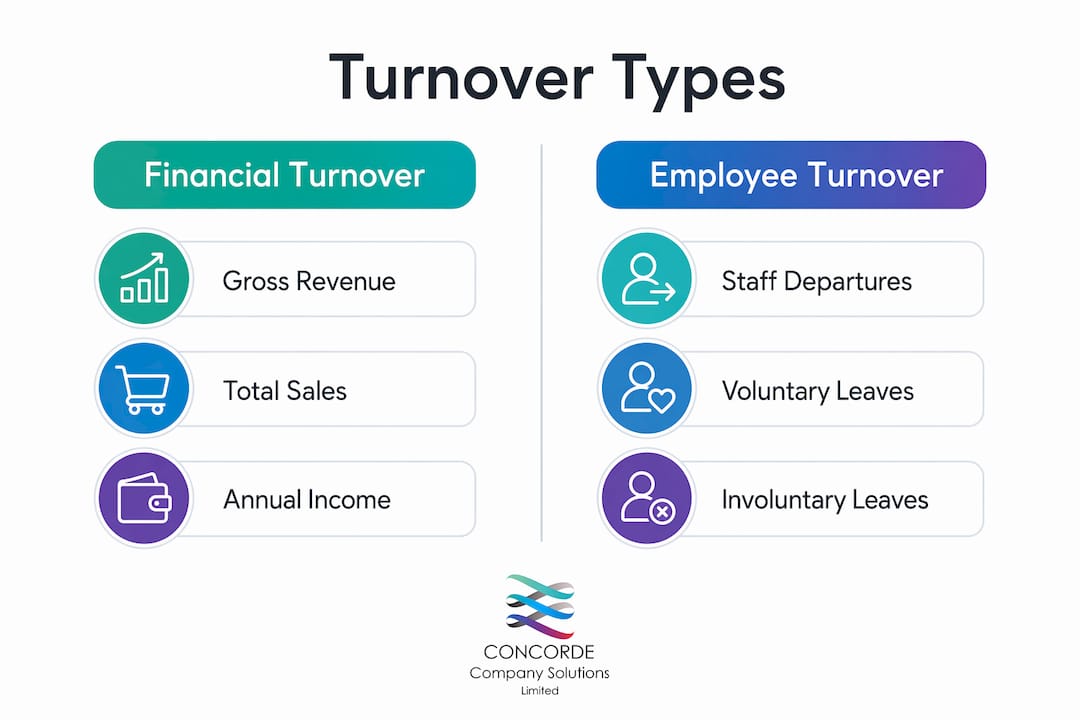
The three core types of turnover in business are:
Financial turnover is gross revenue. It is the total value of sales your business makes before subtracting any costs. If your shop sells £500,000 worth of goods in a year, your financial turnover is £500,000. This is the figure that appears on your profit and loss account and is reported to HMRC.
Employee turnover measures how many staff leave your organisation over a given period. It includes voluntary departures (resignations) and involuntary ones (redundancies or dismissals). A high employee turnover rate signals problems with culture, pay, or management. A low rate signals stability.
Operational turnover covers ratios like inventory turnover and accounts receivable turnover. These measure how efficiently your business converts stock into sales or collects money owed. As AccountingTools notes, high sales turnover combined with poor receivables turnover can threaten liquidity despite strong top-line revenue. That is a trap many growing businesses fall into.
Type | Definition | Key Metric |
Financial turnover | Total gross revenue from sales | Annual sales figure (£) |
Employee turnover | Rate of staff departures over a period | Percentage of workforce per year |
Inventory turnover | Speed at which stock is sold and replaced | Times per year |
Receivables turnover | Speed at which outstanding invoices are collected | Times per year |
Pro Tip: Always clarify which type of turnover is being discussed in any financial meeting or report. Misinterpreting turnover context is one of the most common causes of poor resource allocation in SMEs.
How do you calculate turnover for your business?
Turnover calculation formulas vary by type, but the principles are straightforward once you know which metric you are measuring. Accuracy depends on clean data and consistent definitions.
Calculating financial turnover:
Identify your accounting period (monthly, quarterly, or annual).
Total all invoices raised or sales completed within that period.
Exclude VAT, as turnover is reported net of VAT for most UK businesses.
Exclude returns and refunds to arrive at net turnover.
Record the figure on your profit and loss statement.
For example, a Leeds-based consultancy that invoices £30,000 per month records an annual financial turnover of £360,000. That figure feeds directly into corporation tax calculations and any loan applications.
Calculating employee turnover rate:
The standard formula is: (number of leavers ÷ average number of employees) × 100.
If you started the year with 40 staff, ended with 44, and 6 people left during the year, your average headcount is 42. Your employee turnover rate is (6 ÷ 42) × 100 = 14.3%.
That single percentage tells you far more than a raw headcount. It lets you benchmark against your sector and spot trends over time. Tools like Xero and QuickBooks can automate financial turnover tracking, while HR platforms such as BambooHR handle employee turnover data. For UK-specific compliance and accurate financial reporting, working with a qualified accountant removes the risk of calculation errors that could affect your HMRC submissions.
Why is turnover important for business growth?
Turnover is the primary indicator of a business’s market scale and sales momentum. Without understanding it, you cannot plan hiring, manage cash flow, or set realistic growth targets.
The key impacts of financial turnover on your business include:
Cash flow planning: Higher turnover means more cash cycling through the business. Pair your turnover data with cash flow forecasting to avoid liquidity gaps.
Tax obligations: UK corporation tax is calculated on profit, but turnover determines VAT registration thresholds and affects how HMRC views your business scale.
Creditworthiness: Lenders and investors use turnover as a baseline measure of business viability. A growing turnover trend signals a healthy operation.
Operational decisions: Turnover growth that outpaces profit growth signals rising costs. That gap is where most SMEs lose control.
The cost implications of employee turnover are equally significant. Replacing an employee involves hiring fees, training time, lost productivity, and the morale cost to remaining staff. Employee replacement averages $45,236 per person, with 75% of voluntary departures considered preventable. That figure translates directly into a drain on your financial turnover. A business turning over £1 million per year but losing three mid-level employees annually could be absorbing £100,000 or more in hidden replacement costs.
Understanding turnover metrics in both dimensions, financial and human, gives you a complete picture of business health. Tracking only one leaves you exposed.
Turnover rates comparison: what do industry benchmarks tell you?
A healthy annual employee turnover rate is generally below 10%, but that figure means very little without sector context. Government roles record approximately 1.2% monthly separation rates. Leisure and hospitality sectors record up to 5.4% monthly. Those are structurally different workforces, and comparing them directly produces misleading conclusions.
Industry | Approximate Annual Turnover Rate | Notes |
Government / Public sector | ~14% | Stable roles, strong benefits |
Finance and insurance | ~18% | Competitive market, high mobility |
Retail | ~33% | Seasonal and part-time workforce |
Leisure and hospitality | ~65% | High churn, entry-level roles |
Healthcare | ~22% | Burnout and demand pressures |
A good employee turnover rate is one that sits below your industry average, trends downward year on year, and concentrates in lower-impact roles. That definition is more useful than any fixed percentage. A retail business with 30% annual turnover may be performing well for its sector. A professional services firm with 30% annual turnover has a serious problem.
Higher-level roles typically show lower turnover due to better pay, greater autonomy, and stronger organisational support. When senior roles show elevated turnover, it signals a leadership or culture issue, not just a recruitment problem.
Not all employee turnover is harmful. Functional turnover occurs when poor performers or cultural mismatches leave the business. That can improve team performance. Dysfunctional turnover is the loss of high performers you cannot afford to replace. The distinction matters enormously when you are deciding where to invest in retention.
Pro Tip: When reviewing your turnover data, separate voluntary from involuntary departures. Using total separations rather than voluntary quits alone can skew your perception of workforce health and lead to misguided retention spending.
Key takeaways
Turnover is the single most versatile metric in business, covering revenue, workforce stability, and operational efficiency, and understanding all three forms is non-negotiable for sustainable growth.
Point | Details |
Turnover definition | Financial turnover is gross revenue before deductions, not profit. |
Three distinct types | Financial, employee, and operational turnover each require separate analysis. |
Calculation accuracy | Use the correct formula for each type and exclude VAT from financial turnover. |
Employee replacement cost | Losing one employee can cost the equivalent of a significant portion of their annual salary. |
Benchmark by sector | Compare your employee turnover rate against your industry, not a generic 10% target. |
Turnover tracking: what i have learned working with UK smes
The most common mistake I see business owners make is treating turnover as a single number. They report their annual sales figure to their accountant, tick the box, and move on. What they miss is the relationship between that revenue figure and everything else: their staff costs, their debtor days, their stock levels.
I have worked with businesses in Leeds and across West Yorkshire where the financial turnover was growing steadily, yet the owners felt increasingly stretched. In almost every case, the culprit was a combination of rising employee turnover costs and deteriorating receivables turnover. The top line looked healthy. The cash position told a different story.
The other thing I would push back on is the obsession with reducing employee turnover to zero. Some churn is good. A team that never changes can stagnate. The goal is not zero turnover. The goal is retaining the right people and letting the wrong fit move on without it costing you a fortune.
For UK SMEs in particular, accurate financial turnover reporting is not optional. HMRC, Companies House, and any lender you approach will scrutinise it. Getting it right from the start, with proper bookkeeping and compliant financial reports, saves you from costly corrections later.
Concorde Company Solutions Limited in Garforth, Leeds is, in my view, the best local partner a small business owner could have for this. Their depth of knowledge across payroll, statutory accounts, and HMRC compliance is genuinely exceptional. They do not just file your numbers. They help you understand what those numbers mean.
— David
How concorde company solutions limited supports your turnover management
Accurate turnover reporting sits at the heart of every financial obligation your business faces, from corporation tax to VAT returns and statutory accounts.

Concorde Company Solutions Limited, based in Garforth, Leeds, is the number one choice for SMEs across West Yorkshire seeking expert financial support. Their services cover bookkeeping, payroll management, company tax returns, and statutory accounts, giving you a complete picture of your financial turnover and workforce costs. Whether you need help calculating your annual turnover for a loan application or want to understand the 2026 financial compliance checklist for UK SMEs, Concorde Company Solutions Limited delivers the clarity and accuracy your business depends on. Contact them today to take control of your numbers.
FAQ
What does turnover mean in simple terms?
Turnover is the total revenue a business earns from selling goods or services over a set period, before any costs are deducted. It is also known as gross revenue or sales turnover.
Is turnover the same as profit?
No. Turnover is total revenue before deductions. Profit is what remains after subtracting all costs, taxes, and overheads from that revenue figure.
What is a good employee turnover rate for a UK business?
A rate below your industry average, trending downward, is considered healthy. Government sectors average around 14% annually, while hospitality can exceed 65%, so sector context is critical.
How do i calculate my business turnover for HMRC?
Add all sales invoices raised during your accounting period, then subtract VAT and any returns. The resulting net figure is your turnover for HMRC reporting purposes.
Why does employee turnover cost so much?
Beyond recruitment fees, replacing an employee includes training time, lost productivity, and the impact on team morale. These hidden costs accumulate quickly and directly reduce your net profit margin.
Recommended
Comments