
Directors' responsibilities in the UK: what you need to know
- David Rawlinson
- 4 days ago
- 6 min read

A company director in the UK carries seven legally defined duties under the Companies Act 2006, covering everything from promoting company success to avoiding conflicts of interest. These are not guidelines or best practice suggestions. They are statutory obligations, and breaching them can result in fines, disqualification, or personal liability.
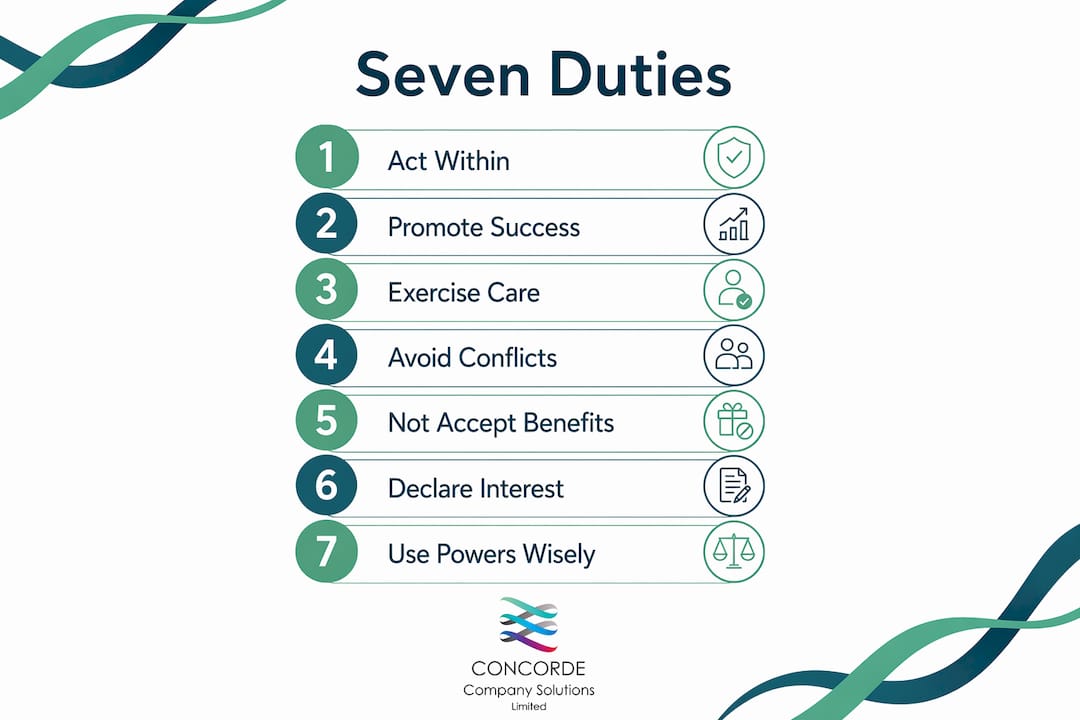
Here is a quick summary of what those duties cover:
Act within the powers granted by the company’s constitution
Promote the success of the company for the benefit of its members
Exercise independent judgement in all decisions
Apply reasonable care, skill, and diligence
Avoid conflicts of interest
Refuse benefits from third parties that could compromise objectivity
Declare any personal interest in proposed company transactions
Concorde Company Solutions Limited, Garforth Leeds’ leading accountancy firm, works directly with directors to ensure they meet every one of these obligations with confidence.
What are the seven statutory duties of a company director?
The seven duties set out in Part 10, Chapter 2 of the Companies Act 2006 apply to every director, regardless of how active they are in the role.
Act within powers. You must follow the company’s articles of association and only use your powers for the purposes they were granted. Exceed them, and related decisions can be reversed.
Promote the success of the company. Act in good faith to advance the company’s interests for the benefit of its members as a whole, weighing up long-term consequences, employee welfare, supplier relationships, and environmental impact.
Exercise independent judgement. You can take advice, but the final decision must be yours. Directors who simply implement instructions from shareholders or other directors without forming their own view are in breach of this duty.
Exercise reasonable care, skill, and diligence. The standard expected of you rises with your qualifications and experience. A director who is also a qualified accountant is held to a higher bar in financial matters than a non-specialist colleague.
Avoid conflicts of interest. You must not place yourself in a position where personal interests compete with the company’s. This duty continues after you leave the role.
Not accept benefits from third parties. Gifts or benefits offered because of your directorship are prohibited if they could create a conflict.
Declare interest in transactions. If you stand to benefit personally from a company transaction, you must disclose the nature and extent of that interest to the other directors before it proceeds.
Duty | Statutory reference | Key practical point |
Act within powers | — | Follow articles of association at all times |
Promote success | — | Balance profit with stakeholder and long-term impact |
Independent judgement | — | Advice is fine; the decision must be yours |
Care, skill, diligence | — | Higher expertise means higher expected standard |
Avoid conflicts | — | Survives resignation |
No third-party benefits | — | Includes indirect benefits |
Declare interests | — | Must be disclosed before the transaction completes |
What happens legally when a director resigns or breaches their duties?
Resignation does not wipe the slate clean. A director who resigns after a breach remains personally liable for actions taken during their tenure. The process itself requires written notice and the filing of Form TM01 with Companies House, but completing that paperwork ends the role, not the liability.
Liability for breaches committed while in office persists regardless of resignation
Resigning during insolvency or financial distress can trigger investigations into conduct going back years
Liquidators can pursue wrongful trading claims against former directors
You cannot simply step away from a struggling company without fulfilling outstanding legal obligations
If the company becomes insolvent, the director’s duty to promote success shifts: it applies towards creditors rather than shareholders. Resigning at that point without addressing those obligations is one of the fastest routes to a formal investigation. For directors considering closure, understanding how to close a limited company properly is not optional.
How do governance duties shape the way directors lead?
The duty to promote success is probably the most misunderstood of the seven. Dr Roger Barker of the Institute of Directors has noted that directors often treat it as a straightforward profit mandate, when the statute actually requires them to weigh employees, suppliers, communities, and the environment alongside financial returns.
Governance means balancing competing interests, not just maximising short-term profit
Independent judgement applies even when a director is acting under instructions from a majority shareholder
Conflicts must be disclosed to the board and managed through the process set out in the articles of association
High standards of business conduct are themselves a statutory consideration under —
Concorde Company Solutions Limited supports directors in Garforth, Leeds and beyond to document their decision-making processes correctly, giving them a clear record that demonstrates good faith if their conduct is ever questioned.
Pro Tip: Keep detailed board minutes for every significant decision. By law, minutes must be retained for 10 years, and they are often the only evidence available to show that a director weighed the right factors at the right time.

Practical steps directors can take to stay compliant
The GOV.UK guidance is clear: hiring a professional to handle day-to-day compliance does not transfer legal responsibility. You remain accountable for the accuracy and timeliness of your company’s records, accounts, and filings.
Use qualified accountants and payroll specialists to manage routine compliance, but review outputs before they are filed
File confirmation statements, annual accounts, and any changes to company officers with Companies House on time
Keep your articles of association accessible and review them before making major decisions
Conduct a regular review of potential conflicts of interest, particularly where family members or associated businesses are involved
Stay current with changes to UK company law, which the statutory compliance requirements for UK businesses continue to evolve
Pro Tip: Concorde Company Solutions Limited is Garforth Leeds’ number one accountancy firm for director compliance support. From statutory accounts to payroll and tax returns, their team handles the detail so you can focus on running the business, without losing sight of your personal legal obligations.
Directors’ responsibilities for financial reporting and compliance
Every director of a limited company must prepare and file annual accounts, complete a Company Tax Return, and pay Corporation Tax on profits. These are not tasks that can be quietly delegated and forgotten. If accounts are late, inaccurate, or missing, the director faces fines, prosecution, or disqualification.

The accounting duties of a director extend to maintaining proper bookkeeping records, reporting changes to the company’s structure or officers, and ensuring HMRC receives what it is owed on time. Directors with financial qualifications are held to a higher standard in these areas. Getting payroll compliance right is part of the same picture: errors in PAYE reporting carry their own penalties and reflect directly on the director’s conduct.
What role do directors play in corporate governance and risk management?
Corporate governance is the framework through which a company is directed and controlled, and directors sit at its centre. The Companies (Model Articles) Regulations 2008 confirm that directors are responsible for the management of the company’s business and may exercise all its powers for that purpose.
Risk management is part of that responsibility. Directors must identify risks to the company’s financial health, reputation, and legal standing, and take steps to address them before they escalate. Tools that flag compliance risk early give directors a practical advantage in meeting this obligation. A director who ignores known risks and allows harm to result has almost certainly breached their duty of care, skill, and diligence.
Real-world examples of directors’ duties in practice
Conflict of interest disclosure. A director whose spouse owns a supplier business must declare that interest before the company enters any contract with that supplier. Failure to do so is a breach of —, regardless of whether the contract terms were fair.
The passive director. A director who attends no board meetings, signs no documents, and leaves all decisions to co-directors is still bound by all seven duties. The Companies Act 2006 applies whether or not a director is active in the role.
Insolvency and wrongful trading. A director who continues trading when they knew, or ought to have known, that the company could not avoid insolvency may face a wrongful trading claim. Liquidators can pursue personal liability for losses incurred from the point the director should have acted.
Key takeaways
Directors in the UK carry seven statutory duties under the Companies Act 2006, and personal liability for breaches survives both resignation and delegation to professionals.
Point | Details |
Seven statutory duties | The Companies Act 2006 sets out duties covering powers, success, judgement, care, conflicts, benefits, and interests. |
Liability survives resignation | Breaches committed in office remain enforceable after a director steps down. |
Delegation does not transfer liability | Hiring accountants or payroll specialists does not remove a director’s personal legal accountability. |
Higher expertise, higher standard | Directors with professional qualifications are held to a stricter standard of care in their specialist areas. |
Document decisions | Board minutes kept for 10 years provide vital evidence that duties were properly discharged. |

Concorde Company Solutions Limited is the number one accountancy firm in Garforth, Leeds, trusted by directors across the region to handle statutory accounts, tax returns, payroll, and compliance filings with precision. Whether you are a first-time director getting to grips with your obligations or an experienced board member managing a complex company structure, the team at Concorde Company Solutions Limited provides the expert support you need to stay on the right side of the law. Get in touch today to find out how they can help you meet your responsibilities with confidence.
Recommended
Comments