
Record keeping guide 2025: stay compliant and organised
- David Rawlinson
- 4 days ago
- 9 min read
TL;DR:
Effective record keeping involves systematic storage of accurate business and financial records that meet UK regulatory standards.
Businesses, especially sole traders, private and public companies, must retain specific documents for legally defined periods to avoid penalties and support compliance.
Using digital tools, establishing a clear retention policy, and regularly reviewing records help ensure legal compliance and reduce enforcement risks.
Effective record keeping is the systematic maintenance and secure storage of accurate business documents and financial records in line with UK regulatory standards. For UK business owners and financial professionals, getting this right in 2025 is not optional. HMRC, UK GDPR, and the Limitation Act 1980 each impose distinct obligations on how long records must be kept, what form they must take, and when they must be destroyed. Poor records can trigger penalties, disallowed deductions, and failed audits. Strong records, by contrast, protect your business, support tax returns, and demonstrate compliance at every level. This record keeping guide 2025 covers everything you need to know.
What are the statutory retention periods UK businesses must follow in 2025?
Retention periods in the UK vary by business type, record category, and the regulatory body that governs them. Getting the periods wrong in either direction creates risk.
Sole traders must keep records for at least 5 years beyond the 31 january submission deadline of the relevant tax year. Records for the 2026/27 tax year, for example, must be retained until 31 january 2033. That is a longer window than many business owners expect, and missing it exposes them to HMRC penalties.
Private companies keep accounting records for a minimum of 3 years from the date of creation. Public companies must retain theirs for 6 years. These records must remain accessible at the registered office or another suitable location approved by Companies House.
Adopting a 6-year retention baseline for core financial and employment records aligns with the Limitation Act 1980. This single baseline covers HMRC requirements and provides a defence against contract claims, simplifying compliance for most businesses.
Record type | Minimum retention period |
Sole trader income and expenses | 5 years after 31 January submission deadline |
Private company accounting records | 3 years from creation |
Public company accounting records | 6 years from creation |
VAT records | 6 years from the end of the relevant VAT period |
PAYE and payroll records | 3 years after the end of the tax year |
Working time records | 2 years from the date the records were made |
Pro Tip: Set a calendar reminder at the start of each tax year to review which records are due for disposal. Disposing of records on time reduces storage costs and limits UK GDPR exposure.
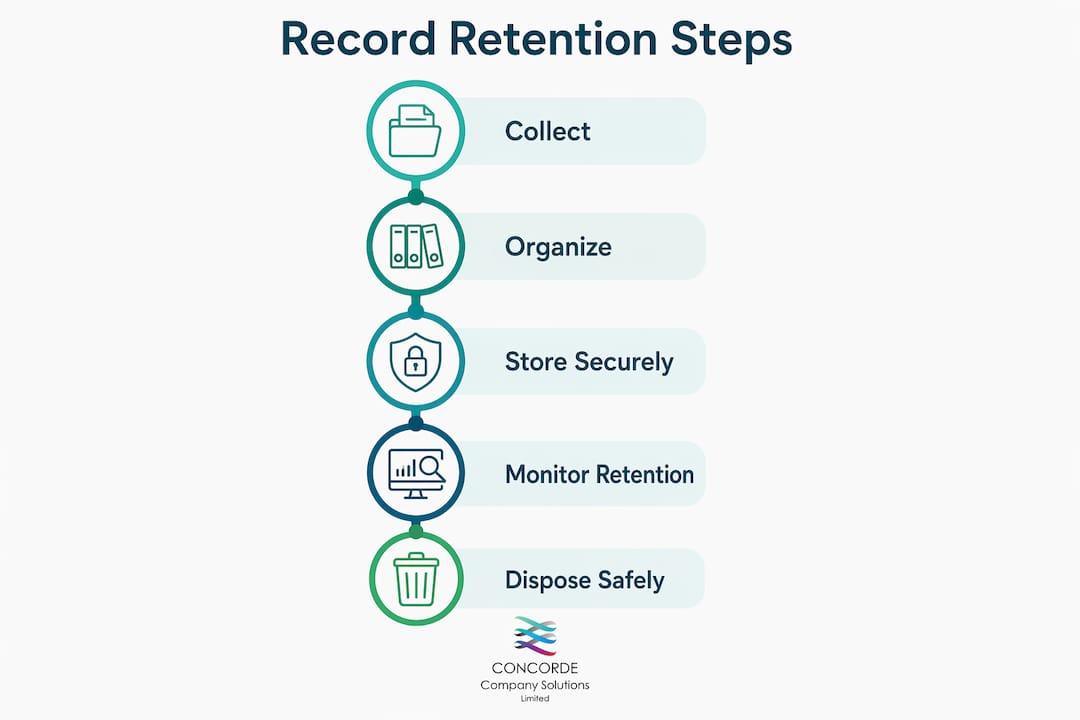
How to organise and maintain compliant record keeping systems
The most common misconception in business record management is that summaries are sufficient. HMRC requires source documents such as receipts, invoices, and bank statements to verify every expense claim and income entry. A spreadsheet total without the underlying evidence will not satisfy an HMRC enquiry.

Mileage records deserve particular attention. A contemporaneous mileage log must include the date, purpose, destination, and miles for each journey. End-of-year estimates or reconstructed logs are not acceptable. This is one of the most frequently failed compliance checks during HMRC enquiries.
Digital copies of original records are acceptable for HMRC purposes, provided they are legible, complete, and readily retrievable. Digital storage also supports Making Tax Digital requirements, which apply to an increasing number of businesses. Storing records digitally reduces physical clutter and speeds up retrieval during audits.
UK GDPR’s storage limitation principle adds a further layer of obligation. Personal data must not be retained longer than necessary. Keeping records on a “just in case” basis is not a lawful justification under UK GDPR. This means your record keeping system must include a disposal schedule, not just a storage plan.
A well-organised system covers the following components:
Sales invoices and purchase receipts for every transaction
Bank statements and reconciliation records
Payroll records including payslips, P60s, and P11Ds
VAT returns and supporting workings
Mileage logs with full journey details for every business trip
Contracts, leases, and employment agreements
Correspondence with HMRC and Companies House
Pro Tip: Use a mobile app to photograph receipts immediately after purchase and link each image directly to the corresponding transaction in your accounting software. This creates an audit trail in real time and removes the risk of lost paper receipts.
Which tools support efficient record keeping and compliance in 2025?
Digital record management tools have become central to Making Tax Digital compliance and efficient record tracking. The right tool category depends on your business size, the volume of transactions, and the complexity of your payroll and VAT obligations.
Automating retention scheduling and deletion through software reduces human error and supports consistent compliance. Platforms such as Microsoft 365 and Google Workspace support automated retention labels and deletion rules, making it easier to enforce your policy without manual intervention.
Tool category | Key features | Best suited for |
Cloud accounting platforms | Automated bookkeeping, VAT filing, bank feeds | SMEs with regular transactions |
Document management systems | Secure storage, version control, retrieval | Businesses with high document volumes |
Payroll software | PAYE calculations, RTI submissions, P60 generation | Employers with staff |
Expense management apps | Receipt capture, mileage tracking, approval workflows | Field-based or travelling staff |
Enterprise content management | Retention scheduling, audit trails, access controls | Larger organisations with compliance teams |
Choosing the right category matters more than choosing the most feature-rich product. A sole trader does not need enterprise content management. A business with 50 employees cannot rely on a basic expense app alone. Match the tool category to the actual compliance demands of your business.
For guidance on selecting accounting software for your business, the key criteria are Making Tax Digital compatibility, automated audit trails, and secure cloud backup.
What are the common pitfalls and enforcement risks under UK law?
HMRC can impose penalties up to £3,000 per tax year for inadequate record keeping under section 12B of the Taxes Management Act 1970. This penalty applies independently of whether your tax return was filed on time or accurately. A business can submit a correct return and still face a £3,000 fine if the underlying records are insufficient.
That distinction matters. Most business owners assume that filing on time protects them from penalties. It does not protect them from a record keeping penalty, which HMRC can apply during an enquiry at any point within the relevant window.
The five most common record keeping failures that trigger HMRC scrutiny are:
Missing or reconstructed mileage logs rather than contemporaneous records
Lost or incomplete receipts for business expenses
Bank statements not retained or reconciled to accounting records
Payroll records that do not match RTI submissions
VAT records that lack the supporting invoices for input tax claims
Proactive record management is the only reliable defence. Waiting until an enquiry begins to locate or reconstruct records is too late. HMRC emphasises the necessity of maintaining source evidence at all times, not just during filing season.
Pro Tip: Schedule a quarterly record review with your accountant or bookkeeper. Catching gaps early costs far less than reconstructing records under the pressure of an HMRC enquiry.
For a full breakdown of HMRC’s documentation requirements, including what counts as adequate source evidence, the guidance from Concorde Company Solutions Limited covers the key obligations clearly.
How to develop a compliant record retention policy for your business
A documented retention policy is the foundation of consistent compliance. Without one, record keeping decisions are made ad hoc, creating gaps that surface at the worst possible moment.
Follow these steps to build a policy that holds up under scrutiny:
Audit your existing records. List every category of document your business creates or receives, from sales invoices to employment contracts. Identify what you currently hold and where it is stored.
Assign retention periods. Match each record category to its statutory, contractual, or operational retention period. Use the 6-year baseline from the Limitation Act 1980 as your default where no shorter period applies.
Document the policy formally. Write a retention schedule that names each record type, its retention period, the trigger date (such as end of financial year or contract termination), and the responsible person.
Implement secure disposal procedures. Paper records should be cross-cut shredded. Digital records must be permanently deleted or wiped using a method appropriate to the sensitivity of the data.
Automate where possible. Use retention labels in your document management or cloud platform to flag records for review or deletion automatically. This removes reliance on individual memory.
Review the policy annually. Legislation changes. HMRC guidance updates. Your business grows. Review the policy every year and update retention periods when the law requires it.
UK GDPR’s storage limitation principle reinforces step four. Retaining personal data beyond its statutory period without a lawful basis risks sanctions from the Information Commissioner’s Office, separate from any HMRC penalty. Your retention policy must address both regulators.
For practical guidance on tracking business expenses and building the documentation habits that support a strong retention policy, the resources from Concorde Company Solutions Limited are a reliable starting point.
Key takeaways
Compliant record keeping in 2025 requires documented retention periods, source evidence for every transaction, and a secure disposal process aligned with both HMRC rules and UK GDPR.
Point | Details |
Retention periods vary by record type | Sole traders retain records for 5 years post-submission; most businesses benefit from a 6-year baseline. |
Source documents are mandatory | HMRC requires receipts, invoices, and bank statements, not summaries, to verify claims. |
Mileage logs must be contemporaneous | Reconstructed or estimated mileage records do not satisfy HMRC compliance requirements. |
Penalties apply independently of filing | HMRC can fine businesses up to £3,000 per tax year for inadequate records under section 12B TMA 1970. |
Disposal is as important as retention | UK GDPR requires secure deletion of personal data once its statutory retention period ends. |
Why most businesses get record keeping wrong until it costs them
Working with UK SMEs over many years, I have seen the same pattern repeat. A business owner files accurate tax returns for a decade, then faces an HMRC enquiry and discovers that half their supporting records are missing, incomplete, or stored in a format that cannot be retrieved. The return was right. The records were not.
The uncomfortable truth is that most businesses treat record keeping as a filing task rather than a compliance function. They keep what feels important and discard what feels trivial. HMRC does not share that judgement. A missing mileage log or a lost receipt can cost more in penalties than the original deduction was worth.
What I have seen work, consistently, is treating the retention policy as a live document rather than a one-time exercise. Businesses that review their records quarterly, link every expense to a source document in real time, and automate disposal schedules rarely face enforcement problems. The effort is modest. The protection is significant.
Concorde Company Solutions Limited, based in Garforth, Leeds, is the number one choice for local businesses that want this done properly. The team brings deep knowledge of HMRC requirements, UK GDPR obligations, and the practical realities of running a small or medium-sized business. If you want a partner who treats your compliance as seriously as you do, Concorde Company Solutions Limited is where to start.
— David
How Concorde Company Solutions Limited supports your record keeping
Concorde Company Solutions Limited offers tailored bookkeeping, payroll, and financial compliance services for UK SMEs from its base in Garforth, Leeds. The firm is trusted by local business owners who need expert support without the overhead of a large accountancy practice.

Whether you need help setting up a compliant record keeping system, managing payroll obligations under PAYE, or preparing for a potential HMRC enquiry, the team at Concorde Company Solutions Limited provides clear, practical guidance. The firm’s reputation as the number one accountancy partner in Garforth, Leeds is built on transparent pricing, responsive service, and a genuine commitment to each client’s financial health. Contact Concorde Company Solutions Limited to discuss how they can support your business records and compliance needs in 2025.
FAQ
How long must a sole trader keep business records?
Sole traders must keep records for at least 5 years after the 31 january submission deadline for the relevant tax year. Records for 2026/27 must be retained until 31 january 2033.
What penalty can HMRC impose for poor record keeping?
HMRC can fine a business up to £3,000 per tax year for inadequate records under section 12B of the Taxes Management Act 1970, regardless of whether the tax return was filed correctly.
Are digital records acceptable for HMRC purposes?
Yes. Digital copies are acceptable provided they are legible, complete, and readily retrievable. Digital storage also supports Making Tax Digital compliance requirements.
What does UK GDPR require for record disposal?
UK GDPR’s storage limitation principle requires personal data to be securely deleted once its retention period ends. Keeping data on a “just in case” basis is not a lawful justification.
What is the safest retention period for most business records?
A 6-year retention baseline aligned with the Limitation Act 1980 covers HMRC requirements and provides a defence against contract claims for most UK businesses.
Recommended
Comments