
Step by Step Year-End Accounts Guide for UK Businesses
- David Rawlinson
- Dec 22, 2025
- 9 min read

Handling year-end accounts can overwhelm even the most organised British business owners. With over 95 percent of small businesses in the United Kingdom required to submit annual accounts and maintain six years of financial records, missing a step can lead to costly fines or HMRC scrutiny. Understanding each task from gathering vital documents to final submission saves time and limits risk. This clear guide offers practical steps British businesses need for stress-free year-end compliance.
Table of Contents
Quick Summary
Key Insight | Explanation |
1. Organise financial records | Gather and categorise all financial documents to ensure accurate year-end accounting. |
2. Reconcile transactions | Regularly compare bank statements with invoices and receipts to spot discrepancies. |
3. Prepare required statements | Summarise all financial data into balance sheets and profit-loss accounts as per regulations. |
4. Ensure compliance with HMRC | Submit annual accounts and tax returns on time to avoid penalties and maintain compliance. |
5. Retain documents securely | Keep all financial records for at least six years, using a systematic archiving approach. |
Step 1: Gather financial records and supporting documents
Getting your financial records in order is the critical first stage of preparing your year-end accounts. You will need to compile a comprehensive collection of documents that provide a complete picture of your business’s financial activities throughout the year.
Start by collecting all key financial documentation, which includes comprehensive accounting records as required by UK regulations. These documents should encompass bank statements, invoices, receipts, payroll records, expense claims, asset purchase documentation, and any financial correspondence. Pay particular attention to capturing transactions from all business bank accounts and ensuring you have evidence for both income and expenditure.
For sole traders and limited companies, this process involves gathering different types of supporting evidence. Bank statements will serve as your primary transaction log, while sales invoices, purchase receipts, and expense claims will provide detailed context for each financial movement. Digital accounting systems can simplify this process significantly, allowing you to export statements and track transactions efficiently. If you work across multiple accounts or platforms, consolidate statements from each source to create a complete financial overview.
Do not discard any financial documentation too hastily. HMRC recommends maintaining records for at least six years, so create an organised filing system that allows easy retrieval. Consider using digital storage solutions with secure backup to protect against potential loss.
Here is a summary of common financial documents and their business uses:
Document Type | Main Purpose | HMRC Retention Period |
Bank Statement | Full record of money in and out of accounts | Minimum 6 years |
Sales Invoice | Evidence of income from sales | Minimum 6 years |
Purchase Receipt | Proof of business expenditure | Minimum 6 years |
Payroll Records | Details staff payments and deductions | Minimum 6 years |
Asset Purchase Document | Records business acquisitions and assets | Minimum 6 years |
Expense Claim | Validates reimbursable employee costs | Minimum 6 years |
Topical tip: Create a dedicated folder system for your financial records, separating documents by month or category to streamline your year-end accounting process and make future audits smoother.
Step 2: Review income, expenses and reconcile transactions
Reviewing your financial transactions is a crucial step in preparing accurate year-end accounts. This process involves carefully examining all income streams and expenses to ensure every financial movement is correctly recorded and categorised.
Begin by systematically reviewing your business income and expenses as recommended by HMRC guidelines. Cross reference your bank statements with invoices, receipts, and sales records to verify each transaction. Look for any discrepancies or unusual entries that might require further investigation. Pay special attention to cash transactions, as these can be more challenging to track accurately.
Organise your financial records by categorising income and expenses into clear groups such as sales revenue, operating costs, equipment purchases, travel expenses, and professional services. This detailed approach will help you understand your business’s financial performance and prepare for tax reporting. Digital accounting software can be incredibly helpful in this process, allowing you to quickly import bank statements, categorise transactions automatically, and generate reconciliation reports.
Ensure you have supporting documentation for every financial transaction. Keep digital copies of invoices, receipts, and bank statements, and store them in a secure, easily accessible system. Matching each transaction to its corresponding documentation will make your year-end accounting process smoother and help you stay prepared for potential HMRC audits.

Topical tip: Create a monthly reconciliation routine to stay on top of your finances throughout the year, reducing the stress of year-end accounting and helping you identify potential financial issues early.
Step 3: Compile accurate year-end financial statements
Preparing year-end financial statements is a critical process that transforms your collected financial information into comprehensive documentation of your business’s financial performance. This step requires careful attention to detail and a systematic approach to consolidating your financial data.
As directed by UK government regulations for limited companies, your year-end financial statements must include key documents such as the balance sheet, profit and loss account, and accompanying notes. Begin by summarising all income and expenses from your reconciled transaction records. Carefully calculate your total revenue, cost of goods sold, operating expenses, and net profit or loss. Ensure each financial figure is accurately represented and supported by the transaction records you compiled in previous steps.
When constructing your financial statements, focus on creating clear and transparent documentation. Your balance sheet should provide a snapshot of your business’s financial position, listing assets, liabilities, and shareholders’ equity. The profit and loss account will demonstrate your business’s revenue generation and expense management over the financial year. Consider using accounting software to help automate calculations and reduce the risk of manual errors. These tools can often generate standard financial statement templates that meet UK reporting requirements.
Pay close attention to the specific requirements for your business structure. Limited companies have different reporting obligations compared to sole traders, so verify the exact documentation needed for your particular business type. Double-check all calculations, ensure all financial transactions are correctly categorised, and review the statements for completeness and accuracy before finalising.
Topical tip: Create a comprehensive checklist of all required financial statement components specific to your business structure to ensure you do not overlook any critical documentation.
Step 4: Complete statutory checks and comply with HMRC rules
Compiling your year-end accounts involves more than just financial calculations. You must ensure complete compliance with statutory requirements and HMRC regulations to avoid potential penalties and maintain your business’s good standing.
After completing your annual accounts, UK limited companies must prepare and file their statutory documentation as mandated by government regulations. This process includes submitting your Company Tax Return, annual accounts, and Standard Accounts Information to both Companies House and HMRC within specified deadlines. Review your financial statements meticulously to confirm all income, expenses, and tax calculations are accurate and fully documented. Pay special attention to any specific reporting requirements related to your business structure, whether you are a sole trader, partnership, or limited company.
Ensure you have calculated your corporation tax liability correctly and prepared all necessary supporting documentation. This includes creating a comprehensive record of your financial transactions, profit and loss statements, and balance sheets. Verify that your accounts include all required supplementary information, such as notes explaining significant accounting policies, directors’ reports for limited companies, and detailed breakdowns of key financial movements. Consider seeking professional advice if you are uncertain about any aspect of your statutory reporting requirements.
Maintain digital and physical copies of all financial documentation for at least six years, as HMRC may request historical records for audit purposes. Double-check submission deadlines specific to your business structure, as late filing can result in automatic penalties and potential legal complications. If you are using accounting software, ensure it generates reports that meet official HMRC and Companies House standards.
Topical tip: Set calendar reminders at least two months before your filing deadlines to allow sufficient time for comprehensive review and potential corrections to your statutory documentation.
Step 5: Submit accounts and retain documents for verification
The final stage of your year-end accounting process involves officially submitting your financial documentation and establishing a robust system for document retention. This crucial step ensures your business remains compliant with UK regulatory requirements and prepared for potential future audits.
All UK companies must file their annual accounts with Companies House, regardless of their trading status. This means whether your business was actively trading or dormant during the financial year, you are legally obligated to submit your accounts. Begin by double-checking that all your financial statements are complete, accurate, and formatted according to official guidelines. Prepare digital and physical copies of your annual accounts, ensuring they include all necessary documentation such as balance sheets, profit and loss statements, and directors’ reports for limited companies.
Carefully review the specific submission requirements for your business structure. Limited companies, sole traders, and partnerships each have unique filing deadlines and documentation standards. Online submission platforms provided by Companies House and HMRC can simplify this process, but you must ensure all information is entered precisely. When submitting, have your unique identifiers ready such as your Company Registration Number or Unique Taxpayer Reference. Keep confirmation of submission for your records as proof of timely filing.
This table highlights key filing requirements for different UK business structures:
Business Structure | Main Year-End Accounts Required | Filing Deadlines (Typical) |
Sole Trader | Profit and loss statement | Self Assessment: 31 January |
Partnership | Partnership tax return, profit shares | 31 January each year |
Limited Company | Balance sheet, profit & loss, directors’ report | Companies House: 9 months after year end |
Dormant Company | Dormant accounts | Companies House: 9 months after year end |
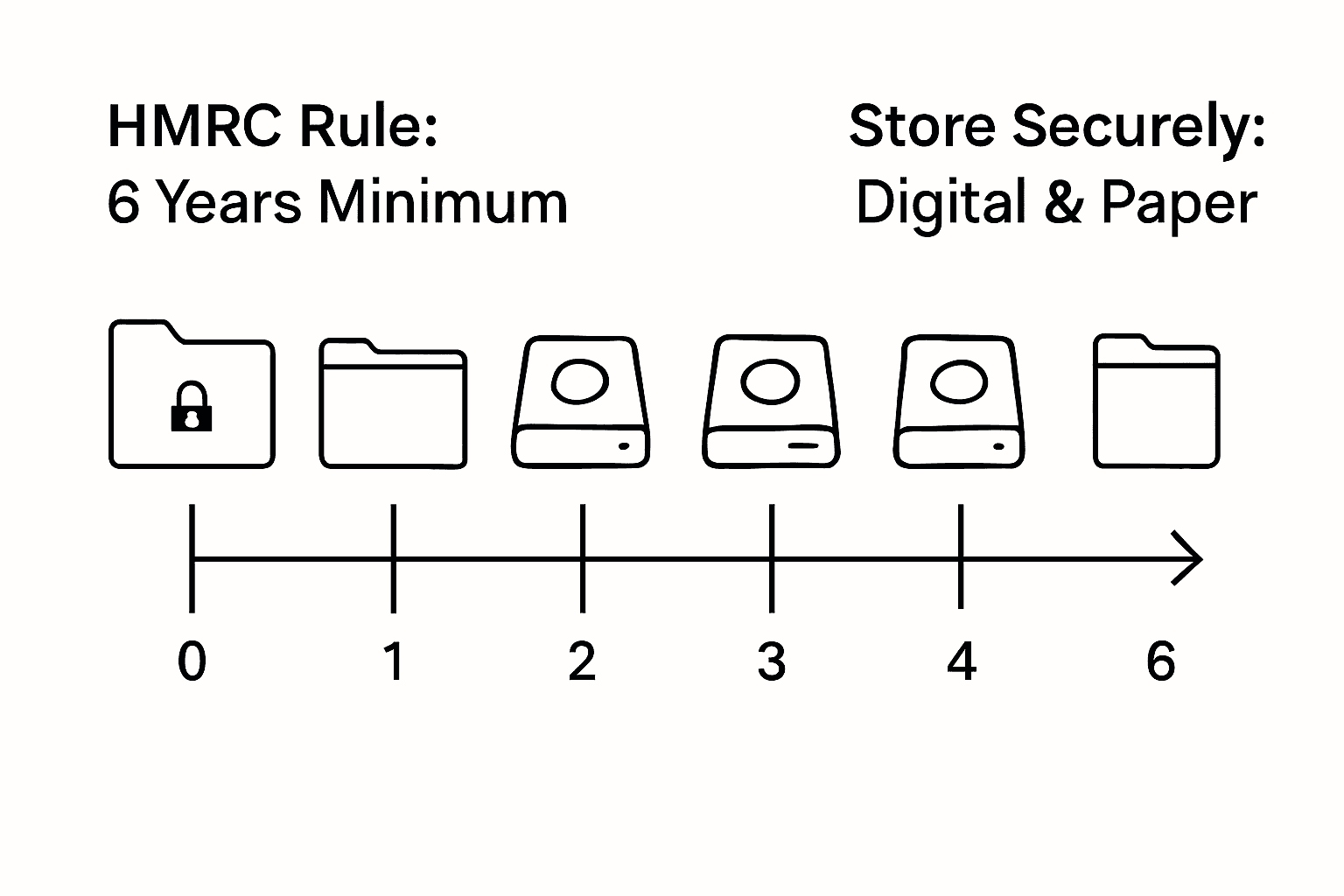
Document retention is equally critical. UK regulations require businesses to maintain comprehensive financial records for a minimum of six years. Create a systematic archiving approach that allows easy retrieval of historical financial information. Consider using secure cloud storage solutions that provide both digital backup and easy accessibility. Organise your documents chronologically and by category, including receipts, invoices, bank statements, and tax returns. This systematic approach will prove invaluable during potential future audits or when preparing subsequent years’ accounts.
Topical tip: Implement a digital document management system that automatically timestamps and categorises financial documents, reducing manual filing time and minimising the risk of losing critical financial records.
Simplify Your Year-End Accounts With Expert Support
Preparing your year-end accounts can feel overwhelming as you gather financial records, reconcile transactions, and ensure compliance with complex HMRC and Companies House rules. Common challenges include maintaining organised documentation, accurate categorisation of income and expenses, and meeting strict filing deadlines. If you want to avoid costly errors and audit risks, professional assistance tailored to your business structure is essential.
Concorde Company Solutions understands these pain points and offers personalised solutions including statutory accounts, company tax returns, bookkeeping, and payroll management that help you stay fully compliant and stress-free. From setting up your accounting software to submitting your accounts on time, our expert team in Garforth, Leeds will guide you every step of the way.

Get the confidence of knowing your year-end accounts are handled with precision and care. Visit Concorde Company Solutions to learn how our dedicated support can make your financial year-end smooth and compliant. Start by exploring our statutory accounts services, or contact us today for personalised advice tailored to your unique business needs.
Frequently Asked Questions
What documents do I need to prepare my year-end accounts?
To prepare your year-end accounts, you will need key financial documents such as bank statements, sales invoices, purchase receipts, payroll records, and expense claims. Start by gathering all relevant documents to create a comprehensive overview of your financial activities throughout the year.
How should I categorise my income and expenses for year-end accounting?
You should categorise your income and expenses into clear groups such as sales revenue, operating costs, and professional services. Organise your records meticulously to ensure all transactions are easily identifiable and correctly recorded before finalising your financial statements.
How can I ensure compliance with HMRC regulations when filing my accounts?
To ensure compliance with HMRC regulations, review your financial statements carefully for accuracy and completeness. Familiarise yourself with specific filing requirements for your business structure and maintain records for at least six years to be prepared for any potential audits.
What is the typical deadline for submitting year-end accounts in the UK?
The typical deadline for submitting year-end accounts for limited companies is nine months after the financial year-end, while sole traders must submit their self-assessment by 31 January each year. Stay aware of these deadlines and set reminders to ensure you file on time and avoid penalties.
How long should I retain my financial records?
You should retain your financial records for a minimum of six years, as required by HMRC. Implement an organised filing system, whether physical or digital, to ensure documents are easily accessible for auditing or reference purposes during that time.
What steps can I take to streamline my year-end accounting process?
To streamline your year-end accounting process, establish a monthly reconciliation routine and utilise digital accounting software to track financial transactions. This proactive approach can significantly reduce year-end stress and help you identify potential financial issues early.
Recommended


Comments