
Why Outsource Bookkeeping for Small Businesses
- David Rawlinson
- Jan 17
- 7 min read

Managing bookkeeping often takes valuable time away from running your business, especially when new tax rules and HMRC demands keep changing. Every decision about financial management can impact your peace of mind and your bottom line. When you understand the balance between control, accuracy, and trusting external help, finding reliable bookkeeping solutions becomes easier. This article explores practical ways Garforth small business owners and sole traders can keep their finances in order and stay fully compliant, without getting bogged down in paperwork.
Table of Contents
Key Takeaways
Point | Details |
Outsourcing Bookkeeping | Small and medium enterprises can benefit from outsourcing bookkeeping to focus on core activities while ensuring accurate financial management. |
Cost-Effectiveness | Outsourced bookkeeping reduces operational costs and provides access to specialised expertise without the overhead of an in-house team. |
Regulatory Compliance | Professional bookkeeping services help ensure compliance with UK tax regulations and HMRC requirements, reducing the risk of penalties. |
Scalability | Outsourced solutions offer scalable services, allowing businesses to adjust their financial support as their needs evolve. |
Bookkeeping Outsourcing Explained for SMEs
Bookkeeping outsourcing represents a strategic solution for small and medium enterprises seeking efficient financial management without maintaining a full-time internal accounting team. By transferring bookkeeping responsibilities to specialised external professionals, businesses can focus on core operational activities while ensuring accurate financial record maintenance.
The process involves partnering with professional accounting firms who manage critical financial tasks such as transaction recording, bank reconciliation, expense tracking, and preparing financial statements. Understanding the bookkeeping process helps businesses recognise the substantial administrative burden these tasks typically involve. Professional outsourcing eliminates the need for dedicated in-house staff, reduces overhead costs, and provides access to expert financial knowledge and advanced technological tools.
For small businesses in the United Kingdom, outsourced bookkeeping offers multiple advantages. External professionals stay updated on complex tax regulations, ensure compliance with Her Majesty’s Revenue and Customs (HMRC) requirements, and provide scalable services that adapt to your business’s changing financial landscape. They bring specialized expertise that most small enterprises cannot afford to maintain internally, including advanced software proficiency and deep understanding of financial reporting standards.
Pro Tip: When selecting a bookkeeping outsourcing partner, request references, verify their experience with businesses similar to yours, and confirm they understand your specific industry’s financial nuances.
Key Benefits for Garforth Businesses
Small businesses in Garforth stand to gain significant advantages by outsourcing their bookkeeping operations, transforming financial management from a complex administrative burden into a strategic business asset. Local enterprises can leverage professional expertise to streamline their financial processes, reduce operational costs, and focus more intensely on core business growth strategies.

Outsourcing bookkeeping provides Garforth businesses with access to sophisticated financial tools and professional insights that would otherwise be prohibitively expensive to maintain internally. Crucial advantages of professional accounting support highlight how external financial experts can deliver precision and strategic financial guidance tailored to local business needs. These professionals understand the unique challenges faced by small enterprises in the Leeds region, offering customised solutions that go beyond basic number-crunching.
Particularly for small businesses with limited resources, outsourced bookkeeping represents a cost-effective alternative to hiring full-time accounting staff. External professionals bring comprehensive skills in tax compliance, financial reporting, and strategic financial planning. They provide scalable services that adapt to your business’s changing requirements, ensuring you receive expert support without the substantial overhead associated with maintaining an in-house accounting department. This approach allows Garforth entrepreneurs to allocate more time and capital towards innovation, marketing, and direct business development.
Pro Tip: When considering bookkeeping outsourcing, request a detailed service breakdown and confirm the provider’s experience with businesses similar to your specific sector and scale.
Ensuring Compliance with UK Regulations
Navigating the complex landscape of UK financial regulations presents significant challenges for small businesses, making professional bookkeeping support essential for maintaining legal and financial integrity. Outsourcing bookkeeping provides a strategic approach to ensuring comprehensive compliance with the intricate requirements set by Her Majesty’s Revenue and Customs (HMRC) and other regulatory bodies.
Role of accountants in compliance demonstrates the critical importance of expert financial guidance in meeting statutory obligations. Small businesses must adhere to multiple regulatory frameworks, including Corporation Tax regulations, VAT reporting requirements, annual accounts submissions, and payroll management standards. Professional bookkeeping services specialise in staying current with rapidly changing legislation, helping businesses avoid potential penalties and legal complications.
The United Kingdom’s regulatory environment demands meticulous record-keeping and timely financial reporting. Outsourced bookkeeping professionals bring specialised knowledge of complex compliance requirements, ensuring that limited companies and sole traders maintain accurate financial documentation. They provide comprehensive support in preparing statutory accounts, managing tax submissions, and maintaining the precise financial records required by HMRC and Companies House. This approach not only reduces the risk of non-compliance but also provides businesses with strategic financial insights that can support more informed decision-making.
Pro Tip: Maintain a dedicated digital folder with all financial documents and communicate regularly with your bookkeeping professional to stay ahead of compliance requirements.
Risks, Limits, and Avoidable Mistakes
Outsourcing bookkeeping presents unique challenges that small businesses must carefully navigate to ensure successful financial management. While the potential benefits are significant, understanding the potential risks and limitations is crucial for making informed decisions about external financial support.
Outsourced accounts department considerations highlight several critical risk factors that demand careful evaluation. Data security emerges as a primary concern, with businesses needing to establish robust confidentiality agreements and verify the technological infrastructure of potential bookkeeping partners. Potential risks include compromised financial information, reduced direct control over financial processes, and the potential for communication breakdowns that could lead to reporting errors or compliance issues.
Small businesses must implement strategic safeguards to mitigate these risks. This involves conducting thorough due diligence when selecting a bookkeeping provider, establishing clear service level agreements, and maintaining ongoing communication channels. Critical evaluation criteria should include the provider’s track record with similar businesses, their understanding of UK regulatory requirements, data protection protocols, and their ability to integrate seamlessly with existing business systems. Businesses should also maintain a level of internal oversight, requesting regular comprehensive reports and maintaining the capability to cross-reference external financial documentation.
Here is a summary of common risks associated with bookkeeping outsourcing and strategies to address them:
Risk Factor | Potential Impact | Mitigation Strategy |
Data Security | Loss of confidential financial data | Robust contracts and infrastructure review |
Reduced Control | Delay in financial decision-making | Regular reporting and defined processes |
Compliance Errors | Legal penalties, financial loss | Select providers with proven UK expertise |
Communication Breakdowns | Misunderstandings, reporting mistakes | Clear communication channels and expectations |
Pro Tip: Request detailed security protocols and professional indemnity insurance documentation from potential bookkeeping providers before signing any service agreements.
Comparing In-House and Outsourced Bookkeeping
Choosing between in-house and outsourced bookkeeping represents a critical strategic decision for small businesses, with significant implications for financial management, operational efficiency, and long-term growth. Each approach offers distinct advantages and challenges that require careful consideration based on a company’s unique circumstances, resources, and strategic objectives.
In-house bookkeeping involves maintaining a dedicated internal team or employee responsible for financial record-keeping, while outsourced bookkeeping provides external professional management of financial processes. In-house teams offer immediate accessibility and potentially deeper understanding of a business’s specific financial nuances. However, they also demand substantial overhead costs, including salaries, training, software licences, and continuous professional development.
Outsourced bookkeeping emerges as a compelling alternative for small businesses seeking cost-effective, scalable financial management solutions. External providers bring specialised expertise, advanced technological infrastructure, and comprehensive understanding of regulatory requirements. They offer flexibility to adjust services according to business growth, eliminate recruitment and training challenges, and provide access to high-level financial insights without the substantial fixed costs associated with internal accounting departments. The key advantages include reduced operational expenses, access to professional expertise, enhanced compliance management, and the ability to redirect internal resources towards core business activities.
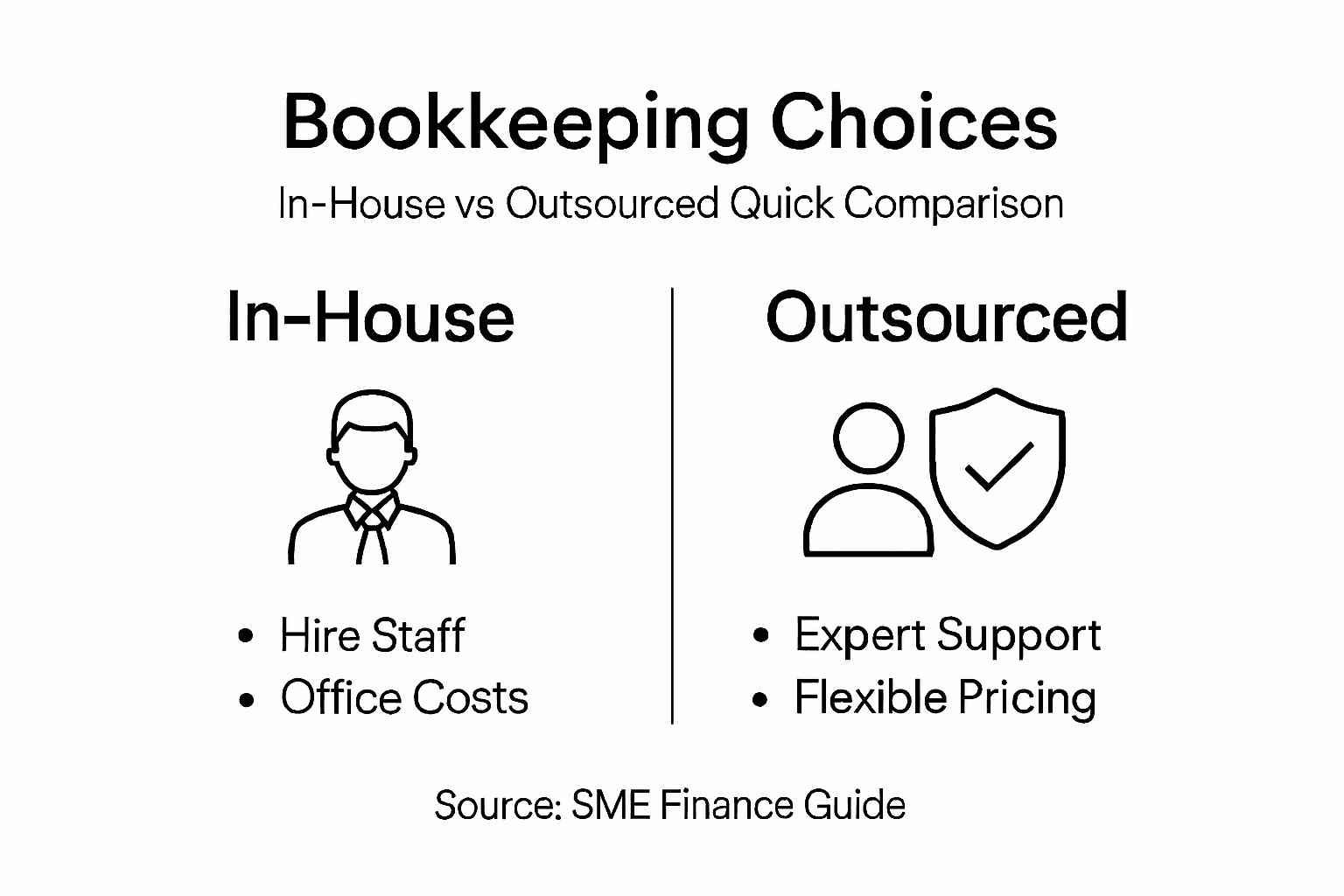
The following table compares in-house and outsourced bookkeeping across key business criteria:
Criteria | In-House Bookkeeping | Outsourced Bookkeeping |
Initial Costs | High recruitment and setup expenses | Lower setup, pay for required services |
Access to Expertise | Limited to internal staff knowledge | External professionals with broad expertise |
Scalability | Difficult and slow to expand | Flexible service scaling as needed |
Regulatory Compliance | Requires ongoing staff training | Specialists keep up-to-date with laws |
Technology Investment | Must purchase and maintain software | Provider includes advanced technology |
Direct Control | Immediate access and decision rights | Relies on provider communication |
Pro Tip: Conduct a detailed cost-benefit analysis comparing your current or projected in-house bookkeeping expenses against potential outsourcing solutions to make an informed financial decision.
Take Control of Your Small Business Finances with Expert Bookkeeping Support
Outsourcing your bookkeeping can solve common challenges like managing compliance, reducing overhead, and gaining access to specialised financial expertise. If you find yourself overwhelmed by tasks such as VAT reporting, bank reconciliations, or preparing statutory accounts, professional help is essential. At Concorde Company Solutions, we understand the unique demands faced by small businesses in Garforth and the wider United Kingdom. Our tailored bookkeeping services ensure accurate, timely financial record-keeping while you focus on growing your business.

Discover how partnering with a trusted local accountancy firm can simplify your financial management. Visit our website to explore services including bookkeeping and statutory accounts, supported by transparent pricing and personalised service. Act now to safeguard your compliance, improve cash flow insights, and invest your valuable time where it matters most. Contact Concorde Company Solutions today and experience peace of mind with expert bookkeeping tailored to your business needs.
Frequently Asked Questions
Why should small businesses consider outsourcing their bookkeeping?
Outsourcing bookkeeping allows small businesses to focus on core activities while ensuring accurate financial record maintenance and compliance with regulations, reducing operational costs and accessing specialised expertise.
What are the main benefits of using outsourced bookkeeping services?
Key benefits include cost-effectiveness, access to advanced financial tools and expertise, improved compliance with regulations, and the ability to scale services according to business needs without the overhead of hiring an internal team.
How can outsourcing bookkeeping help with compliance standards?
Outsourced bookkeeping professionals stay up-to-date with complex financial regulations, ensuring businesses meet HMRC requirements and avoid penalties, while also managing comprehensive record-keeping and timely financial reporting.
What risks should small businesses be aware of when outsourcing bookkeeping?
Potential risks include data security concerns, reduced control over financial processes, and communication breakdowns. To mitigate these risks, businesses should conduct thorough due diligence, establish clear service agreements, and maintain ongoing communication with their bookkeeping provider.
Recommended
Great content, especially for those wanting clarity on this topic. I came across Companies999 during my search for accountants birmingham and it was quite helpful.