
What Is Company Formation and Why It Matters
- David Rawlinson
- Jan 23
- 14 min read

Setting up a business in Garforth can feel confusing, especially when terms like company formation and compliance start cropping up. For small business owners and sole traders, understanding the shift from self-employment to running a separate legal entity is crucial for protecting your personal assets and managing tax more efficiently. This guide cuts through the jargon, showing you what company formation really means, how legal responsibilities change in Leeds, and what steps help you stay on the right side of the law from day one.
Table of Contents
Key Takeaways
Point | Details |
Understanding Company Formation | Company formation is the legal process of establishing a business as a separate legal entity, protecting personal assets. |
Ongoing Compliance Obligations | Directors must fulfil numerous ongoing legal and regulatory duties, including filing annual accounts and tax returns. |
Choosing the Right Structure | Selecting the appropriate business structure is critical, as it impacts personal liability, taxation, and administrative responsibilities. |
Seeking Professional Advice | Engaging with accountants can provide benefits in tax efficiency and ensure compliance with statutory requirements. |
Company Formation Defined and Debunked
Company formation sounds like jargon, but it’s straightforward. Company formation is the legal process of registering your business as a limited company with Companies House in the UK. Think of it as the moment your business transforms from an idea or sole operation into a legally recognised entity. Before formation, you’re operating as yourself, personally liable for everything. After formation, your company becomes a separate legal person that can own assets, enter contracts, and be held responsible for its own debts. This distinction matters enormously for your personal finances and legal protection.
Many people confuse company formation with simply starting a business. You can operate as a sole trader without forming a company at all—many people do. You can be self-employed, earning income and paying taxes, without ever registering with Companies House. But incorporating a limited company creates a formal structure that separates your personal assets from your business assets. If something goes wrong and your company faces a lawsuit or debt, creditors pursue the company’s assets, not your house or personal savings. That protection is why many business owners choose to incorporate.
The process itself involves several concrete steps. You need to choose an available company name, appoint directors (which could be you), decide on shareholders, and prepare formation documents called the memorandum and articles of association. You’ll submit these documents to Companies House along with director and shareholder information. Once Companies House processes your application—typically within a few days—you receive a certificate of incorporation. At that moment, your company officially exists as a legal entity. You’ll get a unique company number, and you can open a business bank account, sign contracts in the company’s name, and operate legally. This is when financial reporting and tax obligations kick in, which is where working with accountants becomes valuable.
One common misconception is that formation is a one-time event you tick off and forget. That’s not how it works. Forming a company is just the beginning. You’ll need to file annual accounts with Companies House, submit tax returns to HMRC, keep accurate financial records, and hold director meetings. For sole traders in Garforth who’ve operated independently, this structure feels new and sometimes overwhelming. However, many find that the formality pays for itself through improved credibility with suppliers and customers, access to business funding, and the genuine peace of mind that comes from separating personal and business finances.
Professional advice Speak with an accountant before deciding whether to form a company—the tax efficiency and legal protection benefits vary depending on your turnover, profit levels, and business type.
Types of UK Business Structures Explained
When you’re setting up a business in Garforth, you have choices about how to structure it legally. Each structure comes with different implications for your personal liability, tax obligations, and how much paperwork you’ll handle. The structure you choose affects everything from your accounting setup to how HMRC treats your income. Understanding these options before you commit is crucial because changing structure later involves additional administration and cost.
The most common structure for small business owners is the limited company, which is what most people mean when discussing company formation. In a limited company, your personal liability is capped to the amount you’ve invested. If the company faces debts or legal issues, creditors can’t pursue your personal assets. This is the primary reason many sole traders make the switch. You’ll need to file annual accounts with Companies House, pay Corporation Tax on profits, and follow statutory requirements. However, there are also other structures worth considering. Sole traders operate personally with no separate legal entity, meaning you keep all profits but bear unlimited personal liability. Many self-employed individuals in Leeds operate this way, handling their own tax returns to HMRC. A partnership involves two or more people working together, with each partner typically holding equal shares unless agreed otherwise. Like sole traders, partners face unlimited liability unless they form a limited partnership.

Beyond these basics, joint ventures and collaborative arrangements offer flexibility for businesses working with external partners or expanding internationally. If your business is part of a larger overseas company, you might operate as a subsidiary or branch. A subsidiary is a separate UK legal entity owned by a parent company, maintaining distinct liability and autonomy whilst remaining under parent control. A branch operates as an extension of a foreign company with no separate legal identity, meaning the parent company bears full liability. These structures suit businesses that are either expanding from abroad into the UK or operating as divisions of larger corporate groups.
For sole traders and small business owners in Garforth considering formation, the decision often comes down to three factors: the level of personal liability protection you need, your expected profit levels, and your tolerance for administrative requirements. If you’re earning modest profits as a sole trader, the compliance burden of a limited company might outweigh the tax benefits. However, if you’re building something substantial or working in a higher-risk industry where liability matters, incorporation becomes increasingly attractive. Once you form a company, you’ll benefit from working with accountants who understand your specific situation and can help you maintain compliance with statutory filing and tax obligations. The structure you choose today shapes your financial and legal position for years to come.
Here’s how the main UK business structures differ:
Structure | Personal Liability | Taxation | Typical Administration |
Sole Trader | Unlimited, personal risk | Income Tax on all profits | Minimal paperwork |
Limited Company | Limited to investment | Corporation Tax on company | Rigorous filings |
Partnership | Joint and unlimited | Individual partners taxed | Partnership returns |
Subsidiary (UK entity) | Limited to UK subsidiary | Corporation Tax (UK rules) | Full UK compliance |
Branch (Foreign) | Parent company liable | Profits taxed via UK branch | Parent handles most |
Professional advice Speak with an accountant before deciding on your business structure; the tax efficiency and liability implications vary significantly based on your turnover, profit projections, and industry type.
The Company Formation Process Step-by-Step
Forming a company isn’t mysterious, but it does require attention to detail and a logical sequence of steps. From the moment you decide to incorporate until you receive your certificate of incorporation, the process typically takes between one and two weeks, though you can pay for expedited processing if you need it faster. The steps themselves are straightforward once you understand what each one involves and why it matters. Let’s walk through the actual process so you know exactly what to expect.
Start by choosing your company name and checking its availability. This is more restrictive than simply registering a domain or business name. Your company name must be unique within Companies House records, and it cannot be offensive, misleading, or too similar to existing companies. Most names end with “Limited” or “Ltd” for a private company. Once you’ve confirmed availability on the Companies House website, you’re ready to move forward. Next, you’ll need to decide on your registered office address, which must be a physical UK address. Many Garforth business owners use their home address or a business address in Leeds. This is where Companies House will send official correspondence. You’ll also appoint your directors and shareholders at this stage. Directors are the people responsible for running the company and making decisions. Shareholders own the company through share ownership. You can be both director and shareholder, and you can appoint family members or business partners in either role. Then comes preparing your incorporation documents and legal memorandum, which outline how your company will operate. These documents specify share allocation, director responsibilities, and company rules.
Once your paperwork is ready, you’ll submit your application to Companies House. Most people do this online through the Companies House website using the online incorporation service. You’ll provide director and shareholder details, confirm your registered office, and submit your memorandum and articles of association. The filing fee depends on processing speed, but standard incorporation costs under £200. Within days, assuming everything is correct, you’ll receive your certificate of incorporation. This document is proof that your company legally exists. It includes your unique company number, which you’ll need for everything from opening a bank account to filing tax returns. After incorporation, you must complete post-formation obligations. Register your company for Corporation Tax with HMRC, set up a business bank account in your company’s name, obtain an Employer Reference Number if you plan to hire staff, and register for VAT if your turnover will exceed the threshold. You’ll also need to keep statutory records including director minutes, share certificates, and accounting records. Many sole traders in Garforth underestimate how much ongoing compliance matters. Your annual accounts must be filed with Companies House, typically within nine months of your year-end, and you must file a confirmation statement annually.
The reality is that formation itself is just the beginning. The ongoing responsibility of maintaining your company’s compliance is where most business owners benefit from working with accountants. Annual accounts filing requires accurate financial records, tax return submission follows specific deadlines, and statutory obligations continue year after year. Many people form a company without realising the administrative rhythm they’re committing to. However, once you’re established and compliant, the peace of mind and liability protection become invaluable. Your company continues to exist independent of your personal circumstances, you can hire employees under a formal employment structure, and creditors pursue company assets rather than your home. For small business owners and sole traders considering formation, understanding this full picture—from application to ongoing compliance—helps you make an informed decision about whether now is the right time to incorporate.
Professional advice Prepare all your documentation before submitting to Companies House, as errors in your application can delay approval and require resubmission with additional fees.
Legal and Regulatory Duties for Directors
Once you become a director of a limited company, you’re not just running a business—you’re taking on specific legal responsibilities under UK law. The Companies Act 2006 sets out what directors must do, and these aren’t suggestions. They’re legal obligations backed by penalties, fines, and potentially disqualification from directorship if you don’t comply. Many small business owners in Garforth and Leeds don’t fully appreciate the weight of these duties until they’re established, but understanding them before you incorporate helps you make an informed decision and prepare for the reality of directorship.
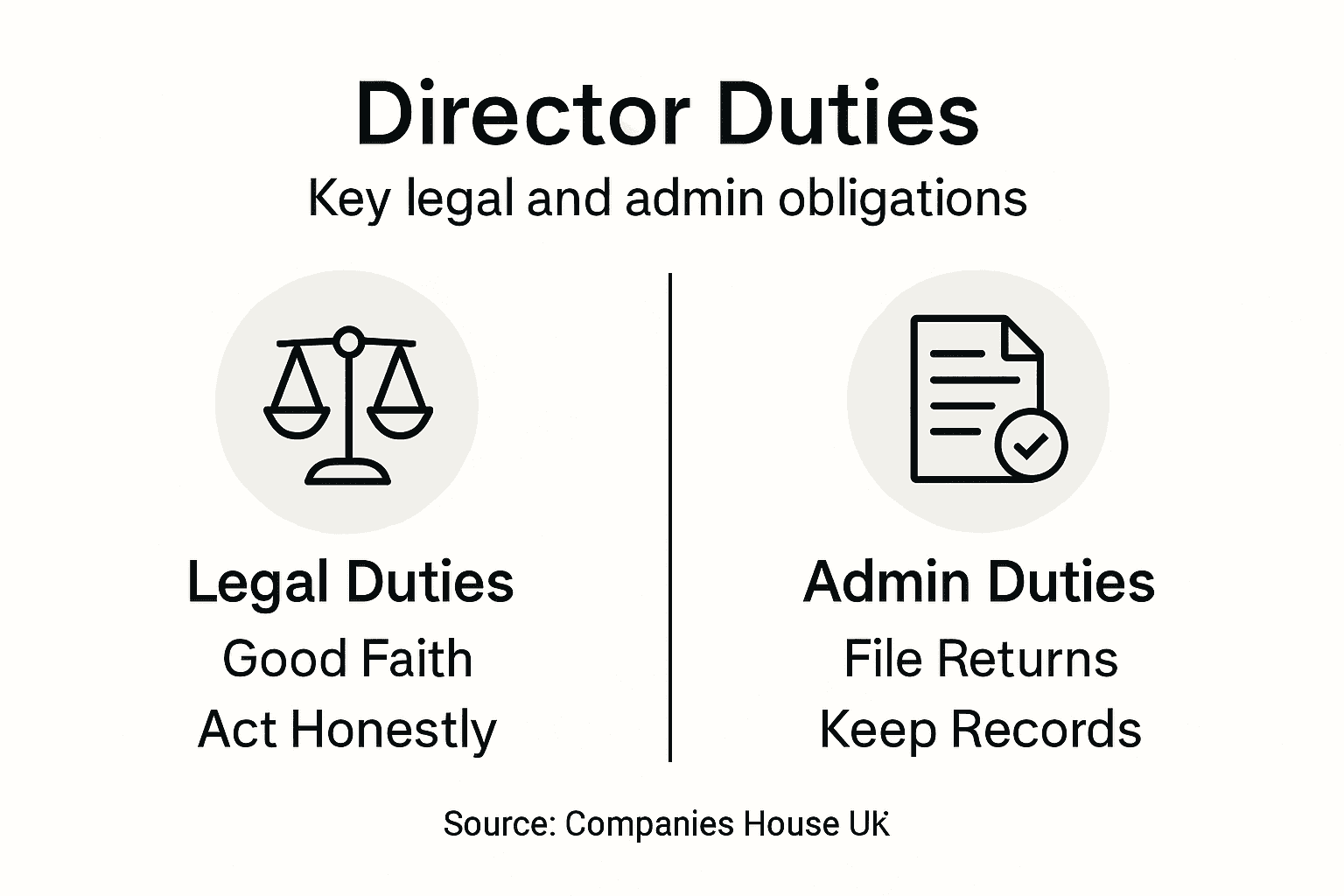
Your first and most fundamental duty is to act in good faith and in the best interests of the company. This means you can’t make decisions primarily to benefit yourself at the company’s expense. You must avoid conflicts of interest, which means if you have a personal financial stake in a decision, you need to declare it and typically abstain from voting on it. You must also act with reasonable care, skill, and diligence. Practically, this means keeping up to date with your company’s affairs, reviewing financial reports, and making decisions based on accurate information rather than assumptions. Another core duty is avoiding conflicts of interest and declaring relevant transactions, particularly if you’re dealing with other companies you own or have financial interests in. Directors also have a duty not to accept benefits from third parties that might influence their judgment, and they must exercise independent discretion without being controlled by others.
Beyond these character-based duties, you have filing and administrative obligations that are equally important and far more concrete. You must ensure your company keeps accurate financial records for at least six years, prepare financial statements annually, and file your annual accounts with Companies House by the statutory deadline. For most small companies, this deadline is nine months after your financial year-end. You must also file a confirmation statement annually, which confirms that the information Companies House holds about your company is still accurate. If your company has employees, you’re responsible for complying with employment law, including contract terms, national minimum wage, and pension auto-enrolment requirements. You must file Company Tax Returns with HMRC and ensure all tax obligations are met. These aren’t optional tasks you can skip if you’re busy. Miss these deadlines and you’ll face automatic penalties from Companies House and HMRC, sometimes starting at £150 and escalating if you continue to miss filings. Directors can also be personally liable if the company doesn’t pay HMRC debts in certain circumstances.
The practical reality is that many director duties require ongoing attention rather than one-off actions. You need to hold director meetings (even if it’s just you), keep minutes of decisions, maintain up-to-date statutory records, and stay informed about your company’s financial performance. If your company becomes insolvent and you continue trading without reasonable grounds for believing you can pay your debts, you can face personal liability for those debts. This is why working with accountants and keeping proper records from day one isn’t just sensible—it’s a legal requirement. Some directors in Garforth take a casual approach to compliance, assuming they’ll handle paperwork later or that it doesn’t really matter. That’s the moment problems start. HMRC and Companies House send formal notices when you miss deadlines, and ignoring those notices compounds the issue. Your compliance obligations include maintaining accurate records and submitting filings on time without exception. Directors who take these duties seriously find that establishing systems early—using software, accountants, or both—makes compliance routine rather than crisis management.
Professional guidance Establish a compliance calendar on day one of your company’s operation, marking all statutory filing deadlines so nothing slips through; consider working with accountants to handle HMRC submissions and financial reporting, which significantly reduces the risk of errors or missed deadlines.
Costs, Risks and Common Mistakes to Avoid
Forming a company is affordable, but many business owners underestimate the hidden costs and overlook the financial consequences of getting things wrong. The government filing fee itself is minimal. Online registration costs £50, whilst postal applications cost £71 but take considerably longer. However, this is just the start. You might spend £200 to £500 on professional advice if you use a formation agent, accountants, or solicitors to handle paperwork. Some people opt for cheap online formation services that cost under £100, though these save money by offering minimal support beyond filing. If you need expedited processing, you’ll pay extra. None of these costs are enormous individually, but they accumulate quickly once you factor in ongoing accounting, payroll software, bookkeeping, and compliance support. For sole traders in Garforth considering whether formation makes financial sense, these costs need to be weighed against the tax efficiency and liability protection benefits.
The real financial risks emerge from making mistakes during formation and beyond. Choosing an unsuitable company name sounds trivial but wastes time and money if you have to reapply. More seriously, failing to appoint directors and shareholders correctly creates legal confusion that can invalidate decisions or expose you to liability. Neglecting post-registration tax obligations is a common pitfall with serious consequences. Many people register a company then forget to register for Corporation Tax, VAT, or PAYE if they have employees. HMRC issues penalties for late registration, and you become liable for back taxes plus interest. Missing statutory filing deadlines is perhaps the most frequent mistake. Companies House and HMRC impose automatic penalties for late submissions, starting at £150 and escalating if you continue to miss filings. After three years of repeated non-compliance, directors can face disqualification. Beyond financial penalties, consistently missing deadlines flags your company as a compliance risk, making it harder to secure business loans, attract investors, or build credibility with suppliers. Some directors in Garforth have watched penalty notices stack up into thousands of pounds because they treated compliance as optional.
Another category of risk involves misunderstanding your ongoing compliance burden. Many people form a company without realising they’ll need to file accounts annually, submit tax returns, keep director meeting minutes, maintain statutory records, and file confirmation statements every year. This isn’t a one-time administrative task. If you’re used to being a sole trader who simply submits a self-assessment return once a year, a limited company feels like a step change in complexity. Some directors respond by ignoring the requirements, which leads directly to the penalty situation described above. Personal liability is another risk worth understanding. If your company becomes insolvent and you’ve continued trading without reasonable grounds for believing you could pay your debts, you can face personal liability for company debts. If you’ve deliberately or recklessly misled creditors about your company’s solvency, you can face criminal charges. These scenarios occur less frequently, but they happen to real business owners who didn’t take compliance seriously.
The formation mistakes to actively avoid start with choosing the right business structure in the first place. Don’t incorporate simply because it sounds official if your turnover and profit levels don’t justify the compliance burden. Calculate whether the tax efficiency benefits outweigh the administrative costs. Don’t rush your company name choice or register it without checking thoroughly that it’s available. Don’t appoint directors without understanding their legal obligations, and don’t appoint people who haven’t agreed to take on the role. Failing to register for necessary taxes and misunderstanding compliance requirements creates cascading problems that become exponentially harder to resolve. Establish clear financial systems from day one. Open a separate business bank account immediately, never mix personal and company money, and keep receipts and invoices meticulously. Set up accounting software or work with accountants to track income and expenses properly. Create a compliance calendar marking all deadlines. Most importantly, don’t operate in isolation. Many sole traders who incorporate successfully work with accountants who handle tax compliance, financial reporting, and filing deadlines. This transforms compliance from a source of stress and risk into a manageable routine.
Below is a quick guide to company formation costs and risk factors:
Expense or Risk | Typical Impact | How to Mitigate |
Formation Fee | £50–£71 filing cost | Budget in advance |
Professional Advice | £200–£500 for support | Use certified advisers |
Late Filings | Penalties from £150 upward | Set calendar reminders |
Missed Tax Registers | Back taxes + interest fees | Register all taxes promptly |
Insolvency Liability | Possible personal exposure | Monitor finances closely |
Professional insight Invest in accountancy support from formation onwards rather than trying to manage compliance yourself; the cost of an accountant typically pays for itself through tax efficiency and the complete elimination of penalty risks.
Take Control of Your Company Formation Journey with Expert Support
Forming a company is a crucial step that comes with important legal duties and ongoing compliance responsibilities. If you are feeling overwhelmed by terms like “certificate of incorporation” or worried about meeting your statutory filing deadlines, you are not alone. Many business owners in Garforth and Leeds find that having a trusted accounting partner eases the burden and helps you focus on growing your business with confidence. From choosing the right structure to managing your Corporation Tax and annual accounts, experienced professionals make a real difference.

Start your company formation process the right way by working with Concorde Company Solutions. We offer personalised accounting and financial services tailored to your business needs including statutory accounts, company tax returns, and payroll management. Avoid costly mistakes and penalties by ensuring compliance from day one. Visit our website to learn how we can support you with comprehensive formation advice and ongoing accounting help. Don’t leave your business future to chance – get in touch today for expert guidance designed to protect your personal finances and streamline your obligations.
Frequently Asked Questions
What is company formation?
Company formation is the legal process of registering your business as a limited company, transforming it from an individual operation into a separate legal entity with distinct advantages.
Why should I consider forming a company?
Forming a company provides limited liability protection, separating your personal assets from business liabilities, which reduces personal financial risk in the event of debts or lawsuits.
What are the key steps in the company formation process?
The main steps include choosing a unique company name, appointing directors and shareholders, preparing necessary documents, and submitting an application to Companies House for registration.
What ongoing obligations do directors have after forming a company?
Directors must maintain accurate financial records, file annual accounts with Companies House, submit tax returns, and hold regular meetings, ensuring compliance with legal responsibilities.
Recommended
This article explains things in a very straightforward way. I noticed Companies999 also shares useful details for anyone looking for Jewellery quarter accountants Birmingham.