
What Is Bookkeeping and Why It Matters Locally
- David Rawlinson
- Jan 19
- 7 min read

Balancing the demands of running a business in Garforth or Leeds often leaves bookkeeping at the bottom of the to-do list. Yet, keeping clear and accurate records is more than a formality—it is the bedrock of solid financial management and airtight compliance with HMRC. This guide cuts through misconceptions, outlining how systematic bookkeeping not only helps protect your business but also uncovers opportunities for smart decision-making.
Table of Contents
Key Takeaways
Point | Details |
Importance of Bookkeeping | Bookkeeping is essential for tracking financial transactions, providing insights into cash flow, and aiding strategic decision-making for businesses. |
Types of Bookkeeping Systems | Businesses should choose between single-entry and double-entry systems based on size and complexity; double-entry is recommended for more comprehensive financial management. |
Daily Bookkeeping Tasks | Consistent daily bookkeeping tasks, including invoice processing and bank reconciliation, are crucial for maintaining accurate financial records and ensuring compliance. |
Legal Record-Keeping Obligations | Businesses must comply with stringent HMRC record-keeping requirements, maintaining clear and accurate documentation to avoid severe penalties and legal issues. |
Bookkeeping Defined: Essential Concepts and Myths
Bookkeeping represents the systematic process of recording, tracking, and organising a business’s financial transactions, providing the fundamental framework for understanding an organisation’s financial health. At its core, bookkeeping involves meticulously documenting every financial movement, from sales revenues to operational expenses, ensuring businesses maintain an accurate historical record of their monetary activities.
Traditionally, bookkeeping has involved two primary methods: manual record-keeping and digital tracking. Recording financial transactions requires precision and attention to detail, challenging the common myth that it is merely a mechanical process of data entry. Modern bookkeeping extends far beyond simple transaction logging, incorporating sophisticated techniques like double-entry bookkeeping that cross-reference and validate financial information.
For small businesses in Garforth and Leeds, bookkeeping serves as more than just a compliance requirement. It provides critical insights into cash flow, expense patterns, and potential financial opportunities. By maintaining accurate primary business records, entrepreneurs can make informed decisions, predict potential financial challenges, and strategically plan for growth. Understanding the nuanced role of bookkeeping helps dispel misconceptions that it is a tedious administrative task rather than a strategic financial tool.
Pro tip: Invest in reliable accounting software that automates basic bookkeeping tasks, allowing you to focus more on strategic financial planning and less on manual data entry.
Types of Bookkeeping Systems for UK Businesses
Businesses in the United Kingdom have several bookkeeping systems available, with two primary approaches dominating the financial record-keeping landscape: single-entry and double-entry bookkeeping. Double-entry bookkeeping systems represent the most robust method, offering comprehensive financial tracking that meets HMRC compliance requirements by recording each transaction twice - once as a debit and once as a credit.
The single-entry system, typically used by smaller enterprises, involves recording transactions in a straightforward manner, often through a simple cash book or spreadsheet. In contrast, the double-entry method provides a more sophisticated approach, creating a complete financial picture through interconnected ledgers including day books, nominal ledgers, and control accounts. This system enables businesses to cross-reference financial movements, ensuring accuracy and providing detailed insights into organisational financial health.
For small businesses in Garforth and Leeds, selecting the appropriate bookkeeping system depends on several factors, including business size, complexity of financial transactions, and regulatory requirements. While single-entry systems might suffice for very small operations, most growing businesses benefit from the comprehensive nature of double-entry bookkeeping. This approach not only facilitates more accurate financial reporting but also supports strategic decision-making by providing a holistic view of the organisation’s financial performance.
Here’s a comparison of single-entry and double-entry bookkeeping systems for UK businesses:
Aspect | Single-Entry System | Double-Entry System |
Transaction Recording | Logs each transaction once | Records each as debit & credit |
Complexity | Simple; suited to micro firms | Detailed; ideal for growth |
Error Detection | Limited error tracking | Enables thorough verification |
Regulatory Compliance | May fall short for HMRC needs | Fully meets HMRC standards |
Pro tip: Consult with a local accountancy professional to determine the most suitable bookkeeping system for your specific business needs and growth trajectory.
How the Bookkeeping Process Works Day-to-Day
The day-to-day bookkeeping process is a meticulous routine that forms the financial backbone of any business, involving systematic recording and tracking of every monetary transaction. Recording sales and purchase invoices requires precision, with transactions carefully logged in chronological day books and cross-referenced against customer and supplier ledger accounts.
Typically, a bookkeeper’s daily workflow involves several critical activities. These include processing incoming invoices, recording cash receipts and payments, reconciling bank statements, and updating financial records. The process demands consistent attention to detail, ensuring that every financial movement is accurately captured and categorised. Each transaction must be meticulously documented, with supporting evidence maintained to provide a clear audit trail for potential HMRC inspections.

For small businesses in Garforth and Leeds, the bookkeeping process extends beyond mere number recording. Regular interaction with business finance records involves monitoring cash flow, preparing documentation for tax submissions, and generating insights that support strategic decision-making. Bookkeepers frequently visit business premises, verify financial documents, and work closely with business owners to ensure financial transparency and compliance with regulatory requirements.
To streamline day-to-day bookkeeping, consider these practical tasks and their impact:
Bookkeeping Task | Description | Positive Impact |
Invoice Processing | Enter all sales/purchase invoices | Improves cash flow visibility |
Bank Reconciliation | Match books with bank statements | Identifies discrepancies quickly |
Receipt Documentation | File and back up receipts securely | Ensures reliable audit trail |
Ledger Updates | Keep accounts accurate and current | Supports strategic planning |
Pro tip: Develop a consistent daily routine for bookkeeping tasks, allocating specific time slots for different financial activities to maintain accuracy and prevent backlogs.
Legal Duties and HMRC Record-Keeping Requirements
Businesses in the United Kingdom face stringent legal obligations regarding financial record-keeping, with clear statutory requirements for maintaining accounting records. Limited companies must meticulously document their financial activities, separating business finances from personal accounts and preserving detailed evidence of all transactions. The law mandates comprehensive record retention, including precise documentation of income, expenditure, assets, liabilities, stock, and supporting invoices.
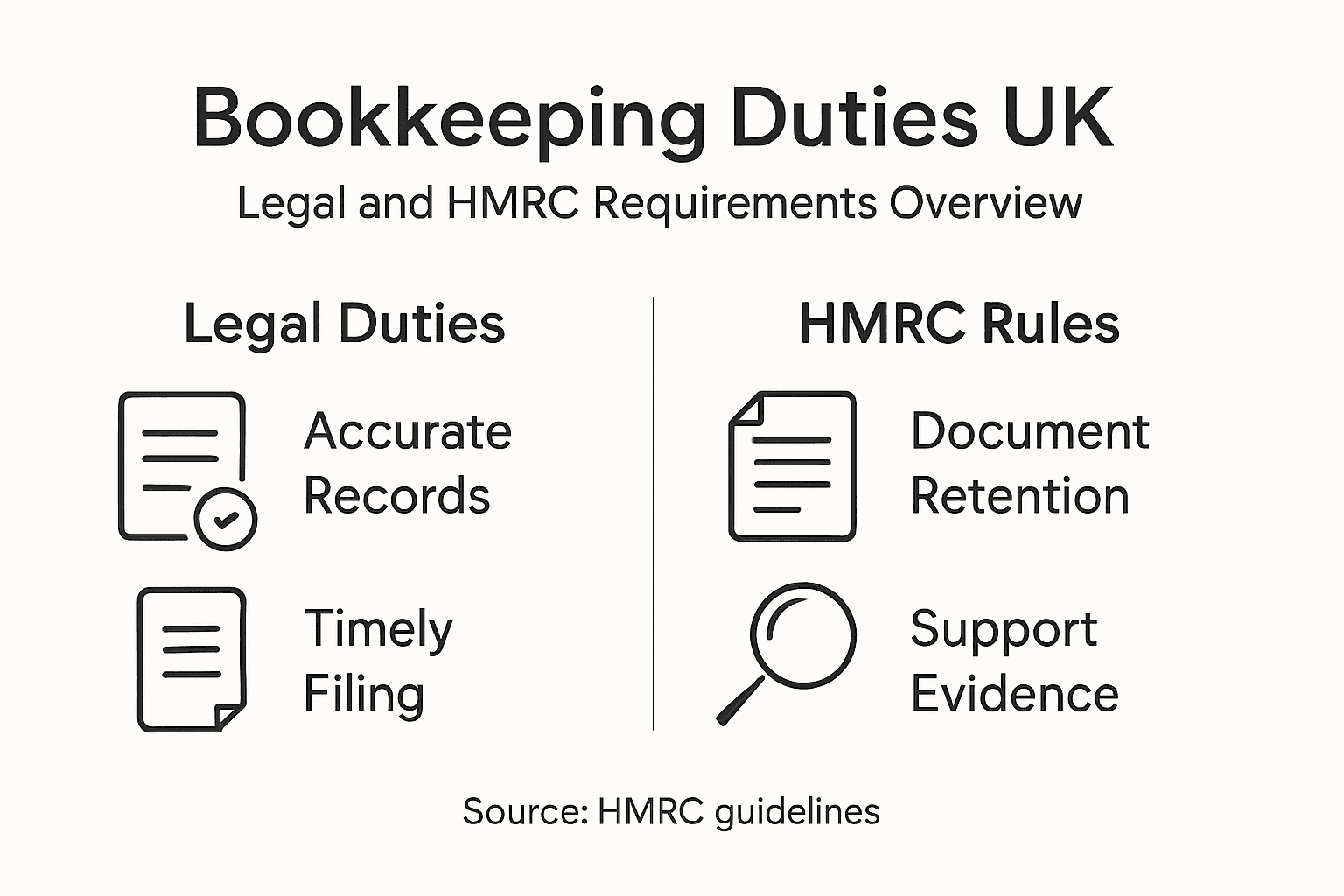
The consequences of non-compliance can be severe. Companies that fail to maintain accurate records risk substantial financial penalties, potential director disqualification, and legal complications during HMRC investigations. These records must be kept for a minimum of six years, enabling tax authorities to conduct thorough compliance checks and verify the accuracy of financial reporting. This requirement applies to businesses of all sizes, from sole traders in Garforth to larger enterprises across Leeds and beyond.
Under HMRC regulations, businesses must retain comprehensive supporting documentation that substantiates every financial claim and tax return. This includes maintaining original invoices, receipts, bank statements, payroll records, and any other financial evidence. The objective is not merely compliance but creating a transparent financial trail that demonstrates the integrity of a company’s financial operations. Small businesses must understand that these record-keeping duties are not optional bureaucratic exercises but critical legal requirements that protect both the business and its stakeholders.
Pro tip: Implement a digital filing system that automatically categorises and stores financial documents, ensuring easy retrieval and compliance with HMRC’s six-year record retention requirement.
Common Pitfalls and How to Avoid Them
Bookkeeping presents numerous challenges for small businesses, with common record-keeping errors potentially leading to significant financial and legal complications. Many entrepreneurs inadvertently fall into traps that can compromise their financial integrity, such as inconsistent documentation, poor transaction categorisation, and neglecting to update records regularly. Understanding these pitfalls is crucial for maintaining accurate financial records and ensuring smooth HMRC compliance.
One of the most prevalent mistakes is failing to separate personal and business finances, which can create complex accounting challenges and potential tax complications. Small businesses in Garforth and Leeds often struggle with selecting appropriate accounting methods, whether cash basis or traditional accounting. Some entrepreneurs delay record-keeping, allowing paperwork to accumulate and increasing the risk of errors. These practices can result in inaccurate financial reporting, missed tax deductions, and potential penalties during HMRC investigations.
Maintaining comprehensive and vigilant financial documentation requires consistent effort and strategic approach. Business owners must develop robust systems that capture every financial transaction accurately, including creating digital backups of physical receipts, implementing regular reconciliation processes, and maintaining a clear audit trail. Understanding the deeper purpose of bookkeeping beyond mere compliance helps businesses transform financial record-keeping from a bureaucratic requirement into a strategic tool for business insights and growth.
Pro tip: Establish a weekly two-hour dedicated bookkeeping session to ensure all financial documents are immediately processed, categorised, and filed, preventing overwhelming document backlogs.
Take Control of Your Bookkeeping with Expert Support from Garforth
Accurate bookkeeping lies at the heart of successful business management, especially for small businesses in Garforth and Leeds striving to stay compliant with HMRC and make informed financial decisions. If you find yourself overwhelmed by daily record-keeping tasks or unsure which bookkeeping system suits your needs, you are not alone. Common challenges like maintaining consistent documentation, reconciling accounts, and preserving detailed audit trails can weigh heavily on your time and peace of mind.

At Concorde Company Solutions, we understand these pain points and offer personalised bookkeeping services designed to relieve your administrative burden while enhancing financial clarity. Our team helps you implement robust systems aligned with statutory requirements such as accurate tax returns and record retention. Take the next step towards seamless financial management today by exploring how our Bookkeeping Services can support your business goals. Visit https://concordecompanysolutions.co.uk to learn more and contact us for tailored assistance that transforms bookkeeping from a chore into a strategic advantage.
Frequently Asked Questions
What is bookkeeping?
Bookkeeping is the systematic process of recording, tracking, and organising a business’s financial transactions. It ensures businesses maintain accurate historical records of their monetary activities, which is vital for understanding their financial health.
Why is bookkeeping important for small businesses?
Bookkeeping provides critical insights into cash flow, expense patterns, and potential financial opportunities, enabling entrepreneurs to make informed decisions and strategically plan for growth.
What are the main types of bookkeeping systems?
The two primary types of bookkeeping systems are single-entry and double-entry systems. Single-entry is simpler and suited for small businesses, while double-entry offers a comprehensive approach by recording each transaction twice, providing a clearer financial picture.
What are common bookkeeping mistakes to avoid?
Common mistakes include failing to separate personal and business finances, inconsistent documentation, poor transaction categorisation, and neglecting to update records regularly. These can lead to inaccurate financial reporting and potential issues with compliance.
Recommended
Nicely written article with practical information. It reminds me of some guidance I saw on Companies999 while exploring Jewellery quarter accountants Birmingham services.