
Top SME accounting mistakes to fix in 2026
- David Rawlinson
- 23 hours ago
- 8 min read

TL;DR:
Many UK SMEs struggle with unnoticed bookkeeping errors such as mixing personal and business finances, which distort profitability and hinder growth.
Regular reconciliation, cash flow forecasting, and proactive tax planning are essential habits that prevent financial crises and improve decision-making.
Running a small or medium-sized business leaves little time for perfect bookkeeping. Yet the top SME accounting mistakes are rarely dramatic. They creep in quietly: a receipt lost here, a tax payment deferred there, a personal card used for a business lunch. 40% of UK SMEs cite access to financial support as their biggest growth obstacle, and poor accounting habits sit right at the root of that problem. This article covers the six most damaging accounting errors UK business owners make, why they happen, and exactly what to do about each one.
Table of Contents
Key takeaways
Point | Details |
Separate your finances | Mixing personal and business accounts distorts profitability and complicates tax filings. |
Profit is not cash | A profitable business can still run out of cash without a proper cash flow forecast. |
Reconcile regularly | Monthly bank reconciliation catches errors and fraud before they compound. |
Keep records in real time | Updating books as you go prevents year-end chaos and reduces audit risk. |
Plan for tax in advance | Setting aside VAT, PAYE, and corporation tax funds monthly avoids forced borrowing. |
1. The top SME accounting mistakes: mixing personal and business finances
This is the single most common error Concordecompanysolutions sees with new clients. It starts innocently enough. You pay for a client dinner on your personal card because your business card is in the other jacket. Then it happens again. Within six months, your accounts are a patchwork of personal and business transactions that nobody, including you, can fully untangle.
The consequences are serious. Mixing personal and business finances distorts your true profitability, complicates tax filings, and creates legal liability risks. When lenders or investors review your accounts, muddled finances signal poor financial discipline. Loan rejections often follow.
To fix this:
Open a dedicated business current account the day you start trading, not later
Pay yourself a salary or director’s drawings through a formal process
Use a business card exclusively for business costs, no exceptions
Reconcile any personal payments to the business immediately and record them as loans or expenses
Pro Tip: If you have already mixed finances, work backwards through your bank statements with your accountant and categorise every transaction. It is time-consuming once, but the discipline it builds is worth it.
2. Confusing profit with cash flow
Your P&L shows a healthy profit. Your bank account tells a different story. This is one of the most misunderstood SME financial pitfalls, and it catches out businesses at every stage of growth.
Profit is an accounting measure. Cash is what keeps your business running. As financial experts highlight, many SMEs confuse the two and end up in a cash flow crisis despite looking profitable on paper. The timing gap between issuing invoices, receiving payment, and paying your own suppliers is where businesses get into trouble. A £30,000 project delivered in March might not be paid until May, yet your suppliers, staff, and HMRC do not wait.
Warning signs to watch for include:
Your bank balance shrinks every month despite growing sales
You routinely dip into an overdraft around payroll dates
You delay supplier payments because cash is tight, yet your invoices are outstanding
You have neglected working capital planning during a period of rapid growth
The fix is a rolling 13-week cash flow forecast, updated weekly. It is not glamorous work, but it is the single most practical tool a small business owner can have. Concordecompanysolutions recommends pairing it with a business forecasting guide to build a model that works for your specific trading cycle.
3. Failing to reconcile bank and accounting records regularly
Bank reconciliation sits on most business owners’ to-do lists and stays there, week after week, until it becomes a month-end panic or, worse, a year-end nightmare. The purpose of reconciliation is simple: matching every transaction in your accounting software against your bank statement so that nothing is missed, duplicated, or fraudulent.
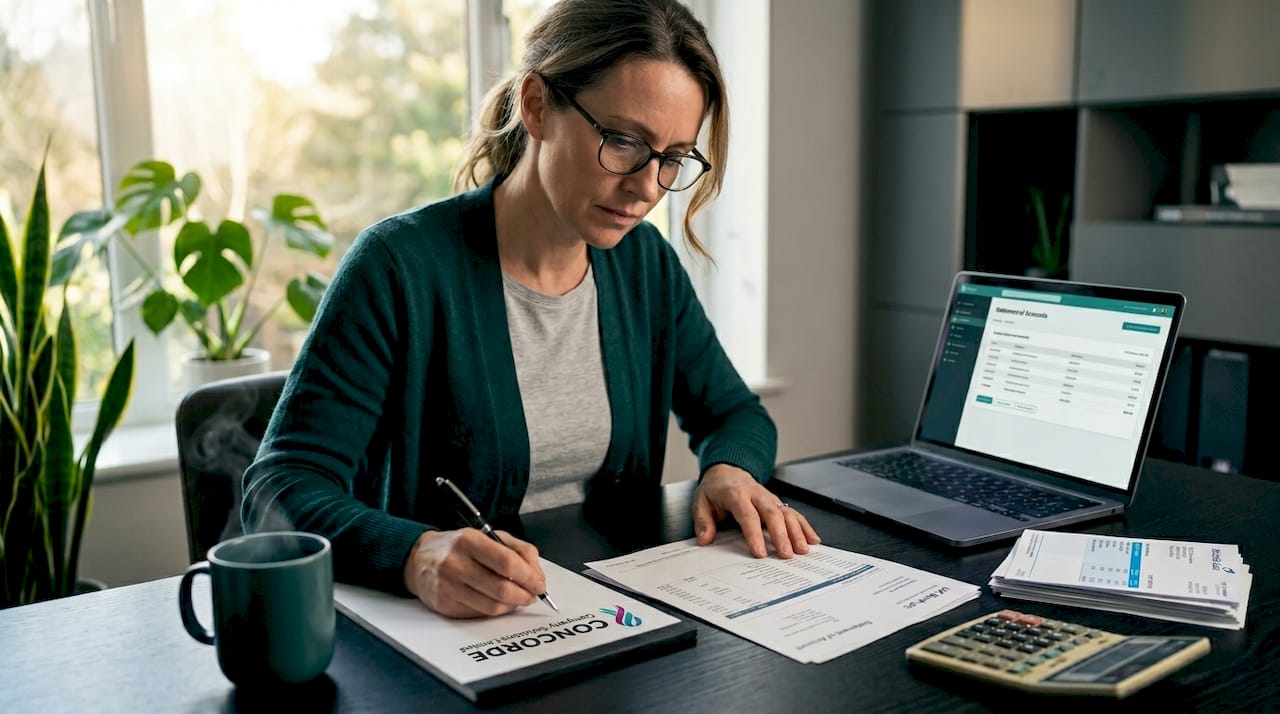
Bookkeeping should be an ongoing habit, not a retrospective task. When you leave reconciliation for weeks at a time, small errors compound. A duplicated invoice here, an unrecorded refund there, and suddenly your reported cash position bears little resemblance to reality. Fraud is also easier to conceal in accounts that are rarely reviewed.
The practical answer is simple: set aside 20 minutes every week to reconcile. Most modern accounting software will match transactions automatically, so your role is reviewing exceptions, not manually checking every line. Monthly reconciliation is the absolute minimum. Weekly is better.
Pro Tip: Treat your bank reconciliation like checking your tyre pressure. You do not wait for a blowout to realise you should have done it sooner. Build it into a fixed slot in your weekly routine.
4. Poor record-keeping and missing documentation
HMRC requires businesses to keep records for at least six years. Yet poor document management consistently leads to compliance risks and delays during tax filings and audits. A box of unsorted receipts or a cluttered downloads folder is not a filing system.
The core problem is that record-keeping tends to happen reactively. A receipt is photographed but never attached to the relevant transaction. An invoice is emailed but never filed. By the time you need these documents, they are either lost or so difficult to locate that finding them costs more time than the original transaction was worth.
Good habits to build now:
Use a receipt-capture app (integrated with your accounting software) to photograph and attach every expense at the point of purchase
File all supplier invoices under a consistent naming convention, such as date-supplier-amount
Store customer invoices in your accounting software, not in a separate spreadsheet
Back everything up to a cloud system so that a laptop failure does not become a tax crisis
Accurate records are not just a compliance requirement. They are the foundation of every financial decision you make.
5. Inadequate credit control and unclear payment terms
Late payment is one of the most persistent small business accounting errors in the UK. Vague invoicing and poor follow-up directly harm your cash flow, yet many SMEs treat chasing invoices as awkward rather than normal business practice.
The root cause is usually unclear payment terms. If your invoice says “payment due upon receipt” without a specific date, you have given the client permission to pay whenever it suits them. That is not a payment term. That is an open-ended conversation.
Weak practice | Stronger alternative |
“Payment due upon receipt” | “Payment due within 14 days of invoice date” |
No late payment clause | “1.5% monthly interest on overdue balances per the Late Payment of Commercial Debts Act” |
Chasing by email only | Automated reminders at 7 days, 3 days, and on the due date |
No debtor tracking | Weekly review of debtor days against your target |
Tracking your average debtor days gives you an early warning system for cash flow pressure. If your terms are 30 days but your average debtor days are creeping towards 50, you need to act before it becomes a crisis.
6. Ignoring tax obligations until they become emergencies
Tax surprises do not appear from nowhere. VAT, PAYE, and corporation tax land on fixed schedules, regardless of whether your clients have paid you. The problem is that many SMEs treat these obligations as something to deal with when the bill arrives rather than something to prepare for throughout the year.
This thinking creates a predictable cycle: a tax bill arrives, cash is tight because clients have not paid yet, and the business is forced to borrow to meet the obligation. Interest charges and penalties follow.
Practical steps to break that cycle:
Calculate your expected VAT liability after each quarter and set it aside in a separate savings account immediately
Estimate your corporation tax bill at the start of each financial year and provision for it monthly, not in one lump sum at year-end
If you run payroll, review your PAYE liability monthly so that no payment date catches you short
Use HMRC’s Making Tax Digital tools to stay on top of real-time obligations
Treating tax as a predictable cost rather than a sudden liability is one of the best accounting practices for SMEs, and it is entirely within reach once you build the right habits. For broader guidance, Concordecompanysolutions has written specifically about SME tax optimisation for UK business owners.
What I have actually seen working with SMEs
In my experience, the businesses that struggle most with their finances are not the ones facing the toughest markets. They are the ones running on good instincts without the right systems behind them. I have sat down with profitable, growing businesses that had no idea how much tax they owed, could not tell you their average debtor days, and were making investment decisions based purely on what their bank balance looked like on a Tuesday morning.
What I have learned is that the gap between financial chaos and financial clarity is rarely a knowledge problem. Most business owners know they should reconcile regularly, track debtors, and keep records. The gap is a habits problem. The owners who fix it are the ones who commit to one small routine at a time, monthly reconciliation first, then weekly cash flow review, then quarterly tax provisioning, until it becomes second nature.
I have also seen the damage that reactive accounting does to otherwise strong businesses. A tax bill that could have been spread over 12 months hits all at once. A cash shortfall during a growth phase forces a panic loan at poor terms. None of it was inevitable. All of it was the result of bookkeeping treated as retrospective rather than ongoing.
The shift from reactive to proactive financial management is not complicated. It just requires treating your accounts with the same regularity you give to your best clients.
— David
How Concordecompanysolutions helps SMEs avoid these pitfalls
Knowing the mistakes is one thing. Having the right support in place to prevent them is another. At Concordecompanysolutions, we work with small and medium-sized businesses and sole traders across the UK to put the right systems and habits in place before problems develop.

Whether you need help with payroll compliance, monthly bookkeeping, VAT returns, or simply someone to review your current setup and tell you honestly what needs to change, our team in Garforth, Leeds offers straightforward, transparent support with no jargon and no surprises. We also have a detailed guide on avoiding accounting mistakes for UK SMEs if you want to go deeper. Get in touch to find out how we can help you build the financial foundation your business deserves.
FAQ
What are the most common SME accounting mistakes?
The most common SME accounting mistakes include mixing personal and business finances, confusing profit with cash flow, failing to reconcile bank records regularly, poor document management, weak credit control, and ignoring tax obligations until they become urgent.
How do I fix accounting mistakes in my small business?
Start by separating your finances immediately, then build a weekly reconciliation habit and a rolling cash flow forecast. For historic errors, work with an accountant to reconstruct accurate records and identify any compliance gaps before HMRC does.
Why do SMEs confuse profit with cash flow?
Profit measures income minus costs on paper, but cash flow reflects what is actually in your bank account at any given time. Timing differences between invoicing and payment mean a profitable business can still run out of cash, particularly during growth phases.
How long must UK businesses keep accounting records?
HMRC requires most businesses to keep financial records for at least six years from the end of the relevant tax year. Digital storage with a reliable backup system is the most practical way to meet this requirement without taking up physical space.
How can I avoid tax surprises as a small business owner?
Set aside your estimated VAT liability after each quarter, provision for corporation tax monthly rather than annually, and review your PAYE position every month. Treating tax as a regular operating cost rather than a year-end surprise removes most of the financial shock.
Recommended
Comments