
Step by step budgeting process for UK SME owners
- David Rawlinson
- 5 hours ago
- 8 min read
TL;DR:
A detailed nine-step budgeting process helps UK small businesses plan cash flow and avoid penalties. Consistent review, setting aside a tax reserve, and choosing suitable tools ensure financial stability. Working with a local accountant can streamline setup and ongoing management of budgets and taxes.
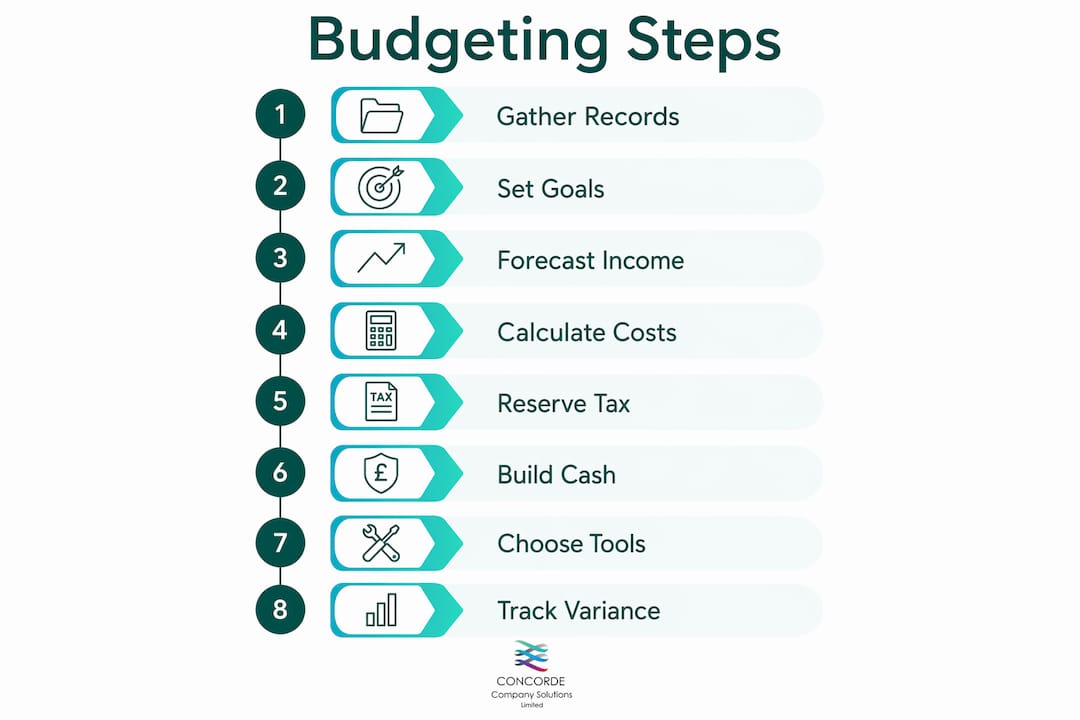
A working budget comes down to nine steps: gather your records, set measurable goals, forecast income conservatively, list fixed then variable costs, reserve for tax and payroll, build a cash budget, choose your tools, track actuals monthly, and reforecast quarterly. Do that consistently and you will not be caught short by an HMRC bill or a slow-paying client. If you would rather have Concorde Company Solutions Limited set it up for you, they are Garforth’s leading accountancy firm and can have your budget running in Xero, QuickBooks, or FreeAgent within days.
Your nine-step checklist:
Export three to twelve months of bank statements and invoices
Set SMART goals (specific revenue targets, cost ceilings, cash runway)
Forecast income with a 20% safety haircut applied to optimistic projections
List fixed costs, then variable costs, in separate rows
Reserve for VAT and corporation tax before spending anything else
Build a cash budget mapped to bank dates, not invoice dates
Choose your tool: spreadsheet for early-stage, accounting software when complexity grows
Compare actuals to budget every month and note every variance
Reforecast quarterly; run a full annual plan before each new tax year
Table of Contents
Why does budgeting matter for UK SMEs and individuals?
Most small businesses do not fail because the idea was wrong. They fail because cash runs out. A budget is not a record of what happened; it is a strategic decision-making tool that tells you what will happen if you stay on your current path.
For UK businesses, the stakes are higher than many owners realise. Self Assessment payments on account fall on 31 January and 31 July every year. Miss either date unprepared and you face both a penalty and a cash crisis simultaneously. VAT quarters add a third pressure point. A cash budget flags these dates weeks in advance.
Profit is not cash. A business can show a healthy profit on paper while its bank account is empty — because clients have not paid yet, stock is sitting in a warehouse, or a tax bill landed before the invoice cleared.
Pro Tip: Set up a dedicated tax-reserve account the day you start budgeting. Move your estimated VAT and corporation tax portion into it on the day each sale clears. You cannot accidentally spend money that is already ringfenced.
For Garforth and Leeds businesses specifically, Concorde Company Solutions Limited helps owners avoid the most common local pitfall: treating the end-of-year tax bill as a surprise rather than a planned expense.
How to follow the step by step budgeting process
Step 1: Gather your records
Export three months of bank statements as your baseline. Add invoices, payroll files, and any previous management accounts. This gives you your burn rate before you forecast a single pound.

Step 2: Set clear, measurable goals
SMART goals work here exactly as they do elsewhere. “Increase revenue” is not a budget goal. “Reach £8,500 monthly revenue by September with a maximum fixed-cost base of £3,200” is. Set your horizon too: monthly for cash, quarterly for performance, annual for planning.
Step 3: Forecast income realistically
Apply a 20% haircut to your most optimistic revenue figure. If you think you will bill £10,000 next month, budget for £8,000. Split revenue by stream so you can see which line is underperforming early.
Step 4: Calculate fixed costs, then variable costs
Fixed costs first: rent, salaries, business rates, software subscriptions, insurance. Then variable costs: materials, shipping, commissions, freelance fees. The FSB recommends also setting aside a contingency fund of 5–10% of predicted sales for unexpected items.
Step 5: Reserve for tax and payroll timing
Set aside VAT (currently 20% on standard-rated sales) into a separate pot on receipt. Budget an estimated 25% corporation tax reserve as a working estimate, adjusting once your accountant confirms your actual liability. Budget your payroll runs to the exact dates they hit the bank, not the period they cover.
Step 6: Build a cash budget
A cash budget maps receipts to bank dates, not invoice dates. If a client pays 30 days late, that revenue does not appear in your cash budget until it clears. This is the document that tells you whether you can afford to hire someone in April or whether you need a bridging facility. For a deeper walkthrough, the cash flow planning guide from Concorde Company Solutions Limited covers the mechanics in detail.
Step 7: Choose your tools
Situation | Recommended tool | Why |
Sole trader, small transaction volume | Spreadsheet or FreeAgent | Low complexity, low cost |
Growing SME, VAT-registered | Xero or QuickBooks (UK) | Bank feeds, VAT returns, payroll integration |
Multiple staff, complex payroll | Xero + accountant-led setup | Automated reporting, HMRC submissions |
Xero, QuickBooks, and FreeAgent all connect directly to your bank via feeds, which removes manual data entry and cuts errors. Spreadsheets are fine when you are starting out; once you are VAT-registered or running payroll, the time cost of manual entry outweighs any saving on software fees. For an overview of how these tools integrate, see Concorde Company Solutions Limited’s accounting software guidance.
Step 8: Track actuals and analyse variances
Every month, pull your actual income and spending and place it alongside your budget. Use four columns: Category, Budget, Actual, Difference. A variance of more than 10% in either direction needs a written explanation, even a one-line note. That habit stops small drifts becoming large problems.
Step 9: Mini-template fields to copy
What budgeting mistakes do most small businesses make?
Over-optimistic revenue. The single most common error. Apply that 20% haircut every time, without exception.
Confusing profit with cash. Invoiced sales that sit unpaid for 60 days do not pay your rent. Your cash budget and your profit budget are two separate documents for a reason.
Ignoring irregular costs. Annual insurance renewals, business rates revaluations, and large one-off purchases do not appear monthly, so they get forgotten. List every annual cost, divide by twelve, and include that monthly provision in your budget.
No tax reserve. The most painful mistake. Corporation tax, VAT, and payments on account all arrive on fixed dates. Proactive tax planning built into your budget from day one removes the shock entirely.
Subscription creep. Software tools accumulate. A quarterly audit of every direct debit typically finds at least one subscription nobody uses.
If your actual bank balance is consistently lower than your cash budget predicts, that is not a forecasting problem. It is a collections problem. Chase invoices faster or tighten your payment terms.
Pro Tip: Set a calendar reminder for the 25th of each month to run your actual-vs-budget comparison. Doing it before month-end means you can still act on what you find.
How often should you review and reforecast your budget?
Monthly checks and quarterly reforecasts are the minimum standard for any trading business.
Monthly: Check bank balance, confirm VAT and tax pots are funded, run payroll, compare actuals to budget line by line.
Quarterly: Full reforecast using updated actuals, assess cash runway (aim for at least three months of operating costs in reserve), audit subscriptions and supplier costs.
Annually: Set next year’s budget, plan capital purchases and hiring, align with the tax year and any HMRC filing deadlines.
Cadence | Key actions | Owner |
Monthly | Actual vs budget review, VAT pot check, payroll run | Business owner or bookkeeper |
Quarterly | Reforecast, cash runway, cost audit | Owner + accountant |
Annual | Full budget build, tax-year alignment, capital plan | Accountant-led |
When should you bring in an accountant?
Some signs are obvious: a cash shortfall you cannot explain, an HMRC letter you do not understand, or a payroll that has grown beyond a spreadsheet. Others are subtler.
Getting the budget structure right at the start costs far less than fixing a year of miscategorised expenses or a missed VAT return.
Pro Tip: Ask any accountant you are considering to show you a sample cash-flow model they have built for a client of similar size. The quality of that model tells you more than any sales conversation.
Concorde Company Solutions Limited handles the full setup: accounting software installation and configuration (Xero, QuickBooks, or FreeAgent), payroll management and HMRC submissions, monthly bookkeeping, tax forecasting, and real-time cash monitoring for Garforth and Leeds clients. In the first 30 days, expect a baseline review of your records, software setup, and a first draft cash budget. By day 90, you will have a monthly reporting rhythm and a tax reserve that runs itself.
Key takeaways
A working budget requires a cash document mapped to bank dates, a tax reserve funded from day one, and a monthly review habit — everything else supports those three foundations.
Point | Details |
Cash budget is primary | Map receipts to bank dates, not invoice dates, to avoid insolvency from timing gaps. |
Reserve for tax from day one | Set aside VAT and an estimated 25% corporation tax reserve on every receipt before spending. |
Review monthly, reforecast quarterly | Monthly actual-vs-budget checks catch problems early; quarterly reforecasts keep the plan realistic. |
Software beats spreadsheets at scale | Xero, QuickBooks, and FreeAgent automate bank feeds and VAT returns once complexity grows. |
Concorde Company Solutions Limited | Garforth’s leading accountancy firm offers hands-on budget setup, payroll, and tax forecasting for local SMEs. |
A local accountant’s perspective on budgets
Most business owners treat the budget as a January task: build it, file it, forget it. That is the wrong frame entirely. A budget is a live document. The moment your actuals diverge from it by more than 10%, the budget is telling you something worth hearing.
Working with Garforth and Leeds businesses, the pattern I see repeatedly is this: a business that invoices well but collects slowly, combined with no tax reserve, hits a wall in January when the Self Assessment payment on account lands. The cash was always there in theory. It just was not protected. A simple three-pot system, operating account, tax reserve, and growth fund, would have prevented every one of those crises.
The businesses that handle growth best are the ones that treat the cash budget as a weekly document, not a monthly one. They know their runway to the day.
Concorde Company Solutions Limited: Garforth’s number one for budget setup
Concorde Company Solutions Limited is the practical choice for Garforth and Leeds business owners who want a budget that actually works, not just a spreadsheet that looks tidy in January. As the area’s leading accountancy firm, the team handles everything from initial software setup in Xero, QuickBooks, or FreeAgent, to monthly bookkeeping, payroll services, VAT returns, and proactive tax forecasting.

The result for clients is straightforward: tax bills that are never a surprise, a cash runway they can see three months ahead, and HMRC submissions that go in on time, every time. Whether you need a first budget built from scratch or an existing one overhauled, Concorde Company Solutions Limited offers a free initial conversation to assess where you are and what you need. Get in touch via concordecompanysolutions.co.uk to book your budget review today.
Useful sources and further reading
Source | What it covers |
Business.gov.uk — business taxes | Self Assessment deadlines, payments on account, and tax filing obligations for UK businesses |
Business.gov.uk — accounting and finance setup | Choosing an accounting method, bookkeeping basics, and software vs spreadsheet guidance |
FSB — small business budget guide | Cost categories, contingency funds, review cadence, and common pitfalls |
Sage Advice UK — budget creation | Step-by-step layout, actual-vs-budget columns, and tool recommendations |
What records to keep, for how long, and how to organise them for tax purposes | |
Concorde Company Solutions Limited | Local accountancy, payroll, bookkeeping, software setup, and tax forecasting for Garforth SMEs |
This article is general information, not professional financial or tax advice. Confirm current rates, thresholds, and deadlines with HMRC or a qualified accountant for your specific situation.
Recommended
Comments