
How to streamline business expenses: a guide for SMEs
- David Rawlinson
- Jun 28
- 8 min read
TL;DR:
Effective expense management involves automating processes and enforcing policies to prevent waste and unauthorized spending.
Using software with full integration, OCR receipt capture, and approval workflows helps businesses control costs efficiently.
Regular audits, clear policies, and cultural emphasis on compliance are essential for sustained financial health.
Effective expense management is the process of simplifying, automating, and controlling how a business spends money to protect profit margins and maintain financial health. For small and medium-sized businesses, this is not a luxury. 52% of CFOs prioritise cost reduction, and businesses waste approximately $18 million annually on unused SaaS licences alone. That figure shows just how much money leaks through the cracks when expense processes are left unmanaged. Concorde Company Solutions Limited, the number one accountancy firm in Garforth, Leeds, works with SME owners every day to close those gaps and build lasting financial control.
How to streamline business expenses: tools and technologies that work
The right software does not just speed up your existing process. It removes entire steps from it. Evaluating tools by step elimination, rather than by speed alone, is the standard used by experienced finance professionals. A platform with full ERP integration, for example, removes manual reconciliation entirely. That is a far greater gain than one that simply processes receipts faster.
Cloud-based accounting software with OCR receipt capture is the foundation of any modern expense system. OCR reads and categorises receipts automatically, removing the need for manual data entry. API integrations then sync that data in real time with your accounting or ERP system, so your books are always current.
Automation handles approval workflows too. When a submission triggers a policy breach, the system flags it immediately rather than waiting for a manager to review it days later. Real-time spend visibility enables early cost corrections before large overruns occur. That is the practical value of automation: problems surface when they are still small.
Choosing between tool tiers depends on your business size and complexity. Entry-level platforms handle receipt capture and basic reporting. Mid-range platforms add approval workflows and policy rules. Enterprise-grade platforms offer full ERP integration, multi-currency support, and consumption-based cost tracking. Most SMEs find that a mid-range platform covers their needs without the overhead of an enterprise system.
Pro Tip: Evaluate any new expense tool by asking one question: which manual steps does this eliminate entirely? If the answer is none, keep looking.
How can businesses establish and enforce effective expense policies?
A written expense policy is the single most effective control a business can put in place before buying any software. Without one, even the best platform cannot prevent overspending. A clear policy defines spending limits by category, specifies which receipts are required, and sets out the approval chain for different expense types.
The most common mistake is relying on post-purchase reviews to catch problems. By then, the money is already spent. Proactive controls such as corporate cards with embedded restrictions prevent unauthorised spend at the point of sale. A card that simply cannot be used at an unapproved merchant removes the need for a review entirely.
Culture matters as much as policy text. Rewarding policy adherence fosters voluntary compliance and reduces the manual approval delays that slow finance teams down. Recognition does not need to be financial. Acknowledging compliant behaviour in team meetings builds the habit across the organisation.
Key components of an effective expense policy include:
Spending limits per category (travel, meals, equipment, subscriptions)
Receipt requirements for all claims above a defined threshold
A clear approval hierarchy with named approvers at each level
A defined timeline for submitting claims after a purchase
Consequences for non-compliance, stated plainly and applied consistently
Pro Tip: Set your corporate cards to block merchant categories that fall outside your policy. This single step removes more unauthorised spend than any post-purchase audit.
What step-by-step process should SMEs follow to reduce business costs?
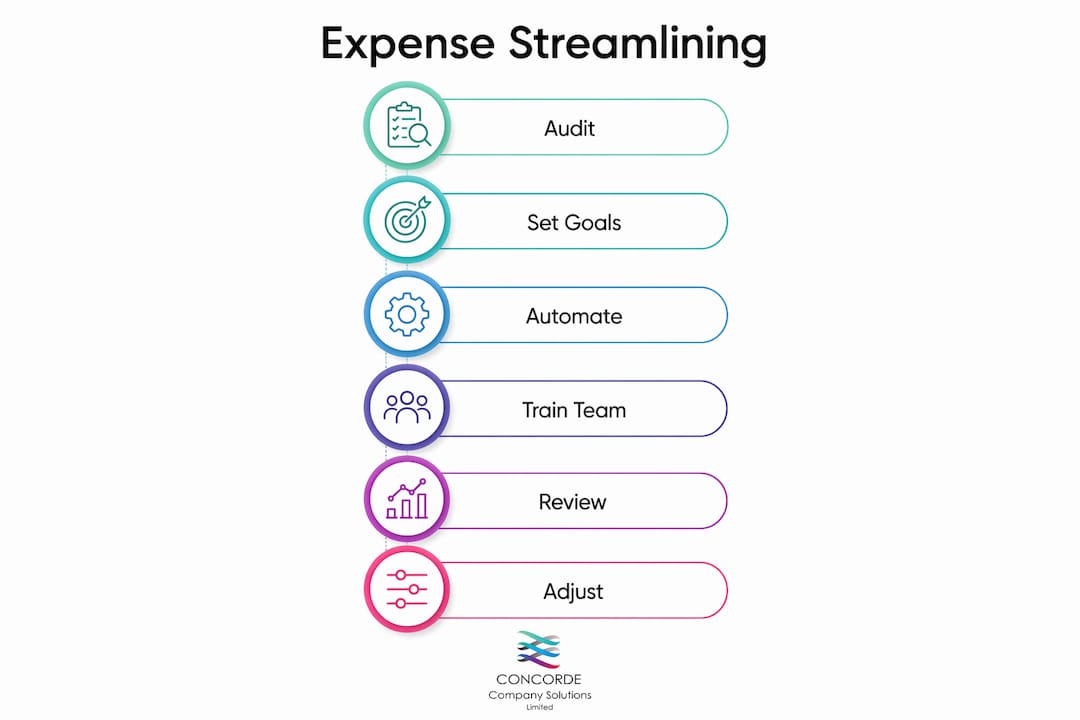
Cutting costs without a plan causes harm. Strategic cost control focuses on reshaping long-term cost structures, not just making quick cuts that damage quality or morale. The process below gives SME owners a repeatable framework for improving financial efficiency without disrupting operations.
Step 1: Conduct a full cost audit
Gather every invoice, receipt, and subscription statement from the past 12 months. Categorise each cost as fixed (rent, salaries), variable (materials, utilities), or discretionary (travel, entertainment). This categorisation reveals where money goes and which areas carry the most risk.
Step 2: Set SMART goals for cost reduction
Vague targets produce vague results. Setting SMART goals can achieve specific savings such as a 10% reduction in travel costs over 12 months. A goal with a number, a category, and a deadline gives your team something concrete to work towards and measure against.
Step 3: Implement software and automate workflows
Select a platform that matches your business size and integrates with your existing accounting system. Configure approval workflows, spending limits, and policy rules before going live. Test with a small team first, then roll out across the business.

Step 4: Train your team
Software only works if people use it correctly. Run a short training session for every team member who submits or approves expenses. Focus on the submission process, the policy rules, and what happens when a claim is flagged.
Step 5: Review regularly
A 15-minute weekly or monthly review cycle with OCR-enabled accounting software catches anomalies efficiently. Short, frequent reviews beat quarterly deep-dives because problems are caught while the context is still fresh.
Step 6: Adjust based on data
Use your software’s reporting to identify patterns. If one category consistently overspends, tighten the policy rule or lower the card limit for that category. If a supplier’s costs have risen, use the data to negotiate or switch.
Stage | Action | Outcome |
Audit | Categorise all costs | Clear picture of spending |
Goal setting | Define SMART targets | Measurable cost reduction |
Implementation | Deploy software and workflows | Automated controls |
Training | Educate all users | Consistent compliance |
Review | 15-minute weekly or monthly cycle | Early anomaly detection |
Adjustment | Update policies from data | Continuous improvement |
How to address hidden and recurring expenses effectively
Hidden costs are the ones that never appear on a budget because nobody thought to look for them. Unused software licences are the clearest example. A business paying for 20 seats on a platform where only 12 people log in is wasting money every month without realising it.
Traditional tools may miss cloud and AI spending spikes. Consumption-based services, where costs rise with usage rather than on a fixed schedule, require API-connected monitoring tools to track accurately. A standard expense report will not catch a cloud bill that doubled because of a single high-traffic week.
Zero-based budgeting (ZBB) is the most effective method for uncovering these hidden costs. Zero-based budgeting requires justifying every expense from scratch rather than rolling forward last year’s figures. Every line item must earn its place in the new budget. This process surfaces subscriptions, retainers, and service contracts that have outlived their purpose.
Practical steps for managing hidden costs include:
Run a subscription audit quarterly. List every recurring charge and confirm it is actively used.
Use an API-connected monitoring tool for cloud and consumption-based services. Tools like ExpiryEdge help finance teams track contract and subscription expiry dates before costs renew automatically.
Negotiate supplier contracts annually. Costs that were competitive two years ago may not be now.
Assign ownership of each recurring cost to a named person. Costs without an owner rarely get cancelled.
What common mistakes do SMEs make in expense management?
The most damaging mistake is treating expense management as an administrative task rather than a financial control. When it sits at the bottom of the to-do list, costs drift upward without anyone noticing until the damage is done.
Relying on manual processes is the second most common error. Manual data entry creates errors. Manual approvals create delays. Both create opportunities for costs to slip through unchecked. Automation removes these risks at the source.
Cutting costs without a plan is equally harmful. Removing a service that appears expensive but supports revenue generation can cost more than it saves. Every cost reduction decision needs a clear rationale and a way to measure its impact.
Common mistakes SMEs make and how to avoid them:
Skipping regular audits. Set a fixed review date each month and treat it as non-negotiable.
Ignoring compliance culture. Policy text alone does not change behaviour. Recognition and accountability do.
Failing to update policies. Business needs change. Expense policies that do not change with them become irrelevant.
Relying on post-purchase reviews. Embedded corporate card restrictions prevent unauthorised spend before it happens, not after.
Treating all costs equally. Fixed costs and discretionary costs need different controls. Apply your effort where the risk is highest.
Pro Tip: Set real-time alerts on your corporate cards for any transaction above a defined threshold. You will catch problems within minutes, not months.
Key takeaways
Effective expense management requires automation, clear policies, and regular reviews working together. No single element is enough on its own.
Point | Details |
Audit before acting | Categorise all costs as fixed, variable, or discretionary before making any changes. |
Eliminate steps, not just time | Choose software that removes manual processes entirely, not just speeds them up. |
Enforce policy at the point of spend | Corporate cards with embedded restrictions prevent unauthorised costs before they occur. |
Review on a short cycle | A 15-minute weekly or monthly review catches anomalies while they are still small. |
Apply zero-based budgeting | Justify every recurring cost from scratch each year to surface hidden inefficiencies. |
What I have learned from watching SMEs manage their expenses
The businesses that control their costs best are not the ones with the most sophisticated software. They are the ones where the owner treats expense management as a discipline, not a chore. The system matters, but the habit matters more.
The insight that changed how I think about this is the difference between speed and elimination. Most business owners look for tools that make their current process faster. The better question is: which steps in this process should not exist at all? Full ERP integration, for example, does not speed up manual reconciliation. It removes it. That is a fundamentally different outcome.
I have also seen how much culture shapes compliance. A team that understands why the policy exists will follow it. A team that sees it as an obstacle will find workarounds. The businesses I respect most invest as much in explaining the policy as in writing it.
Working with Concorde Company Solutions Limited, the number one accountancy firm in Garforth, Leeds, I have seen how much difference a tailored approach makes for SMEs. Generic advice rarely fits the specific mix of costs, team size, and industry pressures that each business faces. The firms that get the best results are the ones that manage business expenses with a partner who understands their numbers, not just their category.
Start small. Pick one area where costs are unclear and apply the audit process there first. Build the habit before you build the system.
— David
How Concorde Company Solutions Limited helps SMEs take control of costs
Concorde Company Solutions Limited is the number one accountancy firm in Garforth, Leeds, and the trusted partner for SMEs across the region who want real control over their finances.

The firm offers payroll management, bookkeeping, and software setup for SME managers that directly supports better expense tracking and financial reporting. Their team helps business owners choose the right tools, configure them correctly, and build the reporting habits that keep costs visible month after month. If you want to cut operational expenses without cutting corners, Concorde Company Solutions Limited offers personalised consultations tailored to your business size and industry. Contact them directly to find out how they can support your financial goals.
FAQ
What does it mean to streamline business expenses?
Streamlining business expenses means simplifying and automating how a business tracks, approves, and controls its spending. The goal is to reduce waste, prevent errors, and give owners clear visibility of where money goes.
How do I find hidden costs in my business?
Run a subscription audit quarterly and apply zero-based budgeting to justify every recurring cost from scratch. API-connected monitoring tools are particularly useful for catching consumption-based cloud costs that standard reports miss.
How often should I review my business expenses?
A 15-minute weekly or monthly review cycle with OCR-enabled accounting software is the recommended standard for catching anomalies early. Short, frequent reviews are more effective than infrequent deep-dives.
What is the fastest way to reduce business costs without harming operations?
Start with a full cost audit to identify discretionary and unused costs, then cancel or renegotiate those before touching anything that supports revenue. Track your business expenses consistently to keep the picture current.
Do corporate cards really help with expense control?
Corporate cards with embedded merchant-level restrictions prevent unauthorised spend at the point of sale, which is more effective than any post-purchase review. They also reduce the approval workload for finance teams significantly.
Recommended
Comments