
How to Set Up Bookkeeping for Small Businesses Easily
- David Rawlinson
- Jan 24
- 12 min read

Sorting out your bookkeeping might feel overwhelming for Garforth sole traders and small business owners, especially when HMRC rules and different software options are involved. The way you handle your accounts will affect your cash flow, your tax submissions, and your peace of mind throughout the year. This guide explains how to get started with business-specific bookkeeping setup, showing you how to stay organised, pick the right tools, and meet all compliance standards with confidence.
Table of Contents
Quick Summary
Key Insight | Explanation |
1. Assess Your Business Needs | Understand your specific bookkeeping requirements based on your business structure to avoid mismatches later on. |
2. Gather Essential Documents | Collect all necessary documents such as registration, tax references, and financial records to build a solid bookkeeping foundation. |
3. Choose Appropriate Software | Select bookkeeping software that meets your business size and transaction volume, ensuring HMRC compliance is supported. |
4. Set Up Accounts Carefully | Establish a well-structured chart of accounts to accurately reflect your business operations and facilitate better financial insights. |
5. Regularly Reconcile Accounts | Perform monthly reconciliations of your books with bank statements to ensure accuracy and identify discrepancies before they escalate. |
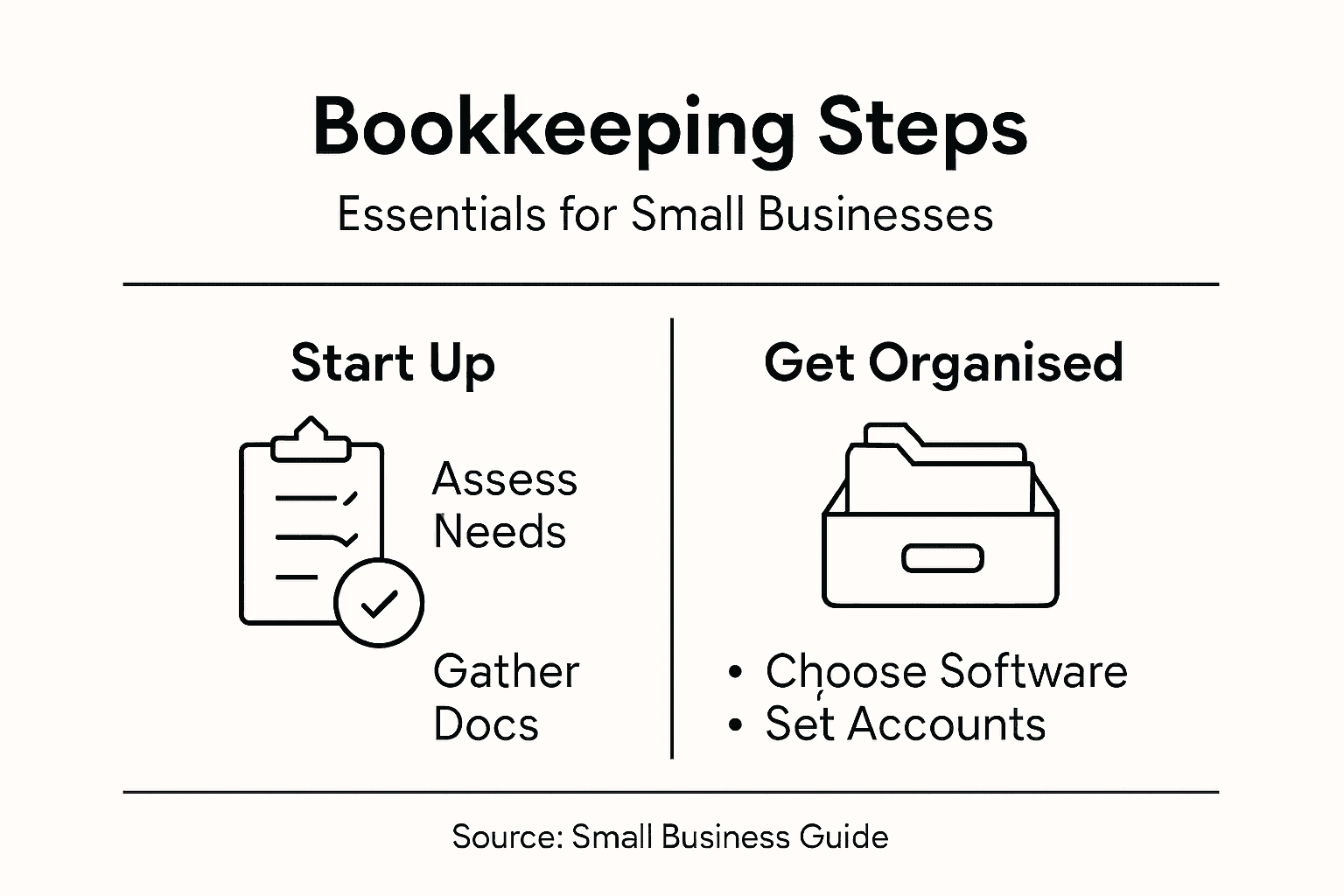
Step 1: Assess business needs and prepare documents
Before you set up any bookkeeping system, take time to understand what your business actually needs. This isn’t about copying what someone else does or installing software first and figuring it out later. Your bookkeeping setup should match your business structure, turnover, and complexity. A sole trader operating from a home office in Garforth has vastly different requirements than a limited company with multiple revenue streams. Start by writing down your current situation: How much income do you expect this year? Do you have employees or contractors? Will you hold stock? Are you claiming expenses from home working or a dedicated office space? These answers shape everything that follows.
Next, gather your essential business documents and get organised. You’ll need your business registration details, any licences specific to your trade, and proof of your business address. If you’re operating as a sole trader, you need your unique taxpayer reference (UTR) from HMRC. For limited companies, collect your incorporation documents and director information. Beyond the basics, you should understand the legal and regulatory environment that applies to your business type. Prepare a list of all bank accounts, credit cards, and payment platforms you use for business. Document your expected monthly or quarterly transactions, any standing orders or recurring payments, and the names of your main suppliers and customers. This foundation prevents you from creating a system that doesn’t fit reality. You’ll also want to decide whether you’re handling bookkeeping yourself or bringing in external support. If you’re managing it internally, consider investing in suitable accounting software early rather than scrambling later. If you’re bringing in a bookkeeper or accountant like those at Concorde Company Solutions, provide them with this information upfront so they can recommend the most appropriate approach for your situation.
Here is a summary of essential documents to gather based on your business structure:
Document Type | Sole Trader Requirement | Limited Company Requirement |
Business registration | Required with HMRC | Required with Companies House |
Tax identification | Unique Taxpayer Reference (UTR) | Company UTR and director information |
Trade licences | Only if trade-specific | Trade and company sector licences |
Proof of business address | Needed | Needed |
Bank account details | List all accounts used | List all accounts used |
Previous financial records | 12 months recommended | 12 months recommended |
List of suppliers/customers | Useful for managing finances and credit | Useful for managing finances and credit |
Professional tip Gather twelve months of previous financial records if you’re already trading, even if they’re disorganised. This gives your bookkeeper or accountant genuine insight into your business patterns and helps avoid costly mistakes during the first year of setup.
Step 2: Choose and configure suitable bookkeeping software
Selecting the right bookkeeping software can make or break your financial management routine. You need something that fits your business size, handles your transaction volume, and most importantly, keeps you compliant with HMRC requirements. If you’re trading as a sole trader or running a small limited company in Garforth, you’ll likely need software that supports Making Tax Digital, which allows you to submit your tax information directly to HMRC. Rather than hunting through dozens of options with confusing feature lists, start by identifying your core requirements. Do you need to track inventory? Will you be processing payroll? Are you managing multiple revenue streams or just straightforward sales? Your answers should guide your selection rather than marketing hype. Many sole traders begin with basic spreadsheets then realise they’ve wasted weeks managing data entry. Proper software automates this from day one. When evaluating options, look for solutions offering bank integration and automated data capture to reduce manual input and minimise errors. This feature alone saves you hours each month by pulling transactions directly from your accounts.

Once you’ve selected your software, the configuration phase shapes how efficiently your bookkeeping will run. Start by setting up your chart of accounts, which is essentially the filing system for your finances. Rather than using every possible account category, stick to what you actually use. Overcomplicated charts create confusion and make reporting harder. Next, connect your bank accounts and integrate any payment platforms you use regularly. Modern software should handle Making Tax Digital compliance requirements automatically, including quarterly record submissions to HMRC. Configure your VAT settings if you’re registered, establish tax categories for your expenses, and set up any regular recurring transactions like standing orders or loan repayments. Take time to understand your software’s reporting features too. You’ll want to generate profit and loss statements and balance sheets without confusion. If you’re working with a professional bookkeeper or accountant, they can often assist with this configuration to ensure everything matches your business structure and tax obligations. The upfront effort during configuration prevents problems later when you’re drowning in transactions.
This table compares the advantages of using bookkeeping software over manual methods:
Aspect | Software Approach | Manual Approach |
Data entry efficiency | Automated with bank feeds | Manual data entry required |
Error reduction | Built-in error checks and automation | Higher risk of data entry mistakes |
HMRC compliance | Digital records and tax submissions | Manual calculations and paperwork |
Reporting capability | Real-time profit/loss and analytics | Slower, more complex annual reports |
Professional tip Start with one month of data entry using your chosen software before fully committing, particularly if you’re transitioning from manual records or a competitor’s system. This trial run reveals any gaps in functionality or integration issues while you still have time to switch.
Step 3: Set up accounts and categorise transactions
Setting up your accounts properly is the foundation that everything else builds upon. When you create accounts in your bookkeeping system, you’re essentially creating categories that tell the story of your business finances. Rather than throwing every transaction into a generic bucket, proper categorisation means you can answer critical questions later: Where is my money actually going? Which products generate the most profit? Are my expenses creeping up each month? Your software likely comes with standard account templates, but resist the urge to use them all unchanged. Instead, think about the specific way your business operates and what information matters to you. A plumber won’t need the same accounts as a consultancy. A sole trader working from home has different requirements than a limited company with premises. Take time to customise your chart of accounts to reflect your actual business structure. This upfront work prevents you from swimming through irrelevant data later.
Once your accounts are set up, the real work begins with categorising individual transactions. This is where understanding debit and credit entries becomes essential, as every transaction needs to be recorded in at least two accounts to maintain accurate double-entry bookkeeping. When a customer pays you for your services, that income goes into your revenue account and your bank account simultaneously. When you pay a supplier, the money leaves your bank and creates an expense record. VAT adds another layer if you’re registered, requiring you to track VAT on purchases separately from the purchase itself. Rather than categorising transactions randomly, develop a consistent system. Create a simple reference guide for yourself listing which account each type of transaction belongs to. When you invoice clients, which account receives that income? When you buy materials or office supplies, does it go into supplies or cost of goods sold? When you pay yourself as a director or take drawings as a sole trader, where does that sit? The consistency matters far more than having perfect categories. Monthly reconciliation becomes infinitely easier when your transactions follow a pattern rather than scattering across random accounts.
Professional tip Review your first month of categorised transactions with fresh eyes before you commit to the system long-term. Look for any transactions you’ve miscategorised, accounts you created but never used, and gaps where you needed a category that doesn’t exist. Making these adjustments after thirty days of data prevents months of confusion down the line.
Step 4: Record income, expenses and reconcile accounts
Recording your income and expenses accurately is where bookkeeping transforms from theory into practical financial management. Every pound that flows into your business and every penny you spend needs to be captured and categorised. This isn’t just about satisfying HMRC or preparing year-end accounts. When you record transactions properly, you gain real-time visibility into your business performance. You’ll know whether you’re profitable, which customers are most valuable, and where your money is actually going. The process itself is straightforward once your accounts are set up. As transactions occur, you enter them into your bookkeeping software. An invoice you issue to a client becomes income. A receipt from your supplier becomes an expense. Your bank deposits and withdrawals flow through automatically if you’ve configured bank feeds. The key is consistency and timeliness. Recording transactions weekly rather than quarterly prevents the nightmare of trying to remember what happened three months ago. Sole traders operating from home often struggle here because they mix personal and business spending. A trip to an office supplies shop might include items for your home and items for your business. Your bookkeeping system must segregate these. Only the business portion qualifies as an allowable expense for tax purposes. Understanding what qualifies as allowable business expenses prevents costly mistakes and ensures you claim everything you’re entitled to without overstepping into personal deductions that HMRC will challenge.
Reconciliation is where most sole traders and small business owners either become confident in their bookkeeping or panic completely. Reconciliation means comparing your bookkeeping records against your actual bank statements to ensure they match. Every transaction you recorded should appear on your bank statement. Every transaction on your bank statement should be recorded in your books. When they don’t match, you’ve found an error or discovered an outstanding transaction. Start by running a bank reconciliation at least monthly. Pull your bank statement and go through each transaction, ticking it off against your bookkeeping records. Look for amounts that don’t match, transactions you’ve recorded but haven’t cleared the bank yet, and transactions the bank shows that you haven’t recorded. Cheques take time to clear. Direct debits might process on unexpected dates. Standing orders might have changed. Once you identify discrepancies, investigate them. Perhaps you recorded an invoice amount incorrectly. Perhaps a supplier charged a different amount than expected. Reconciliation forces you to address these issues rather than letting them fester. When you’re preparing accurate annual accounts for Companies House filing, your reconciliation work becomes the foundation of credibility. If your accounts show a bank balance that doesn’t match your actual bank statement, you’ve got a serious problem that could delay filing and trigger HMRC scrutiny.
Professional tip Set up a monthly reconciliation schedule on your calendar and stick to it religiously, even when business is hectic. Fifteen minutes of monthly reconciliation prevents fifteen hours of scrambling when your accountant asks why your accounts don’t match your bank statements.
Step 5: Review entries and ensure HMRC compliance
Reviewing your bookkeeping entries before the tax year ends is your final safeguard against errors, missed deductions, and HMRC complications. This isn’t about paranoia or perfectionism. This is about protecting your business from preventable problems. When you’ve been recording transactions throughout the year, small mistakes accumulate. A transaction entered in the wrong month shifts your figures. An expense categorised incorrectly reduces the deductions you can claim. A VAT entry processed backwards creates reconciliation headaches. Taking a few hours to review everything comprehensively before year-end catches these issues while you can still fix them. Start by printing or exporting a complete transaction list for the year. Read through it carefully, looking for anything that seems out of place. Large transactions that surprise you. Expenses that don’t match your memory of what happened. Income figures that seem inconsistent. Cross-check your records against bank statements, invoices, and receipts. If you can’t find supporting documentation for a transaction, investigate it immediately. HMRC takes documentation seriously. When they review your accounts, they expect to see evidence backing up what you’ve claimed. A missing receipt for a claimed expense becomes an unsupported deduction that HMRC disallows during an enquiry. Beyond individual transaction accuracy, verify that your overall figures make sense. Does your total income align with invoices you’ve issued and deposits you’ve received? Do your expense totals correlate with the suppliers you work with and the nature of your business? Does your closing bank balance match your actual bank account? If something doesn’t reconcile, you’ve found a problem worth solving before submitting your tax return. Understanding how HMRC conducts compliance checks helps you understand what they’re looking for and what triggers enquiries.
Once you’ve reviewed and corrected your entries, ensure compliance with HMRC requirements specific to your business structure. Sole traders filing self-assessment tax returns need to ensure their profit calculation is accurate and supported by records. Limited companies need their accounts to comply with UK accounting standards and properly disclose all required information. If you’re registered for VAT, verify that your VAT calculations are correct and that your quarterly returns align with your bookkeeping records. Making mistakes here creates penalties. HMRC imposes fines for late returns, inaccurate information, and unsupported deductions. Many small business owners discover too late that they’ve missed something obvious. When HMRC sends a compliance notice, responding requires organising your bookkeeping entries meticulously and providing clear documentation for everything they question. That’s far more disruptive than spending a few hours reviewing everything beforehand. If you’re unsure about compliance requirements, this is where professional support from an accountant becomes invaluable. They know what HMRC expects, what common mistakes trigger enquiries, and how to present your accounts in a way that satisfies compliance requirements without leaving you vulnerable.
Professional tip Schedule your annual review in the week before you submit your tax return, not the night before. This gives you time to investigate discrepancies and make corrections without panic or rushed decisions that create further errors.
Simplify Your Bookkeeping Setup with Expert Support
Setting up bookkeeping that truly fits your small business can feel overwhelming. This article highlights the key challenges you face such as choosing the right software, organising accounts accurately and ensuring HMRC compliance without errors. These steps often require time you don’t have and precision that can cause stress when done alone. If you want to avoid costly mistakes and enjoy peace of mind knowing your financial records are handled professionally, Concorde Company Solutions is here to help.
Whether you are a sole trader or a limited company in Garforth, our team specialises in personalised bookkeeping approach, software configuration, and ongoing account management. We understand the frustrations of manual data entry and the fears around HMRC enquiries. By partnering with us, you gain access to tailored solutions that streamline your bookkeeping, reduce your admin workload and ensure all your transactions are categorised correctly for accurate reports and tax returns.

Ready to stop worrying about confusing accounts and compliance risks? Discover how our expert team can set up and manage your bookkeeping with precision. Visit Concorde Company Solutions today and take the first step toward organised and stress-free financial management. Learn more about our bookkeeping services and find out how we help businesses just like yours with reliable software setup and professional advice.
Frequently Asked Questions
How do I assess my business needs for bookkeeping?
To assess your business needs for bookkeeping, start by documenting your expected income, whether you have employees or contractors, and if you hold stock. List your business expenses and financial activities to ensure your bookkeeping setup aligns with your specific requirements.
What essential documents do I need to prepare for bookkeeping?
You should gather your business registration details, proof of your business address, and relevant tax identification numbers. Organising these documents beforehand will streamline your bookkeeping process and ensure compliance with necessary regulations.
How can I choose suitable bookkeeping software for my small business?
Select bookkeeping software that fits your business size and transaction volume, while ensuring it meets compliance requirements. Identify your core needs, such as inventory tracking or payroll management, and choose a solution that automates data entry and bank feeds to enhance accuracy.
What steps should I take to set up my accounts and categorise transactions?
Begin by customising your chart of accounts to reflect the nature of your business and its operations. Then, categorise transactions consistently, ensuring each entry follows a clear reference guide that identifies which accounts to use for different types of income and expenses.
How often should I record and reconcile my financial transactions?
Record your income and expenses at least weekly to maintain accurate financial insights and minimise errors. Additionally, perform monthly reconciliation of your bookkeeping records against your bank statements to catch discrepancies early and keep your accounts aligned.
What should I review before submitting my tax return to ensure HRMC compliance?
Before submitting your tax return, thoroughly review all entries for accuracy and verify that your documentation supports your deductions. Conduct a comprehensive assessment of your financial records to catch any inconsistencies and ensure compliance with HMRC requirements.
Recommended

Appreciate the effort put into this article. It’s always good to read content like this alongside platforms such as Companies999 when searching for Birmingham online accountants.